Sunday, March 24, 2019

And A Raven Came Calling…©


Minister Valley, Allegheny National Forest, Warren County, Pennsylvania, picture by the Author

Krrroooaaackkk!  It was a bright spring morning in Minister Valley, which is in Warren County, Pennsylvania, and is part of the Allegheny National Forest.  I was sitting at the mouth of a rock shelter, by a fire, boiling water for breakfast, when I heard Krrrroooaaackkk!

I said to myself, out loud, “that sounds like a raven!” a bird whose call I know well from my travels in Algonquin Park, Canada.  But, I knew that it couldn’t be a raven, because ravens were extinct in western Pennsylvania.  However, I knew what I’d heard.

So when I got back to Internet-land, I did some research, and here is what I found.

Unlike crows, whose range expanded due to human settlement and logging, ravens retreated as the forests shrank and the farms and cities grew, retreating until, in Pennsylvania, they only hung on in the wildest ridges of Allegheny and Appalachian Mountains.  Because of logging and settlement, ravens had almost vanished from Pennsylvania by the early 1900s and ornithologists thought that ravens would be extinct there by 1940.

However, ravens are adaptable and opportunistic birds, who have a greater worldwide range than any other bird, and somehow they managed to survive in the wildest parts of Pennsylvania’s central mountains.

Fast forward to today and the forests have regrown over large areas that were once farmland and the ravens have been leaving their mountain hideouts to return to places where they haven’t been seen for decades, such as Warren County, Pennsylvania.  Even though ravens have been slowly expanding their range, mountainous, wilderness areas are still where you will most likely meet ravens.  Today, in Pennsylvania, ravens are found mostly in the remote parts of the north-central counties of the Allegheny Plateau and south-central counties, of the Appalachian Mountains.


Distribution of the Common Raven in North and Central America, Fig. 1, by Boarman, W. I. and Heinrich, B., “Common Raven

Usually your first clue that a raven has come calling is its call.  Crows cannot “croak” they make a high-pitched “caw”, so if you hear a deep croaking call it is probably a raven.  Raven calls can be heard [HERE]

So, if you do hear a deep, croaking call, look up but how do you know if that black bird that you just heard is a raven or a crow? 

At an average of 20 to 25 inches in length, ravens are about 25% larger than crows, weighing on average 32 ounces and have a wingspan of four feet: crows have an average weight of 16 ounces.  In fact, crows are about the same size as a large hawk.  However, it is difficult to tell bird species apart by relative size, unless you can see both birds at the same time. 

The two most distinctive features that will help you distinguish between ravens and crows are; one, ravens have a thicker and heavier beak than crows, whose beaks by comparison are slim.  Also, the feathers on a raven’s throat are shaggy. 

Two, in flight, a raven’s tail has a distinct wedge shape and a crow’s tail is fan shaped.  When flying a raven has both a pointy-head and a pointy-tail.  Also, when flying, ravens keep their wings horizontal, while the wings of crows form a shallow vee.  In addition, ravens when flying, tend to soar long distances without flapping their wings, while crows rarely soar and must constantly flap their wings.

Adapted from “All About Birds: Similar Species: Crows and Ravens”
Lastly, ravens are usually found alone or at most in pairs, while the more gregarious crows are usually in groups of three or more, sometimes many more.

So, if you happen to be in the Pennsylvania wilderness and you hear a deep Krrroooaaackkk, look up perhaps a raven came calling…

Sources:

“All About Birds: Similar Species: Crows and Ravens”, Kevin McGowan, August 3, 2012, [Cornell Lab of Ornithology, Ithaca, NY], https://www.allaboutbirds.org/similar-species-crows-and-ravens/, Accessed 3/21/19

“All About Birds: Common Raven” [Cornell Lab of Ornithology, Ithaca, NY], https://www.allaboutbirds.org/guide/Common_Raven/sounds, Accessed 3/12/19

BirdNote, “Ravens and Crows - Who Is Who”, https://www.birdnote.org/show/ravens-and-crows-who-who, Accessed 3/20/19

BirdNote, “How to Tell a Raven From a Crow”, https://www.audubon.org/news/how-tell-raven-crow, Accessed 3/20/19

Boarman, W. I. and Heinrich, B., “Common Raven (Corvus corax), version 2.0.” In The Birds of North America, (A. F. Poole and F. B. Gill, Editors). [Cornell Lab of Ornithology, Ithaca, NY, 1999], https://doi.org/10.2173/bna.476, Accessed 3/12/19


Moyer, Ben, “Ravens, Often Mistaken For Crows, Have Rebounded Following Decades Of Decline”, Special to the Pittsburgh Post-Gazette Feb 19, 2012 https://www.post-gazette.com/sports/hunting-fishing/2012/02/19/Ravens-often-mistaken-for-crows-have-rebounded-following-decades-of-decline/stories/201202190516, Accessed 3/12/19


Sunday, March 17, 2019

Survival Hints for the Sportsman, 1959©


Survival Hints for the Sportsman, courtesy of The Woodsman’s Journal Online


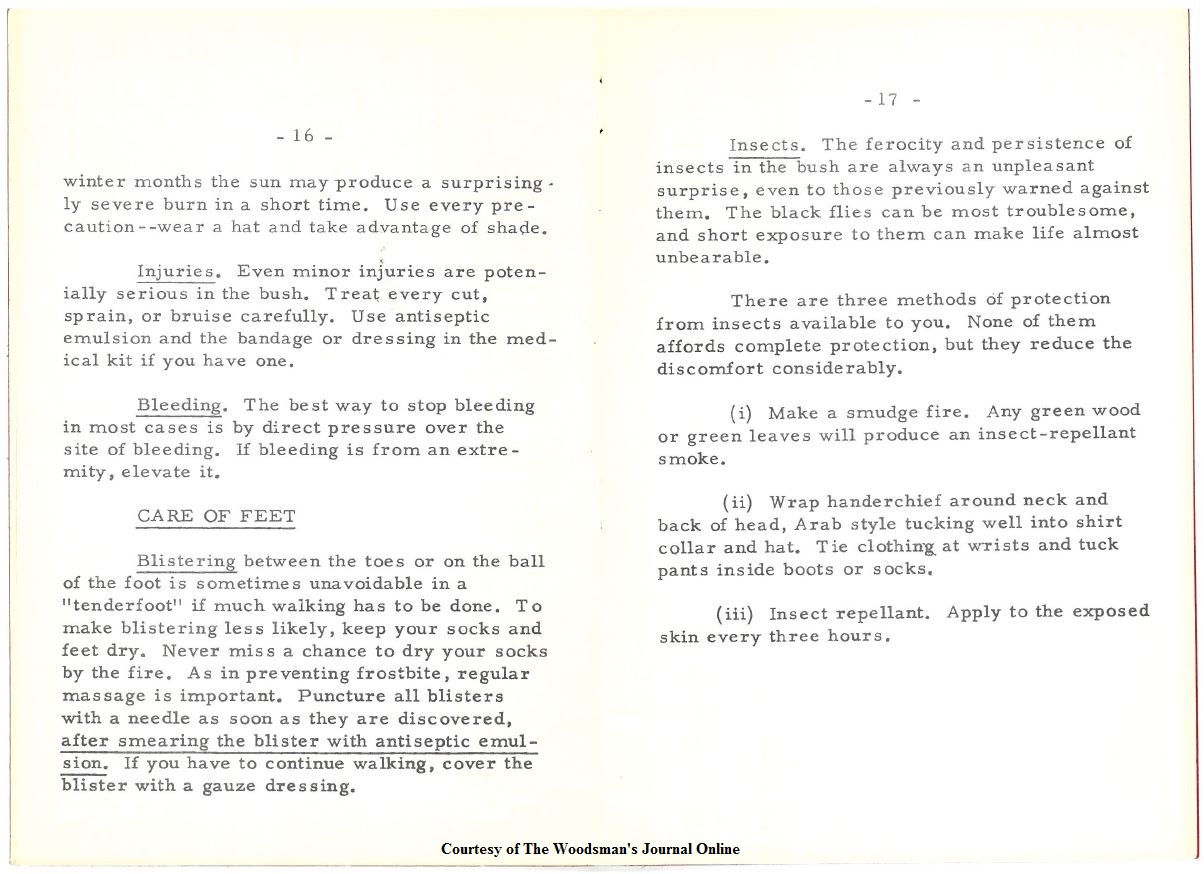
Survival Hints for the Sportsman, was compiled in 1959, by the RCAF Eastern Area Rescue Co-Ordination Centre, and is an interesting and very hard to find booklet, which includes some great points and tips on survival, particularly on survival in the Canadian forest.  I found a copy for sale a couple of years ago, purchased it, and in the spirit of the compiler's wishes, I have decided to share it with you.


The authors of Survival Hints,  explained that they had three main ideas in mind when they wrote the booklet.  First, that it was to be used as a guide to help you prepare for an expedition into the wilderness, second, that should you become lost in the wilderness, that you could use the instructions provided to stay alive, and third, to help you help your rescuers to find you.


The authors also recommended learning to use and always carrying, several essential survival tools, whenever you go into the woods.  They felt that you should always carry a sharp axe with a sheath or a sharp knife, strike anywhere matches in a water-proof container, a compass and map and some emergency food (for information on a really tasty 1962 survival ration go [HERE] and [HERE]).  The authors also suggested the following optional items, a whistle, sunglasses, signal mirror, mosquito net, snare wire and a medical kit which includes tape, a sewing kit and insect repellent.  These essential and optional tools are very similar to the early 10 Essentials developed by The Mountaineers.


What I liked most about this booklet was the philosophy of the authors, which is as follows, that there is no disgrace in becoming lost, although there is a potential for a tragedy, particularly if you haven’t prepared ahead of time or you give in to your fears, lose your will to live and then die before you are found.  The compilers of Survival Hints believed that tragedy could be avoided with “a little knowledge, a minimum of skills and a STRONG DESIRE TO LIVE”.  Additionally, they felt that “YOU MUST HELP YOURSELF!” and that “ounce of prevention is worth a pound of cure”.  To help yourself, you have to learn and practice some essential habits and skill, so “LEARN THESE…AND LET’S STAY ALIVE”.


I hope that you reading this booklet as much as I did and until next time, Happy Trails!


Sources:

RCAF Eastern Area Rescue Co-Ordination Centre, Survival Hints for the Sportsman, The Queen’s Printer And Controller Of Stationary; Ottawa, Canada; [1959]


Front and back cover, courtesy of The Woodsman’s Journal Online

Inside cover and preface, courtesy of The Woodsman’s Journal Online


Inside cover and pg. 1, courtesy of The Woodsman’s Journal Online


Pg. 2 to 3, courtesy of The Woodsman’s Journal Online


Pg. 4 to 5, courtesy of The Woodsman’s Journal Online


Pg. 6 to 7, courtesy of The Woodsman’s Journal Online

Pg. 8 to 9, courtesy of The Woodsman’s Journal Online


Pg. 10 to 11, courtesy of The Woodsman’s Journal Online


Pg. 12 to 13, courtesy of The Woodsman’s Journal Online


Pg. 14-15, courtesy of The Woodsman’s Journal Online


Pg. 16-17, courtesy of The Woodsman’s Journal Online


Pg. 18-19, courtesy of The Woodsman’s Journal Online


Pg. 20-21, courtesy of The Woodsman’s Journal Online


Pg. 22-23, courtesy of The Woodsman’s Journal Online


Pg. 24-25, courtesy of The Woodsman’s Journal Online


Pg. 26-27, courtesy of The Woodsman’s Journal Online


Pg. 28-29, courtesy of The Woodsman’s Journal Online


Pg. 30 and inside back cover, courtesy of The Woodsman’s Journal Online


Monday, March 11, 2019

Further Thoughts on Survival Rations … 1962 Civil Defense Style


Canteen cup, measuring cup and survival bar, picture by the Author


After I had published, “Survival Rations … 1962 Civil Defense Style”, which can be found [HERE], I received several questions from readers.

Wegmans brand Oats & Honey Flakes, picture by the Author

 The first question was, “you demonstrated making the ration bar with Wegmans brand Oats & Honey Flakes, where I live there aren’t any Wegmans stores, what type of cereal should I use?”

This is a very good question.  The recipe was not very specific about the type of cereal that was used, stating only “3 cups cereal – Oatmeal or Barley, Corn or Wheat Flakes”.  I used two cups of rolled oats and one cup of Wegmans brand Oats & Honey Flakes, because breakfast cereal is heavily fortified and I wanted the ration bar to have a higher nutritional content.  If I wanted to have a more accurate 1962 look to the bar or if there were no Wegmans where I live, I would have used two cups of rolled oats and one cup of Kellogg’s Corn Flakes.  The nutritional content of the ration bar with Corn Flakes is:


Kellogg’s Corn Flakes, picture by the Author

Nutritional information of survival ration with Kellogg's Corn Flakes, information condensed by the Author

 In addition, if you wanted to change the texture and make the survival bar chewier, you could substitute ½ or even one cup of the rolled oats for an equal amount of steel cut oats.  Next time I make these bars, I plan to substitute one cup of rolled oats for one cup of steel cut oats.  I will report back and let you know how this experiment turns out.  Substituting steel cut for rolled oats would not only change the texture of the bar, but it would also increase both the calorie and nutritional count. 

Wegmans Organic Steel Cut Oats

Nutritional information of survival ration with one cup of steel cut oats, information condensed by the Author

Nutritional information of survival ration with half cup of steel cut oats, information condensed by the Author


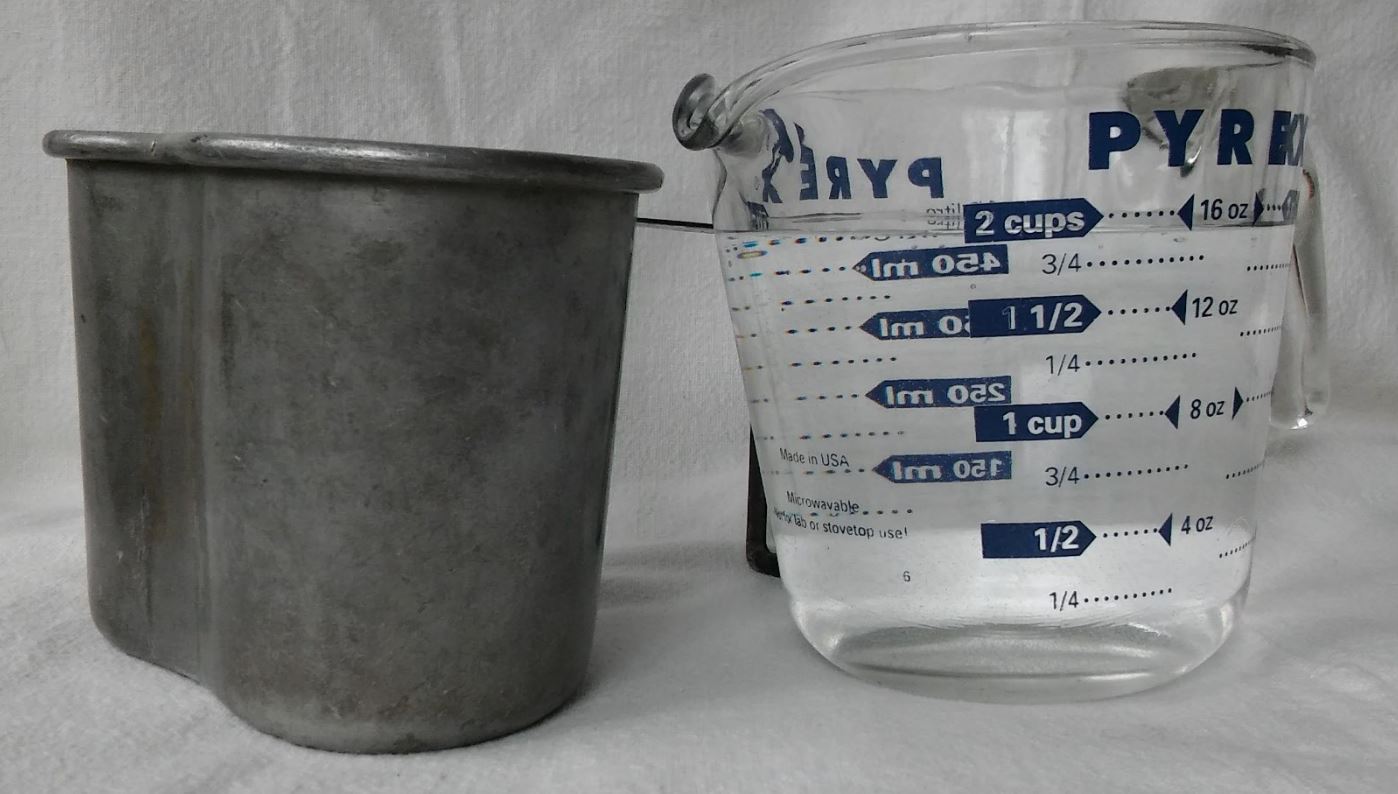
 The second question that I received was, “the recipe said the bar could be cooked with 2/3 of a canteen cup of water, how much water is that?”

Canteen cup and measuring cup, picture by the Author

 That is also a very good question and to answer your question I pulled out my 1941 US Army issue canteen cup to measure it.  During the 1960's, because of the sale of military surplus items, a canteen cup would have been very familiar to campers and other outdoors-people.  One full canteen cup measures three cups or 24 ounces and therefore a 2/3 canteen cup measurement is equal to two cups or 16 ounces of water.

The last question that I received asked, “You told us how the survival bar tasted when it was dry, how did it taste when it was cooked?”

Up until I was asked this question, I had only eaten these survival bars in their dry, uncooked and un-hydrated state, so I decided to experiment.  First, I put an 1/8 of a survival bar into a ¼ cup of cold water (a ¼ cup, is 1/8 of the two cups that the recipe called for) and let it sit without heating it.  I ended this experiment after 15 minutes and discovered that while the bar had softened a little, only the out layer that had softened to the consistency of cooked oatmeal.

1/8 of a survival bar soaked in ¼ cup of cold water for 15 minutes, picture by the Author


Second, I put a 1/8 of a survival bar into a ¼ cup of cold water, but this time I set it to boil.  In this experiment, the bar crumbled easily with a fork and dissolved into a watery oatmeal within three minutes and 53 seconds.

1/8 of a survival bar boiled in ¼ cup of water for 3 minutes, 53 seconds, picture by the Author

 In both cases, it was the texture of the bar that changed and not the flavor, which remained a rather yummy orange-honey-oatmeal flavor.

I hope that these answers helped and until next time, Happy Trails!

Wednesday, February 27, 2019

Some Additional Thoughts on How to Sleep Warm in the Winter


The Author.  Picture Taken by the Author

Here are some additional thoughts on how to sleep warm in the winter.  For videos on this subject see my earlier entries to my blog, [Part one HERE] and [Part two HERE], or go to my YouTube channel at BandanaMan Productions, [Part One HERE] and [Part two HERE].

So, how do you sleep warm in the winter?  First, we need to talk about the four ways your body loses heat

Radiation: you lose up to 50% of your body’s total heat production from your head at 39o F and 75% at 5o F if it is uncovered

Author’s knit cap and fleece hood.  Picture Taken by the Author

In fall, winter or spring you should always bring a knit cap or a fleece hood just for sleeping in.  I bring a knit cap with me even in the summer, when I am in Algonquin Provincial Park, because that way I can take a lighter sleeping bag and still sleep warm.  The old wives tale about wearing a hat to keep your feet warm is true.

Author’s sweater.  Picture Taken by the Author

Bring a sleeping layer that you can easily put on or take off.  I bring a sweater with me for sleeping, because even during the summer it can be cold at night, sometimes.  Because I brought a sweater as a middle insulating layer for sleeping in, I can bring a lighter sleeping bag and still sleep warm, just as with my knit cap.  I have taken this sweater on many outdoor adventures.  When it isn’t needed, it goes in my stuff sack and becomes a pillow.

Evaporation and respiration: you should always change into dry clothes before sleeping, since you lose body heat as sweaty or wet clothes dry on you.  No matter how careful you are with your layers, your day clothes, particularly your base layers, will be damp from residual sweat.  I always bring a pair of wool socks for just sleeping in, and in the winter, I always bring a base-layer that I wear just for sleeping.

In addition, open the vents in your tent, even if it is freezing, otherwise the moisture in your breath will condense creating frost or dew inside of your tent.  Along the same lines, don’t cover your face with your sleeping bag, the moisture from your breath will condense in it, wetting it and chilling you.

Convection: you lose heat to moving air and the purpose of your tent is to block both precipitation, and wind.  A bivvy bag, just like a tent, when added to your sleeping system, will stop heat loss due to convection.

Conduction, you lose heat to the ground or snow beneath you.  To keep from losing body heat to the ground, you need insulation in the form of trapped air between you and cold ground.  This insulation can be in the form of a bough bed or a sleeping pad.

R-value is a measure of a sleeping pads ability to insulate you from the ground.  The higher the R-value, the higher the insulation it provides.  During the spring, summer and fall, you should use a 3-season sleeping pad, which has an R-value of 2 or higher.  In the winter, you should use a sleeping pad with an R-value of 5 or higher.

R-values are additive, as with clothing layers, you can combine 2 pads to increase your warmth.  In addition, unlike a sleeping bag, using a higher R-value sleeping pad, won’t lead to the sleeper overheating.  Also, since women sleep colder than men, due to an average lower body mass, they will need to increase the recommended R-value by 1: this is true as well for other cold sleepers.

It was in the 20os the day I camped out and it got even colder that night, dropping down to the mid-teens.  I used two sleeping pads, an inflatable pad and a closed-cell foam pad, and my sleeping bag was a three-piece sleeping bag set.

The NeoAir® All Season™ SV.  Picture Taken by the Author

¾-sized (gray) and full sized (black) closed-cell foam pads. Picture Taken by the Author

The inflatable pad in the picture above is a NeoAir® All Season™ SV, which has 2.5” of loft and an R-value of 4.9.  In the other picture above, I showed both a ¾-sized closed-cell foam pad, which I have used for years, and a full sized foam pad, both of which have an R-value of 1.4.  I had only planned to use one of the foam pads; however, in the end I used them both, with the ¾-sized pad under my head and torso.  By combining the three sleeping pads, I had a total R-value of 7.7 between the ground and me.

The HQ ISSUE Military Style Sleep System, 3 Piece sleeping bag set.  Picture Taken by the Author

The sleeping bag set that I used was the HQ ISSUE Military Style Sleep System, 3 Piece sleeping bag set, which is two nested sleeping bags, inside of a bivvy-bag.  When all three parts are used together, the sleeping bag set is rated for minus 4o Fahrenheit to minus 22o Fahrenheit. 

Some other things that you can do to sleep warm in the winter are:
  
·      Make sure that you are warm when you get into your sleeping bag.  Do some jumping jacks or pushups, just enough to warm you up without making you sweat.  If you are cold when you go to bed, you will probably be cold all night long.

·      Shake up your sleeping bag, before you go to bed.  If your sleeping bag has spent the day compressed into its stuff sack, the insulation will need to be fluffed and redistributed, so that there are not col spots.

·      Since your sleeping bag depends on you to warm it up and then keep it up to temperature, use hand warmers or, fill your Nalgene bottle with boiling water and put it into a large sock, and use them to help get your sleeping bag up to temperature.

·      If there is room in your sleeping bag, put your next day’s clothes into the bag with you.  You don’t want to have big pockets of empty space around you, since it is just space that you will have to warm up. 

·      Pull your backpack up over the foot of your sleeping bag.  This will help insulate your feet.

·      Hydrate, hydrate, hydrate.  Your body needs water to keep you warm.  Obviously, if you drink too much you will have to get up and pee, however if you drink to little you won’t be able to maintain your body temperature.

·      If you do have to pee, don’t hold it.  Get up and go or use a pee-bottle, since your body has to spend valuable calories to keep the liquid in your bladder warm.

·      If there are other people in your tent, sleep close together to share body heat.

Before I crawled into my sleeping bag, I did some exercises, ate a high energy, protein and fat rich snack before bed and filled a up a Nalgene bottle with near-boiling water to help me warm up the sleeping bag.  And with the sleeping pads blocking heat loss to the ground by conduction and with my tent and the 3 Piece sleeping bag set blocking heat loss due radiation and convection, I felt that I would be all set for the night. 

So how did it go you might ask?  It dropped to 15o F by 3:00 am, that night and I slept very warm.  In fact, the biggest problem that I had was that I started to get too warm by 3:00 am and I had to remove some layers to keep from sweating.  The next time that I sleep out in a tent at 15o F, I will do without the bivvy-bag, because the outer sleeping bag’s surface became damp and so, the bivvy-bag was accumulating too much moisture and apparently too much heat.  Interestingly, my Nalgene hot water bottle was still nice and warm at 3:00 am and was a real comfort to curl up with, especially during the early part of the night, when I was still chilled.

Some other cold weather tips:

·      Put your hiking boots or other things that you don’t want to freeze into your sleeping bag stuff sack and push it to the bottom of your sleeping bag.  I learned this lesson the hard way, some-when in the late 70s, when I was sleeping in a tent on a frozen lake.  I left my leather boots in the vestibule of my tent, and the next morning they were frozen solid and I couldn’t put them on until I had thawed them out.  Not a great way to start the morning.  Ever after that, I have put my boots either into my sleeping bag or under my sleeping bag and on top of my foam pad.  Other things that can stop working when they are cold are batteries, cell phones and lighters.

·      Wrap your metal liquid fuel bottles with duct tape, since metal fuel bottles can frost bite your hands in cold weather.  Duct tape will help insulate you from them and it is a good way to store duct tape.

·      Turn your water bottle upside down, in cold weather.  This way if they freeze, they will freeze at the bottom first.

I hope that this helps you to sleep warm in the winter, when you adventure into the outdoors.

Sources:

Clarke Green, “How to Sleep Warm When Camping”, Dec. 20, 2011, https://scoutmastercg.com/how-to-sleep-warm-when-camping/, accessed Nov. 3, 2017

Keith Erps, “What is R-Value?”, Aug. 2, 2018, https://thermarestblog.com/r-value-meaning/, accessed Feb. 4, 2019

William W. Forgey, M.D., The Basic Essentials of Hypothermia, ICS Books, Inc. [Merrillville, Indiana 1991] p 38

“NeoAir® All Season™ SV Review”, https://www.thermarest.com/neoair-all-season-sv#product-info, accessed Feb. 4, 2019

Valerie Loughney Stapleton, “How to Choose Sleeping Pads”, https://www.rei.com/learn/expert-advice/sleeping-pads.html, accessed Feb. 4, 2019


Philip Werner, “Sleeping Pad R Values”, Updated 2019, https://sectionhiker.com/sleeping-pad-r-values/, accessed Feb. 4, 2019

Peggy Wang, “23 Essential Winter Camping Hacks”, http://www.buzzfeed.com/peggy/essential-winter-camping-hacks#39b0zr9, accessed Nov. 3, 2017

Sunday, February 17, 2019

Survival Rations … 1962 Civil Defense Style©


Picture by the Author


In October 2018, I posted a copy and wrote a review of Desert Survival: Information For Anyone Traveling In The Desert Southwest 1962 [HERE], and this weekend I decided to make and test, Mr. Lee Kelly’s “Survival Rations” recipe, which, was featured in this pamphlet.


Desert Survival: Information For Anyone Traveling In The Desert Southwest 1962, p.16


Picture by the Author


I found the recipe to be very complete and easy to use.  I listed, below, the modifications or the things that I did, where the original recipe was not clear.


When I made this recipe, I used two cups of rolled oats and one cup of Wegmans brand Oats & Honey Flakes.  I substituted a cup of breakfast flakes for one of the cups of rolled oats that the recipe called for, because breakfast cereal is heavily fortified, and I wanted the ration to have a higher nutritional content. 


After mixing the cereal and rolled oats, I crushed the flakes by pressing the bottom of the metal mixing cup into the oatmeal and breakfast cereal; I did this to make the ration bar, denser.  After smashing the flakes, I continued to mix in the rest of the dry ingredients, except the gelatin.


When I had boiled the water, honey and gelatin and mixed it into the dry ingredients, there were some dregs left in the pot that I had boiled the honey and gelatin in.  So, I added two more tablespoons of water to the pot, swirled it around and then added it to the ingredients, to wet the mix completely.


Pictures by the Author


I then mixed and kneaded the dough with my hands, until everything was combined and then I split the dough into two equal pieces and pressed them into the mold.


The recipe called for a bar that was two inches wide by five inches tall and one and a half inches thick, which makes a 15 cubic inch bar.  My mold is four inches wide, 5 inches tall and one inch deep, and I packed the dough into the mold until the ration bar was about ¾ inch thick.  By bar when finished it was also a total of 15 cubic inches.  

 
Picture by the Author


I dried the bar for two hours, an hour on each side, at 200o F and when they were done, I had two survival ration bars that weighed one pound each. 


Information condensed by the Author


I had the bars taste tested by four very through and competent judges, my children, and my youngest son’s 14-year-old friend.  My 14 year old thought that they were “great” and my 19 year old said that they tasted “okay” and that “they were better than hardtack”, which I think means that they are good.  My 23 year old said “these are very good … they have a good texture … they taste kind of like apples” and my youngest son’s friend thought that they were “okay”.  So, that made two polite statements of indifference and two positive reviews.  Personally, I like the way they taste, and I think that they have the flavor of orange blossom honey.  I liked them and I hope that you try them.


Picture by the Author


Sources:

Civil Defense Joint Council, Desert Survival: Information For Anyone Traveling In The Desert Southwest 1962, (Maricopa County; Phoenix, Arizona [1962]) reprinted in http://docs.azgs.az.gov/SpecColl/1988-01/1988-01-0026.pdf, p. 5-20