Sunday, February 18, 2024

Winter Survival Tips, Part Three©


You never know when a late winter storm is going to blow in, don’t forget Punxsutawney Phil is only right 39% of the time1 and February is a great time for winter snow!  


So, here is the final installment of our winter survival tips, which didn’t make it into earlier articles.  In Part One and Two we talked about dressing for winter weather and taking shelter, and this week we’ll talk about staying hydrated to prevent hypothermia and some general survival tips.


Dehydration...


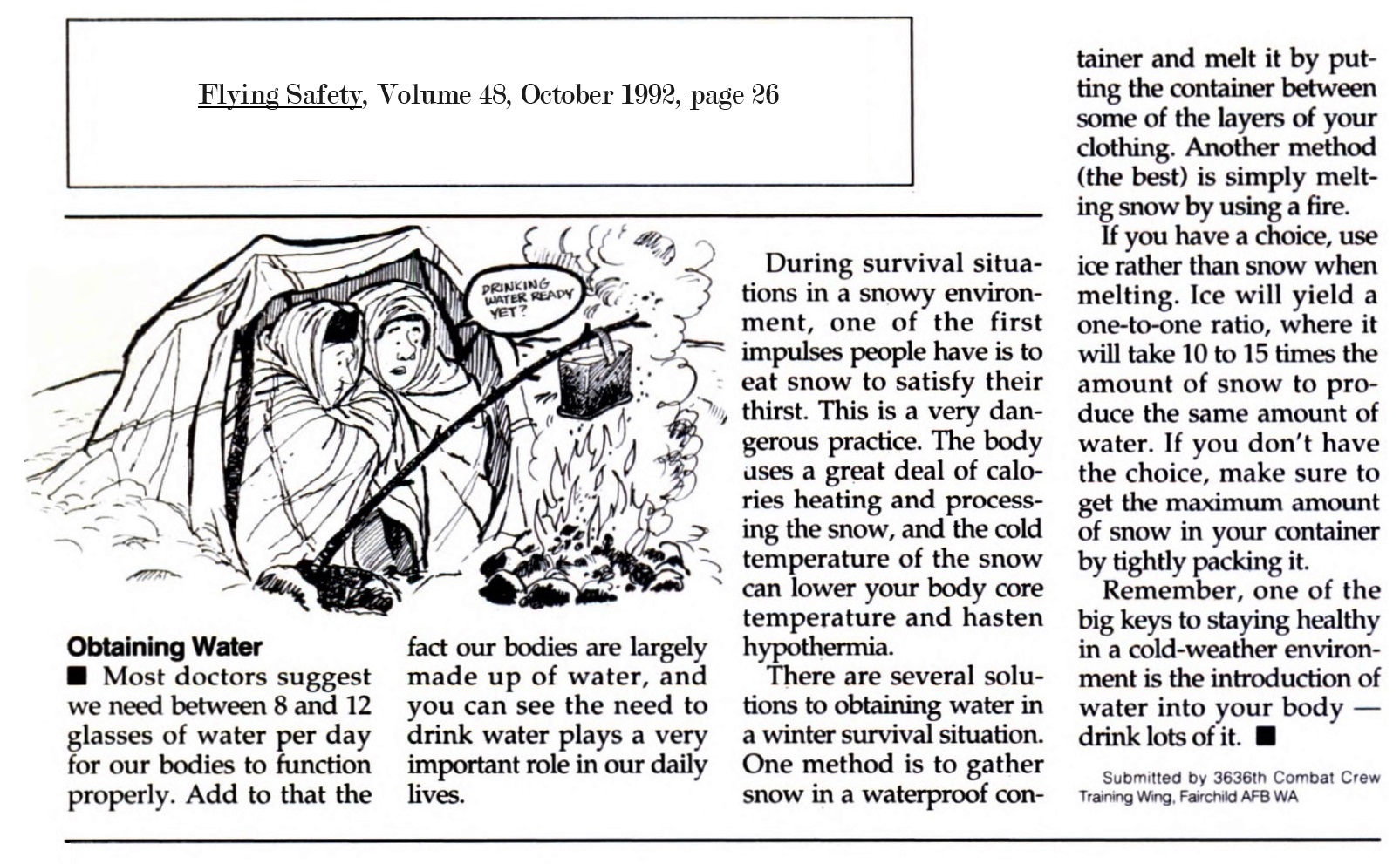
“Staying hydrated?!”, you exclaim, “Boring!”  But before you turn the page, did you know that most people are walking around chronically dehydrated, and that when you are thirsty you are already 1% dehydrated, or a quart (almost a liter) of water low2!  Feeling thirsty yet?


 “But people only get dehydrated when it’s hot”, you suppose “right” ?  Wrong!  The air is the dryest when it is cold, because when the temperature is cold, the ability of air to hold water vapor decreases and it becomes dry. 
“Sure, but with all this snow, I’ll just eat some if I’m thirsty”, you guess.  Bad idea, can we say hello, to death by hypothermia!


Winter Survival Tips...


The same general survival tips that the experts recommend are the same survival tips that you need to pay attention to during the winter; stay dry, stay warm, always have a buddy.


Always have a way to create a fire and know how to build one in any weather.  Carry a candle, it makes it easier to light a fire in wetweather and you can use it to warm up a snow shelter.  Don’t forget that survival is a mental attitude, and 90% of survival is controlling your fear and panic.  Keep a positive, can do attitude, and don’t give into useless negative what-if conjecture.


Let’s hope you never get lost in a winter storm, but if you do, maybe these tips will help you to survive the snow and cold.


I hope that you continue to enjoy The Woodsman’s Journal Online and look for me on YouTube at BandanaMan Productions for other related videos, HERE.  Don’t forget to follow me on both The Woodsman’s Journal Online, HERE, and subscribe to BandanaMan Productions on YouTube.  If you have questions, as always, feel free to leave a comment on either site.  I announce new articles on Facebook at Eric Reynolds, on Instagram at bandanamanaproductions, and on VK at Eric Reynolds, so watch for me.


That is all for now, and as always, until next time, Happy Trails!


Notes


1 From “How accurate is Punxsutawney Phil?”, HERE


2 By the time you notice you are thirsty you’re already 1% dehydrated.  For a 150 pound (68 kg) person, this means you have already lost about 1-½ pounds (.7 kg), or almost a quart (almost a liter) of water.


Sources


Circle No. 36, Reader Service Card; Backpacker, March 1995, https://books.google.com/books?id=5t4DAAAAMBAJ&pg=PA73&dq=winter+survival+tips&hl=en&sa=X&ved=2ahUKEwiVgsfYmO-DAxXyCTQIHcexCGgQ6AF6BAgEEAI#v=onepage&q=winter%20survival%20tips&f=false, page 73, accessed January 27, 2024


Flemens, Norm, Maj.; “Hot Info About Cold Weather”, Combat Crew, Volume 34, January 1984, page 19 to 20, https://books.google.com/books?id=KgMQ17xpzVMC&pg=PA18&dq=winter+survival+tips&hl=en&newbks=1&newbks_redir=0&sa=X&ved=2ahUKEwiqtLWtxO-DAxUBFVkFHfIBAx04HhDoAXoECAYQAg#v=onepage&q=winter%20survival%20tips&f=false, accessed January 27, 2024


House, Mike, Sgt.; “Motorcyclists Warned of Hypothermia”, Driver, Volume 19, Issue 10, March 1986, page 25, https://books.google.com/books?id=HkxdD5t6SdIC&pg=PA25&dq=heat+loss+wet+clothes&hl=en&newbks=1&newbks_redir=0&sa=X&ved=2ahUKEwjpiNedqv6DAxXuF2IAHfztBbYQ6AF6BAgMEAI#v=onepage&q=heat%20loss%20wet%20clothes&f=false, accessed January 27, 2024


Livermore, Beth; “Survival School”, Snow Country, January 1997, page 99 to 102, https://books.google.com/books?id=Q8k-kqIvS-YC&pg=PA99&dq=arctic+survival+tips&hl=en&sa=X&ved=2ahUKEwj9meSOzO-DAxUOF1kFHXz4C8o4ChDoAXoECAMQAg#v=onepage&q=arctic%20survival%20tips&f=false, accessed January 27, 2024


Odom, Jerry, R., CMSgt.; “Letter From USAF Survival Training School”, Driver, January 1981, Volume 14, Issue 8, page 17, https://books.google.com/books?id=UtknYZSnKEcC&pg=PA17&dq=arctic+survival&hl=en&newbks=1&newbks_redir=0&sa=X&ved=2ahUKEwj8yrKy1u-DAxXrKlkFHTkqC6A4HhDoAXoECAQQAg#v=onepage&q=arctic%20survival&f=false, accessed January 27, 2024


United States Immigration and Naturalization Service; Safety and Health Guidebook, page 77-95, [MA-502, May 2000], https://books.google.com/books?id=JR-lqAaTZGAC&pg=PA95&dq=winter+survival+tips&hl=en&newbks=1&newbks_redir=0&sa=X&ved=2ahUKEwiw-8G_m--DAxWUFzQIHUnTC144ChDoAXoECA0QAg#v=onepage&q=winter%20survival%20tips&f=false, accessed January 27, 2024


United States Air Force; “Survival in the Snow”, Driver, Volume 11, Issue 7, page 15 to19, https://books.google.com/books?id=ljEaTOOMPZYC&pg=PA16&dq=fire+starting+survive&hl=en&newbks=1&newbks_redir=0&sa=X&ved=2ahUKEwi45pys6YyEAxUHkIkEHZxrCts4HhDoAXoECAwQAg#v=onepage&q=fire%20starting%20survive&f=false, accessed February 2, 2024


United States Air Force Survival School, 3636 Combat Crew Training Wing, Fairchild AFB, Washington; “Winter Survival Tips”, Boys' Life, December 1990, [Boy Scouts of America, Irving TX], page 75, https://books.google.com/books?id=jfgDAAAAMBAJ&pg=PA75&dq=winter+survival+tips&hl=en&sa=X&ved=2ahUKEwiVgsfYmO-DAxXyCTQIHcexCGgQ6AF6BAgHEAI#v=onepage&q=winter%20survival%20tips&f=false, accessed January 27, 2024


Wikimedia, “The Four Horsemen of the Apocalypse”, by Albrecht Dürer, 1497, https://commons.wikimedia.org/wiki/File:Durer_Revelation_Four_Riders.jpg


Wikimedia, “Snow drifts turned many roads into one-lane traffic.  This photo is from Feb. 7, 1977”, by NOAA, https://commons.wikimedia.org/wiki/File:Blizzard_of_1977.jpg, accessed February 3, 2024


Sunday, February 11, 2024

The Four Horseman of Wilderness Death ©


Last week we talked about some general winter survival tips, so this week I thought a brief introduction to the “Four Horseman of Wilderness Death” was in order.  The four horsemen, from right to left, are Windchill, holding a bow in his hand, Hypothermia, swinging a sword, Dehydration, holding scales, and Panic, shown as a decaying body1.


Hypothermia, windchill and dehydration...


The first three horsemen, Hypothermia, Windchill and Dehydration work as a team, and you defy them at your peril.  They’ll gang up on you and kill you fast!  Windchill cools you and makes it easier for his brother Hypothermia to cut you down.  And Windchill, with his wind blowing on you, helps his buddy Dehydration, to dry you out.  Remember when you are dehydrated, it’s harder for your body to regulate its temperature, and that’s when Hypothermia moves in for the kill!


Windchill


The first horseman, Windchill is a thief, armed with the wind, his bow.  The first thing to do in any survival situation is to take shelter from Windchill’s wind, and your first line of defense is your clothes.  Dress for the worst weather you will face.  Layer your clothing, so you can take off and on insulating layers as you warm up or cool down.  If it’s windy or wet, wear a windproof/waterproof outer layer.  And always bring a knit hat and wear it if you start to get cold!


And stay dry!  Because when they are wet, your clothes will conduct heat just like water, which because of its greater density conducts heat as much as 240 times faster than air.  So, Windchill will steal your body heat much, much faster when your clothes are wet, than when dry.


Also, always carry a heavy trash bag, or two, when you travel in the wilderness.  If you get caught out in the wet or the wind you can make a quick shelter by cutting or tearing a hole about four inches (10 cm) from one of the bottom corners of the bag and pull it over you, sticking your face out of the hole.  If you are more than petite, sit inside the second bag and pull the top one down over it.  A shelter like this will protect you from Windchill, even if you are wet, by stopping him from stealing your body heat with evaporation and convection.


Hypothermia


Windchill’s brother Hypothermia, is a killer.  Armed with his sword he kills year round, even during the summer.  As Jack London wrote in To Build a Fire, that “Freezing was not so bad...There are lots worse ways to die”, but as Keith McCafferty wrote in the December 1999 Field & Stream “there were none more common”!2 


Normal human body temperature is 98.6o F (37o C) and if your temperature falls below 98.6o (37o C) you will begin to shiver and as your core temperature continues to drop your shivering will become more intense and your ability to perform complex tasks will become impaired.  At 92o F (33o C) you will no longer be able to save yourself, at 87o F (30o C) and you will become unconscious, and at 75oF (24o C) it is too late for anything except candles and flowers.


Every year many people die of hypothermia, which used to be known as exposure or freezing to death.  But it isn’t just a winter or a northern problem, in fact, according to the CDC the top ten states are Alaska, Illinois, Alabama, Arizona, Virginia, North and South Carolina, New Mexico, Oklahoma and Tennessee2.  Factors that increase your risk for hypothermia are severe winter cold, such as in Alaska and Illinois, shifting weather systems with rapid changes in temperature, typical of Virginia and the Carolinas, and high elevation, with plummeting overnight temperatures, found in New Mexico and Arizona.


To beat Hypothermia:


1)  Dress for the worst weather conditions you MIGHT encounter.

2)   Know when it is time to stop and seek shelter.

3)   Be able to build a fire and keep it going.


Dehydration


Dehydration, the third horseman, will creep up on you slowly and by the time you notice you are thirsty you’re already 1% dehydrated.  For a 150 pound (68 kg) person, this means you have already lost about 1-½ pounds (.7 kg), or almost a quart (almost a liter) of water!


Dehydration of less than 2% of your body weight does you no harm and many people are this dehydrated regularly; in fact, right now, as you read this article, you might be this dehydrated!  With a loss of 2.5% of body weight, about 2 quarts of water, work efficiency decreases by 25%.  When this happens, for example, you will only be able to walk ¾ as far and as fast, work only ¾ as hard or lift just ¾ as much, as you could if fully hydrated. 


As survival expert Peter Kummerfeldt says, “When you're dehydrated, your ability to function efficiently degrades rapidly.  Then you make mistakes”, and in survival situations, mistakes kill. 


So, always bring water with you when you venture into the wilderness and know how to find and disinfect more when you need it.  Try to limit your sweat, don’t ration your water.  Too many victims of dehydration have been found with water in their canteens, so if you are thirsty, drink! 


Panic


Panic, the last big bad, is the deadliest of the horseman, because he is one who lives in your head!  Panic whispers about loneliness, pain, cold, thirst, hunger, fatigue, boredom, and fear in your head until you become irrational, lose control, and attempt to escape by running!  Panicking only makes things worse and running will lead either to your death or to you finding yourself exhausted and in a much situation than before.


Staying calm and conquering Panic is 90% of survival.  Conquering Panic is simple, but it isn’t easy!  To keep Panic away remember these four things:


1)   Fear is normal, just don’t give into it.

2)   Recognize dangers and dangerous situations and then plan to avoid them.

3)   Subdue your fears by keeping mentally and physically busy.

4)   Think positively, pray, be realistic and don’t let your imagination run away with you.


I hope that you never meet the Four Horseman of Wilderness Death in person, but if you do, remember how to defeat them.


I hope that you continue to enjoy The Woodsman’s Journal Online and look for me on YouTube at BandanaMan Productions for other related videos, HERE.  Don’t forget to follow me on both The Woodsman’s Journal Online, HERE, and subscribe to BandanaMan Productions on YouTube.  If you have questions, as always, feel free to leave a comment on either site.  I announce new articles on Facebook at Eric Reynolds, on Instagram at bandanamanaproductions, and on VK at Eric Reynolds, so watch for me.


That is all for now, and as always, until next time, Happy Trails!


Notes


1 In Dürer's wood print, four horsemen are from right to left; the Epidemic holding a bow in his hand, War holding a sword in his hand, Famine holding scales in his hand, and Death, which is depicted as a decaying body.


2 Keith McCafferty, Field & Stream, January 2000 and Don Colburn, “Hypothermia's Top Ten May Include Your State”, Washington Post, January 1, 1996


Sources


Conover, Keith, M.D.; “Hypothermia: Killer of the Unprepared”, https://sites.pitt.edu/~kconover/ftp/Hypothermia%20Basics.pdf, accessed February 10, 2024


FAA; “How Strong it Blows, How Low it Goes: Windchill”, FAA Aviation News, Volume 7, February 1969, page 6 to 7, https://books.google.com/books?id=-iy2jQh-enAC&pg=RA9-PA7&dq=windchill+survival&hl=en&newbks=1&newbks_redir=0&sa=X&ved=2ahUKEwjdt_jz8ZKEAxXQkYkEHZ6ABsYQ6AF6BAgKEAI#v=onepage&q=windchill%20survival&f=false, accessed February 10, 2024


Holzer, Ricky; “How to Dress For Winter Hiking in the Midwest”, February 7, 2019, https://www.nocoastbestcoast.com/article.php?url=how-to-dress-winter-hiking-midwest, accessed February 9, 2024


Lauffer, Brian P., and O’Bryan, Bob; “Baby It’s Cold Outside!” Maintenance, Volumes 9-11, October/December 1984, page 12 to 13, https://books.google.com/books?id=HiFN5OQiSvAC&pg=RA3-PA13&dq=windchill+survival&hl=en&newbks=1&newbks_redir=0&sa=X&ved=2ahUKEwi_kM_l9JKEAxUyhYkEHVQeD2c4HhDoAXoECAwQAg#v=onepage&q=windchill%20survival&f=false, accessed February 10, 2024


McCafferty, Keith; “Death by Degrees, Part 1”, Field & Stream, December 1999, page 40 & 42, https://books.google.com/books?id=TMK7ROgAJKEC&pg=PA42&dq=survival+hypothermia&hl=en&sa=X&ved=2ahUKEwipt4yklZOEAxUBhIkEHRCyCAc4FBDoAXoECAYQAg#v=onepage&q=survival%20hypothermia&f=false, accessed February 10, 2024


McCafferty, Keith; “Death by Degrees, Part 2”, Field & Stream, January 2000, page 78 to 79, https://books.google.com/books?id=8Gj0yRugg3MC&pg=PA78&dq=%22death+by+degrees,+part+2%22&hl=en&sa=X&ved=2ahUKEwiUgsGk1qGEAxV34ckDHVv_CfUQ6AF6BAgHEAI#v=onepage&q=%22death%20by%20degrees%2C%20part%202%22&f=false, accessed February 10, 2024

Nelson, Janet; “How Cold is (Damn) Cold”, Skiing, January 1972, page 12, https://books.google.com/books?id=zL-h_HP9DXQC&pg=PA140&dq=windchill+survival&hl=en&sa=X&ved=2ahUKEwjVpNqA95KEAxXzjokEHfYiCTA4KBDoAXoECAMQAg#v=onepage&q=windchill%20survival&f=false, accessed February 10, 2024


Robel, Robert J., Sgt.; “Survival Working For You”, Aerospace Safety, Volume 35, December 1979, page 25 to 26, https://books.google.com/books?id=ZL9_FhZV2_EC&pg=RA11-PA24&dq=layering+clothes+survival&hl=en&newbks=1&newbks_redir=0&sa=X&ved=2ahUKEwjvz83znZ2EAxUklIkEHRYeDGUQ6AF6BAgEEAI#v=onepage&q=layering%20clothes%20survival&f=false, accessed February 9, 2024


Sunday, February 4, 2024

Winter Survival Tips, Part Two©


Ok, the woodchuck didn’t see his shadow this morning, and that means winter is over, no more cold and no more snow, right?  Wrong!  Phil is only right 39% of the time1 and February is a great time for winter snow.  Anybody remember the Blizzard of 1977?  


The Blizzard of 1977 obviously happened in 1977.  Between January 28th and February 1st, 50 mph (80 kph) winds whipped up snowdrifts 20 to 40 foot (6 to 12 m) high!  Also, up to 100 inches (254 cm) of snow fell, temperatures dropped from 26 to 0 °F (-3 to -18 °C), and there were 23 total storm-related deaths in Western New York alone.  Incidentally, Phil saw his shadow on February 2nd, but the blizzard was still blowing, and continued blowing through February 4th, 19772.


So, here are some more winter survival tips, which didn’t make it into earlier articles.


If you don’t have to go out into a blizzard or winter storm, DON’T!  If you are already out on foot, then find shelter, FAST, don’t keep walking.


It doesn’t have to be fancy, kicking a trench or hole in the leeward side of a snow drift will do, it just needs to get you out of the windand stop windchill from stealing away your body temperature.


Try to line your snow-hole or trench or whatever shelter you take with evergreen boughs, dry grass or whatever you must insulate you from the cold ground. 


If you’re driving and your car crashes, or slides off the road, then stay with your car because it is easier to see a disabled car in a snow drift than a person.  If not totally wrecked or in an unsafe spot, a car does make a good windbreak, but it is not warm because it lacks insulation.


Now that you are in shelter wrap up in anything that you have to further cut heat loss due to wind and to insulate yourself from the elements as much as possible.


Hopefully, you will never have to survive a blizzard stuck in a car or a snow drift, but if you ever find yourself stuck in a snowdrift, hopefully these tips will help.  Look for even more winter survival tips in part three of this article, coming soon.


Don’t forget to come back next week, and we will talk about The Four Horseman of survival, Windchill, Hypothermia, Dehydration, and Panic.


I hope that you continue to enjoy The Woodsman’s Journal Online and look for me on YouTube at BandanaMan Productions for other related videos, HERE.  Don’t forget to follow me on both The Woodsman’s Journal Online, HERE, and subscribe to BandanaMan Productions on YouTube.  If you have questions, as always, feel free to leave a comment on either site.  I announce new articles on Facebook at Eric Reynolds, on Instagram at bandanamanaproductions, and on VK at Eric Reynolds, so watch for me.


That is all for now, and as always, until next time, Happy Trails!


Notes


1 From “How accurate is Punxsutawney Phil?”, HERE


2 From Wikipedia, the “Blizzard of 1977”, HERE, and “Punxsutawney Phil Groundhog Day shadow history”, HERE


Sources


Circle No. 36, Reader Service Card; Backpacker, March 1995, https://books.google.com/books?id=5t4DAAAAMBAJ&pg=PA73&dq=winter+survival+tips&hl=en&sa=X&ved=2ahUKEwiVgsfYmO-DAxXyCTQIHcexCGgQ6AF6BAgEEAI#v=onepage&q=winter%20survival%20tips&f=false, page 73, accessed January 27, 2024


Flemens, Norm, Maj.; “Hot Info About Cold Weather”, Combat Crew, Volume 34, January 1984, page 19 to 20, https://books.google.com/books?id=KgMQ17xpzVMC&pg=PA18&dq=winter+survival+tips&hl=en&newbks=1&newbks_redir=0&sa=X&ved=2ahUKEwiqtLWtxO-DAxUBFVkFHfIBAx04HhDoAXoECAYQAg#v=onepage&q=winter%20survival%20tips&f=false, accessed January 27, 2024


House, Mike, Sgt.; “Motorcyclists Warned of Hypothermia”, Driver, Volume 19, Issue 10, March 1986, page 25, https://books.google.com/books?id=HkxdD5t6SdIC&pg=PA25&dq=heat+loss+wet+clothes&hl=en&newbks=1&newbks_redir=0&sa=X&ved=2ahUKEwjpiNedqv6DAxXuF2IAHfztBbYQ6AF6BAgMEAI#v=onepage&q=heat%20loss%20wet%20clothes&f=false, accessed January 27, 2024


Livermore, Beth; “Survival School”, Snow Country, January 1997, page 99 to 102, https://books.google.com/books?id=Q8k-kqIvS-YC&pg=PA99&dq=arctic+survival+tips&hl=en&sa=X&ved=2ahUKEwj9meSOzO-DAxUOF1kFHXz4C8o4ChDoAXoECAMQAg#v=onepage&q=arctic%20survival%20tips&f=false, accessed January 27, 2024


Odom, Jerry, R., CMSgt.; “Letter From USAF Survival Training School”, Driver, January 1981, Volume 14, Issue 8, page 17, https://books.google.com/books?id=UtknYZSnKEcC&pg=PA17&dq=arctic+survival&hl=en&newbks=1&newbks_redir=0&sa=X&ved=2ahUKEwj8yrKy1u-DAxXrKlkFHTkqC6A4HhDoAXoECAQQAg#v=onepage&q=arctic%20survival&f=false, accessed January 27, 2024


United States Immigration and Naturalization Service; Safety and Health Guidebook, page 77-95, [MA-502, May 2000], https://books.google.com/books?id=JR-lqAaTZGAC&pg=PA95&dq=winter+survival+tips&hl=en&newbks=1&newbks_redir=0&sa=X&ved=2ahUKEwiw-8G_m--DAxWUFzQIHUnTC144ChDoAXoECA0QAg#v=onepage&q=winter%20survival%20tips&f=false, accessed January 27, 2024


United States Air Force; “Survival in the Snow”, Driver, Volume 11, Issue 7, page 15 to19, https://books.google.com/books?id=ljEaTOOMPZYC&pg=PA16&dq=fire+starting+survive&hl=en&newbks=1&newbks_redir=0&sa=X&ved=2ahUKEwi45pys6YyEAxUHkIkEHZxrCts4HhDoAXoECAwQAg#v=onepage&q=fire%20starting%20survive&f=false, accessed February 2, 2024


United States Air Force Survival School, 3636 Combat Crew Training Wing, Fairchild AFB, Washington; “Winter Survival Tips”, Boys' Life, December 1990, [Boy Scouts of America, Irving TX], page 75, https://books.google.com/books?id=jfgDAAAAMBAJ&pg=PA75&dq=winter+survival+tips&hl=en&sa=X&ved=2ahUKEwiVgsfYmO-DAxXyCTQIHcexCGgQ6AF6BAgHEAI#v=onepage&q=winter%20survival%20tips&f=false, accessed January 27, 2024


Wikimedia, “The Four Horsemen of the Apocalypse”, by Albrecht Dürer, 1497, https://commons.wikimedia.org/wiki/File:Durer_Revelation_Four_Riders.jpg


Wikimedia, “Snow drifts turned many roads into one-lane traffic.  This photo is from Feb. 7, 1977”, by NOAA, https://commons.wikimedia.org/wiki/File:Blizzard_of_1977.jpg, accessed February 3, 2024