Sunday, December 6, 2020

Fuzzy Wuzzy was a ... Weatherman?! ©


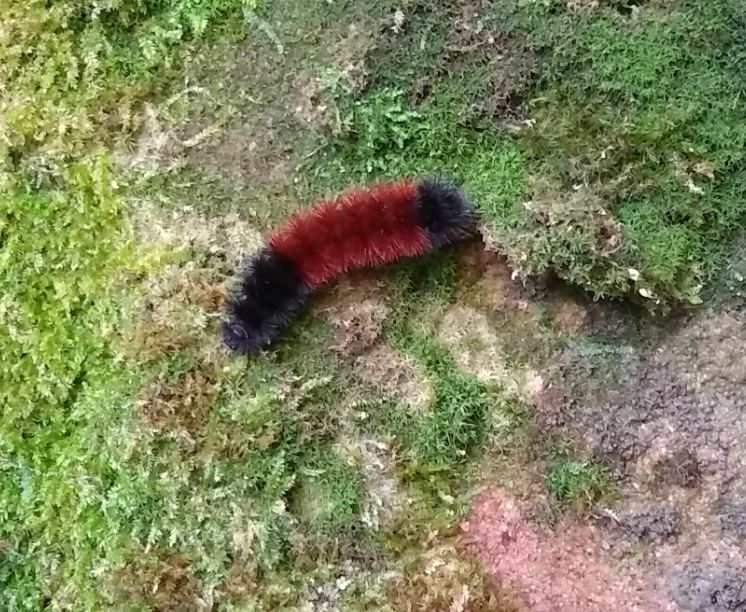
A woolly-bear that I that rescued, on the 10th of October, as it tried to cross the road.  Unfortunately, there were several nearby woolly bears that hadn’t survived their trip across the two-lane.  Photograph by the Author.

I know that “Fuzzy Wuzzy was a bear” and not a woolly bear, but I couldn’t resist – Author’s Note 


Do woolly bears predict the weather?  Are they weathermen?  That is what the legend says, anyways.  Did you ever wonder if the myth was true?  I did, and here is what I found out.


Woolly bear, black-ended bear, fuzzy bear, woolly worm, hedgehog caterpillar, it doesn’t matter what you call them, these are all names for the same thing, the caterpillar form of the isabella tiger moth (pyrrharctia isabella).  Woolly bears are bristly and black on both ends with an orange or rusty-brown middle, and if you pick them up, they will curl into a tight ball and play dead, which is why they are sometimes called hedgehog caterpillar.  You commonly see them, at least in the Northeast United States in early autumn, as they search for a dark, dry, sheltered place, like a pile of leaves, or under some bark, a rock or a log, to hibernate for the coming winter.  By the way if they are not black and rust colored and instead are all black or black and some other color then they are not a woolly bear caterpillar but are something else instead1.


A giant leopard moth caterpillar found in Minister Valley, Pennsylvania, on October 30, 2020, photograph from the Katie Reynolds collection, used with permission.


Each fuzzy 1½ inch (3.8 cm) long woolly bear becomes an isabella tiger moth, which is an orange-yellow moth with a wingspan of 1½ to 2 inches (or 3.8 to 5 cm) and a body that is spotted with rows of black dots running up and down the body.  Isabella tiger moths are commonly seen at night throughout the summer.  Woolly bears feed upon a variety of plants and weeds, like dandelions, plantains, nettles, violets, lamb’s quarters, and clover.  Insect experts note that there are two generations of woolly bears each year, one generation appearing in June and July and the second one in September.  It is the second generation of woolly bears that according to folklore can foretell the coming winter weather. 


“Pyrrharctia isabella – Isabella Tiger Moth”, photograph by Andy Reago and Chrissy McClarren, “Pyrrharctia isabella – Isabella Tiger Moth”, August 4, 2014, HERE.


According to folklore common throughout the Midwest and Northeast United States, the bristles on woolly bear caterpillars can predict how bad the coming winter will be.  Woolly bears are covered in black bristles on their front and rear and with rusty-brown bristles upon their middles and according to the myth, the wider the bands of black fuzz on the woolly bear, the harder, colder, snowier and more severe the coming winter will be.  If the bands of black fuzz are narrow and the middle band of rusty-brown fuzz is wide, then the winter will be mild, with less snow and cold.  And finally, traditional forecasters say that since woolly bears have thirteen segments, which correspond to the thirteen weeks of winter, if the black band on the rear of the caterpillar is larger than the front, then the second half of the winter will be worst and if the black band on the front of the caterpillar is the largest then the first half of winter will be the worst. 


A woolly bear found in Minister Valley, Pennsylvania, on October 30, 2020, photograph by the Author.


This myth has existed since the late 18th and early 19th centuries.  However, it didn’t become popular until Dr. Howard Curran, the curator of entomology, at the American Museum of Natural History, in New York City, conducted a study on woolly bears and weather during the fall of 1948.  He examined 15 woolly bears that he collected in Bear Mountain State Park, 40 miles north of New York City, counted the number of rusty-brown segments and then made a prediction about the coming winter.  His prediction was printed in the New York Herald Tribune where it was picked up by the national press and the rest is, as they say, history!  Dr. Curran continued his experiment over the next eight years, until 1956, in an attempt to scientifically prove the old wives’ tale about woolly bears and winter weather prediction2.


Unfortunately, woolly bears can’t predict future winter weather.  The length of a woolly bear’s rusty-brown middle section is an indication of how long and how well the caterpillar has been feeding and on how old it is.  The better the spring and summer growing and feeding season, the bigger the caterpillar will be and the narrower its middle rusty-brown section will be.  Also, the width of the woolly bears rusty-brown mid-section shows its age, because the caterpillars shed their skin and molt six times before reaching their full adult size.  With each molt, a wooly bear becomes less black and more reddish-brown.  So, really the amount of orange-brown on a woolly bear just tells us about the weather of the past several months and has nothing to do with what the coming winter weather!


So, if the color of the woolly bear bristles can’t tell us what the future winter will be, what do they do?  The bristles, or setae, help the caterpillar freeze solid more comfortably and survive the freezing cold winter.  During hibernation woolly bears create glycerol, a natural, organic antifreeze.  Woolly bears will freeze until all but the center of their cells are frozen.  Woolly bears can survive winter temperatures as low as -90oF (-68oC) and have even been known to survive an entire winter frozen inside of ice3.


The woolly-bear that I that rescued, on the 10th of October, photograph by the Author.


So next autumn, when you see a fuzzy wuzzy woolly bear crossing your path, you will know that it isn’t a weatherman.


I hope that you continue to enjoy The Woodsman’s Journal Online and look for me on YouTube at Bandanaman Productions for other related videos, HERE.  Don’t forget to follow me on both The Woodsman’s Journal Online, HERE, and subscribe to BandanaMan Productions on YouTube.  If you have questions, as always, feel free to leave a comment on either site.  I announce new articles on Facebook at Eric Reynolds, on Instagram at bandanamanaproductions, and on VK at Eric Reynolds, so watch for me.


That is all for now, and as always, until next time, Happy Trails!


Notes


1 All black bristly caterpillars, doesn’t mean that a new Ice Age is coming, it is just a caterpillar from a different species of moth.  Giant leopard moth caterpillars (hypercompe scribonia, formerly ecpantheria scribonaria), which is found across the eastern half of the United States and Canada, look like a solid black woolly bear.  And if you see a woolly caterpillar that is solid yellow color, you might think that the coming winter is going to be very mild, when in fact what you are seeing is a yellow bear caterpillar (spilosoma virginica), that can be found across the United States, Canada and eastern Mexico.


From National Weather Service, “Woolly Bear Caterpillar - Winter Predictor Or Not?”


2 Between 1948 and 1956, Dr. Curran’s research concluded that the average number of rusty-brown segments of woolly bear caterpillars, ranged from 5.3 to 5.6 out of 13 segments, which is more than a third of the length of the average woolly bear, interestingly, between 1948 and 1956, the winters were milder than usual around New York City.  Dr. Curran, rather tongue in cheek, concluded that there might be something to legend of the woolly bear as weatherman.  However, he knew that his sample size was too small and his conclusions scientifically invalid, and in the end his annual trip to the woods to look for caterpillars was just a good excuse to get away from the city and look at the fall foliage!


From Catherine Boeckmann, “Woolly Bear Caterpillars And Weather Prediction, Do Woolly Worms Really Predict Winter Weather?”


3 National Weather Service, “Woolly Bear Caterpillar - Winter Predictor Or Not?”


Sources


Boeckmann, Catherine; “Woolly Bear Caterpillars And Weather Prediction, Do Woolly Worms Really Predict Winter Weather?”, September 21, 2020, Old Farmer’s Almanac, [©2020 Yankee Publishing Inc], accessed October 16, 2020


National Weather Service, “Woolly Bear Caterpillar - Winter Predictor Or Not?”, https://www.weather.gov/arx/woollybear, accessed October 16, 2020


Reago, Andy and McClarren, Chrissy; “Pyrrharctia isabella – Isabella Tiger Moth”, August 4, 2014, https://commons.wikimedia.org/wiki/File:Pyrrharctia_isabella_%E2%80%93_Isabella_Tiger_Moth_(14842796231).jpg, accessed December 2, 2020


Sunday, November 29, 2020

Nocake, Pinole, Even Rockahominy...It’s Still Parched Corn to Me! ©


An excerpt from “Movable Feasts: Rockhominy”, by Charles R. Blair, Backpacker Magazine, Spring 1974, page 48.


Recently, I was googling through some old magazines online when I stumbled across an article about rockhominy in the Spring 1974, Backpacker Magazine, and it got me to thinking...  

This article can be used by experimental archaeologists, re-enactors or historical trekkers of the late 18th and early 19th centuries, and by anyone who is interested in wilderness survival and trekking food. 

For a video, watch “How to Make Parched Corn ©”, HERE.  – Author’s note.


Nocake, pinole, rockahominy...what’s that?


All of these are simply different names for parched and crushed or milled corn, or for my European readers, maize.  Parched and powdered corn was the original Native American traveling food.


Parching, or browning the corn kernels, both dehydrates and pre-cooks the corn and helps to preserve it, while grinding or crushing the kernels makes the parched corn easier to carry and easier to eat.  Native Americans, and later Euro-American woodsmen, who travelled in the wilderness of North America carried parched corn with them on their journeys.  If a traveler hadn’t been able to find fresh meat for a meal, he or she would eat a spoonful or two of parched corn and wash it down with a cup or bowl of water and would have had a “good meal1,  especially if they had combined it with some jerky, dried fruit, maple sugar, chocolate or portable soup2.


Parched corn is not only nutritious, but when taken with water, instead of being cooked in a pot, it swells in your stomach and makes you feel full.


From “Generic – Corn, Parched”, HERE.


When Europeans first came to North America, and came upon corn, or maize as it came to be known in Europe, for the first time; they had no word for it or for the food products that were made from it,  Usually, they used the local Native American word for that food, and that is why there are different regional names for parched corn.


An excerpt from Wood's New-England's Prospect, by William Wood, page 76, Part Two.


In the New England states, according to William Wood, who wrote Wood's New-England's Prospect in 1634, parched corn was called “nocake”, an anglicized version of the Narragansett word “nókehick4, which apparently sounds like “nookik5.  In Virginia, parched corn was “rockahominy”, according to The Westover Manuscript, by William Byrd, which detailed an expedition along the line between Virginia and North Carolina in 1728 to 1729.  John Gottlieb Ernestus Heckewelder, a Moravian missionary who was active in the frontier areas of Pennsylvania and Ohio during the late 18th century, wrote in History, Manners and Customs of the Indian Nations, about the Lenni Lenape6, who called parched corn “Psindamócan or Tassmanáne”.  And according to Horace Kephart, writing in The Book of Camping and Woodcraft, Vol. II on page 153, that in Louisiana parched corn was known as “gofio” and in Mexico it was called “pinole”.


An excerpt from History, Manners and Customs of the Indian Nations, by John Heckewelder, page 195


“So, how do your make parched corn”, you ask.  That is a good question, so let’s dive into it.  For more information on making parched corn watch my video, “How to Make Parched Corn ©”, HERE.


Step One: assemble your ingredients and tools. Photograph by the Author.


The first step is to assemble your ingredients and tools.  I used Indian Head: Old Fashioned Stone Ground Yellow Corn Meal, a course ground corn flour made of “yellow dent corn”.  Indian Head, and for that matter the majority of corn meal today, is made of “yellow dent corn”, zea mays var. indentata.  Historically, parched corn was made from “flint corn”, zea mays var. indurata, which is also known as “indian corn”.


Photograph by the Author.

If you choose to use corn meal, make sure that it is NOT degerminated.  Many mills remove the germ portion and the hull of the kernel, which allows the grain to be stored for a much longer time without refrigeration.  Unfortunately, removing the germ and the hull also removes much of the fats and vitamins, particularly niacin (vitamin B3), from the corn meal.  Always read the package to make sure, that your corn meal is whole grain and is not degerminated.


Photograph by the Author.

You could also parch whole corn kernels, form either yellow dent or flint corn.  I chose to use corn meal so I wouldn’t have to take the extra step of crushing or grinding the kernels, after I parched them.  If you use whole kernels, after you parch them, you can either grind them in a coffee mill or hand grinder or crush them in a mortar and pestle.


A hand grinder, photograph by the Author.


Step Two: parching the corn.  Note how the corn meal is a bright yellow color, photograph by the Author.


I didn’t grease the cast iron pot that I used before I put the corn meal into it.  Some recipes that you find online will tell you to lightly grease the cast iron pot or skillet before you parch the corn.  However, since historically Native Americans parched their corn kernels in hot ashes, obviously without grease or oil, I chose to parch my corn meal in ungreased pot.


I set the heat of my stove between low and medium heat and stirred the corn meal constantly.  It took about ten minutes to parch one cup, 8 ounces or 120 grams, of corn meal.  As the corn meal becomes parched, it changes from a bright yellow color to a light brown color and begins to slightly smoke.


The corn meal is now parched, note how it is now a light brown color, photograph by the Author.


A side-by-side comparison between corn meal and parched corn, note the difference in color, photograph by the Author.

Historically, Native Americans sometimes added maple sugar to their parched corn, mixing it into the corn after it was parched and ground or crushed.  In the past, I have added brown sugar, instead of maple sugar, to my parched corn and it is very tasty.  I added a ¼ cup (48 grams) of light brown sugar to each cup of parched corn.  I know that brown sugar isn’t very authentic, but I was out of maple sugar that day.


According to the Indian Head corn meal package, one ¼ cup (1 ounce or 30 grams) of corn meal is a meal and ¼ cup equals three tablespoonfuls.  Photograph by the Author.


After I finished parching my corn meal, since I hadn’t had any lunch and I was famished, I took a tablespoonful of parched corn (10 grams) with a cup of water (eight ounces or approximately ¼ liter).  I felt full for at more than two hours, as the corn meal expanded in my stomach.


Historically, authors suggested that “Two heaping tablespoonfuls was the usual ‘sup’...7, although William Wood’s wrote that three tablespoonfuls were a meal and John Heckewelder suggested that you only needed one tablespoonful of parched corn (with 16 ounces or ½ half a liter of water) for a meal.


An excerpt from Wood's New-England's Prospect, by William Wood, page 76, Part Two.

You can also make cakes out of parched corn, by wetting it with water and baking it, , as the author Daniel Neal suggests, or you can make porridge or mush by boiling it in water, as the John Heckewelder says the Lenni Lenape did at their camps.  


An excerpt from History, Manners and Customs of the Indian Nations, by John Heckewelder, page 195


An excerpt from the The History of New-England, by Daniel Neal, page 200.

Don’t eat too much dry, uncooked parched corn and always drink water with it, remember it swells in your stomach!  Follow John Heckewelder’s advice.


An excerpt from History, Manners and Customs of the Indian Nations, by John Heckewelder, page 195


So, during this long Thanksgiving Day weekend, I hope that you get a chance to make some accurate and historic Native American travelling food.  Have fun and enjoy!


Don’t forget to come back next week and read “Fuzzy Wuzzy was a ... Weatherman!? ©”, where we will talk about Wooly Bear caterpillars and whether or not they can forecast the weather.


I hope that you enjoy learning from this resource!  To help me to continue to provide valuable free content, please consider showing your appreciation by leaving a donation HERE.  Thank you and Happy Trails!


I hope that you continue to enjoy The Woodsman’s Journal Online and look for me on YouTube at Bandanaman Productions for other related videos, HERE.  Don’t forget to follow me on both The Woodsman’s Journal Online, HERE, and subscribe to BandanaMan Productions on YouTube.  If you have questions, as always, feel free to leave a comment on either site.  I announce new articles on Facebook at Eric Reynolds, on Instagram at bandanamanaproductions, and on VK at Eric Reynolds, so watch for me.


That is all for now, and as always, until next time, Happy Trails!


Notes


1 William Wood, 1634, as reported in The Book of Camping and Woodcraft, by Horace Kephart, page 151


2 Todays bouillon, which during the 18th and early 19th centuries was known as “cake soup”, “Veal Glue” (The Lady’s Companion, 1743) or “glue-broth” (The Westover Manuscripts, 1841). 


Hmm... that sounds appetizing doesn’t it.


William Byrd, who wrote The Westover Manuscript, which described a trip along the dividing line of Virginia and North Carolina in the years of 1728 to 1729, noted that “...two to three drachms [one drachma is about 4.3 grams or .15 ounces – Author’s note], dissolved in boiling water with a little salt, will make half a pint of good broth...this broth will be still more heartening, if you thicken every mess with half a spoonful of rockahominy...”.


William Byrd, The Westover Manuscripts, page 70


4 From “Nocake” by List of Nouns


5 Horace Kephart, in The Book of Camping and Woodcraft, Vol. II, on page 150, wrote that in “New England it went by the name ‘nocake’, a corruption of the Indian word nookik”, possibly because that is how it sounded to him when it was pronounced.


6 The Lenni Lenape, were also called the Delaware by chroniclers during the 18th, 19th and even up through most of the 20th centuries.


7 Horace Kephart, in The Book of Camping and Woodcraft, Vol. II, on page 154.


Sources


Blair, Charles R.; “Movable Feasts: Rockhominy”, Backpacker, Spring 1974, Vol. 6, No. 4, page 48, https://books.google.com/books?id=7eMDAAAAMBAJ&printsec=frontcover&dq=backpacker+magazine&hl=en&sa=X&ved=2ahUKEwiS4LD5k5rtAhWzsDEKHQijBY44oAEQ6AEwA3oECAUQAg#v=onepage&q=backpacker%20magazine&f=false, accessed October 29, 2020


Byrd, William; The Westover Manuscripts: Containing the History of the Dividing Line, [Printed by Edmund and Julian C. Ruffin, Petersburg, 1841] p. 70 to 71, https://books.google.com/books?id=TMLpBsVTdWIC&printsec=frontcover&dq=%22The+Westover+Manuscripts%22&hl=en&newbks=1&newbks_redir=0&sa=X&ved=2ahUKEwjSpYu266jlAhWlUt8KHXpeAXIQ6AEwAHoECAQQAg#v=onepage&q=%22The%20Westover%20Manuscripts%22&f=false, accessed 10/19/19


Earle, Alice Morse; Home Life In Colonial Days, [The Macmillan Company, New York, 1898], page 137, https://books.googleusercontent.com/books/content?req=AKW5Qaft6BzI649tDdpTAJX9k_SdpFzpmGPlJCJtvo51qUTzd0Frq0l3pq8aVoZs_Un0nubzWgPF1Efl9QStp5cVszVx7nWiChTTfnezGnBg5xTajAtZr8lT_pCDbw29ArWXvRnfPCJdn82cJ431m9tK54pP57BLouVYCnIt4doPHLLsicQfN_WNghx-LP8zEnYPjdfmg6_TnhZyjQC75DTrg_sWG-1cN1__xLD71_Ku_ARL_yDQZfSRn1AGenMDo4p_XnotovzBr7vWwC606KtOgfOq3UJxIw, accessed November 23, 2020


“Generic – Corn, Parched”, [© 2020 Under Armour, Inc.], https://www.myfitnesspal.com/food/calories/454623218, accessed November 23, 2020


Heckewelder, John; History, Manners and Customs of the Indian Nations, [The Historical Society of Pennsylvania, Philadelphia, 1876], page 195,

https://www.google.com/books/edition/History_Manners_and_Customs_of_the_India/F8wLAAAAYAAJ?hl=en&gbpv=1&dq=%E2%80%9CHistory,+Manners+and+Customs+of+the+Indian+Nations%E2%80%9D&printsec=frontcover, accessed November 24, 2020


Kephart, Horace; The Book of Camping and Woodcraft, Vol. II, [The Macmillan Company, New York, 1947] page 150 to 155


List of Nouns, “Nocake”, [© 2017 List of Nouns], https://listofnouns.net/noun-nocake-definition-and-examples, accessed November 24, 2020


Neal, Daniel; The History of New-England, Volume II, [Printed for A. Ward, in Little-Britain, London, 1747], page 200, https://books.google.com/books?id=u3opAAAAYAAJ&pg=PA200&dq=%22NOCAKE%22&hl=en&ei=y2X5TPbvIY6cOqvizdUK&sa=X&oi=book_result&ct=result&resnum=4&ved=0CDIQ6AEwAw#v=onepage&q=%22NOCAKE%22&f=false, accessed November 21, 2020


Waugh, F. W.; Iroquis Foods and Food Preparation, Memoir 86, No. 12, Anthropological Series, [Government Printing Office, Department of Mines, Ottawa, Canada, 1916], pages 88-90, https://ia800207.us.archive.org/28/items/cu31924101546921/cu31924101546921.pdf, accessed November 22, 2020


Wood, William; Wood's New-England's Prospect, [Prince Society, published by John Wilson and Son, Boston, 1865], Part Two, page 76, https://www.google.com/books/edition/Wood_s_New_England_s_Prospect/ZWoFAAAAQAAJ?hl=en&gbpv=1&dq=%22william+wood%22+nocake&pg=PA76&printsec=frontcover, accessed 11/24/20