Sunday, May 5, 2024

How Long Would You Last? Part Two©


 To read “How Long Would You Last? Part One©”, go HERE.


Last week we talked about how, on April 15th, 1912, the RMS Titanic sank.  The water temperature that night was just above 28o F (-2o C) and the RMS Carpathia arrived to rescue the survivors within just an hour and fifty minutes, but of the approximately 2,200 people aboard the ship that night, only about 700 survived, even though they all had life preservers! 


Cold water kills!  Human deaths from cold water immersion (cold water is considered to be any water below the temperature of 59o F, or 15o C), are seldom caused by actual hypothermia.  Instead over half of all deaths are caused by the first two stages of cold water death; “cold shock” and then “incapacitation”, a near term symptom of mild hypothermia, which causes them to lose their physical and mental ability to survive1, causing swimmers to become weak and unable to help or rescue themselves.


Cold water death


“Cold Shock” - - You have 1 minute to control your breathing...


The human body’s immediate response to immersion in cold water is called “cold shock” and can occur at any water temperature below
77o F (25o C).  The severity of the “cold shock” you experience is directly proportional to the temperature of the water – the colder the water temperature, the greater the shock.  In water temperatures of 35o F (2o C) and below you will suffer intense pain and severe shock on first plunging into the water. 


On initial immersion, “cold shock” will cause you to take an involuntary and uncontrollable large gasp, followed by hyperventilation and the inability to hold your breath during the first one to three minutes of immersion, this can cause water inhalation and drowning.  There is also a massive increase in your heart rate and blood pressure, which can cause cardiac issues and death.  Your chance of death within the first few minutes of immersion in cold water is dependent on your overall health and body type AND whether you are wearing a life jacket or not.


Wearing a life jacket will keep your head above water during those first moments of “cold shock” and allow you time to control your breathing and keep your head above the water.  If your head is below the surface, those first gasps will suck in water and less than ½ a cup (120 ml) will drown you!


You have one minute to get your breathing under control and get your wits about you.2


Okay, you’ve survived the first minute, you’ve gotten your panic and breathing under control, and haven’t drowned...yet!  But what do you do to prevent the second stage of cold water death, “incapacitation”, from killing you in the next ten minutes?  Don’t forget to come back next week and read “How Long Would You Last? Part Three©”, to find out.


I hope that you continue to enjoy The Woodsman’s Journal Online and look for me on YouTube at BandanaMan Productions for other related videos, HERE.  Don’t forget to follow me on both The Woodsman’s Journal Online, HERE, and subscribe to BandanaMan Productions on YouTube.  If you have questions, as always, feel free to leave a comment on either site.  I announce new articles on Facebook at Eric Reynolds, on Instagram at bandanamanaproductions, and on VK at Eric Reynolds, so watch for me.


That is all for now, and as always, until next time, Happy Trails!


Notes


1 Cold Water Survival & Hypothermia – you May Not Know As Much As You Think”, by The United State Coast Guard.


2 “How to survive a fall through the ice”, by Rena Sarigianopoulos.


Sources


Auerbach, Paul S.; “Wilderness Medicine E-Book”, page 1502, https://books.google.com/books?id=tdTInPqMCjMC&pg=PA1502&dq=able+to+swim+approximately+800+m+in+10+%C2%B0C&hl=en&newbks=1&newbks_redir=0&sa=X&ved=2ahUKEwjKm-KUg_OFAxXbLFkFHbNBBvwQ6AF6BAgLEAI#v=onepage&q=able%20to%20swim%20approximately%20800%20m%20in%2010%20%C2%B0C&f=false, accessed May 3, 2024


Ferrell, Jesse; “Weather maps from the night the Titanic sank”, AccuWeather, April 12, 2022, https://www.accuweather.com/en/weather-blogs/weathermatrix/weather-maps-from-the-night-the-titanic-sank/1173542#:~:text=Although%20the%20weather%20itself%20didn,certainly%20contributed%20to%20the%20tragedy, accessed April 27, 2024


Hamilton, Terry; “Hypothermia is a Major Cause of Winter Drowning Deaths”, Spartanburg Herald-Journal, Dec 8, 1979, page B-9, https://books.google.com/books?id=Wm0sAAAAIBAJ&pg=PA30&dq=survival+shelter+lost&article_id=6980,2137795&hl=en&sa=X&ved=2ahUKEwjD49-L7vGFAxWrD1kFHRj8D9E4UBDoAXoECAUQAg#v=onepage&q=survival%20shelter%20lost&f=false, accessed May 3, 2024


Joiner, William C. SSGT; “Cold Water Immersion”, Aerospace Safety, United States Air Force, Volumes 34, Number 1, January 1978, page 6 to 7, https://books.google.com/books?id=BDf0AAAAMAAJ&newbks=1&newbks_redir=0&printsec=frontcover&pg=RA12-PA7&dq=water+chill+without+anti+exposure+suit&hl=en#v=onepage&q=water%20chill%20without%20anti%20exposure%20suit&f=false, accessed April 24, 2024


Kalkomey Enterprises, LLC; “Stages 1 and 2 of Cold Water Immersion”, [© 1998–2024], https://www.boat-ed.com/canada/studyGuide/Stages-1-and-2-of-Cold-Water-Immersion/10119902_114125/, accessed April 27, 2024


Mathews, Blake; “How weather helped sink the Titanic”, April 10, 2018, https://www.khou.com/article/news/local/how-weather-helped-sink-the-titanic/285-537036316#:~:text=The%20lookouts%20along%20with%20the,lethal%20temperature%20for%20any%20person, accessed April 27, 2024


Navigation Center; “How Large Was The Iceberg That Sank The Titanic”, U.S. Department of Homeland Security, United States Coast Guard, https://web.archive.org/web/20140105034754/http://www.navcen.uscg.gov/?pageName=iipHowLargeWasTheIcebergThatSankTheTITANIC, accessed April 27, 2024


Parchman, Greg, Capt.; “So, Let Me Get This Straight-High Body Fat is a Good Thing?”, Approach, Volume 41, Issue 2, March -April, 1996, page 18 to 20, https://books.google.com/books?id=LQNQRzJjOoQC&newbks=1&newbks_redir=0&printsec=frontcover&pg=PA20&dq=water+chill+without+anti+exposure+suit&hl=en#v=onepage&q=water%20chill%20without%20anti%20exposure%20suit&f=false, accessed April 24, 2024


Titanic Inquiry Project; “United States Senate Inquiry: Day 4 - Testimony of Herbert J. Pitman”, [Copyright © 1998-2017: Titanic Inquiry Project], https://www.titanicinquiry.org/USInq/AmInq04Pitman03.php, accessed April 27, 2024


Titanic’s Officers; “Second Officer C.H. Lightoller – Sinking and Collapsible B”, © 2024 TitanicOfficers.com, https://www.titanicofficers.com/titanic_04_lightoller_08.html, accessed April 27, 2024


United State Coast Guard; “Cold Water Survival & Hypothermia–You May Not Know As Much As You Think”, https://www.dco.uscg.mil/Portals/9/DCO%20Documents/5p/CG-5PC/CG-CVC/CVC3/notice/flyers/Cold_Water_Survival_Hypothermia.pdf, accessed April 27, 2024


Warren, Elizabeth G., SSGT; “Hypothermia: Missing in the Atlantic”, Flying Safety, November 1983, pages 12 to 15, https://www.safety.af.mil/Portals/71/documents/Magazines/FSM/1980s/198311%20-%20FlyingSafetyMagazine.pdf, accessed May 4, 2024


Wikimedia; “Jack Thayers description of the sinking of RMS Titanic”, https://commons.wikimedia.org/wiki/File:Thayer-Sketch-of-Titanic.png, accessed April 27, 2024


Wikimedia; “The iceberg suspected of having sunk the RMS Titanic”, https://commons.wikimedia.org/wiki/File:Titanic_iceberg.jpg, accessed April 27, 2024


Sunday, April 28, 2024

How Long Would You Last? Part One©


Just over 114 years ago, on April 15th, 1912, the RMS Titanic sank and of the approximately 2,200 people aboard the ship when it wentdown, only 706 are known to have survived!  Everyone knows that there were too few lifeboats to hold even half of the people onboard, but there were enough life jackets for everyone, so why did so many people die? 


The night the Titanic scraped its starboard side along the iceberg, the weather was calm, clear, and colder than average for April in the north Atlantic.  According to Third Officer Herbert J. Pitman, the air temperature “...may have been 40 ... 35 to 40 [degrees Fahrenheit or, 2 to 4 degrees Celsius]”1.  When the Titanic sank, just two and a half hours later at 2:20 am, plunging the survivors into the icy waters of the north Atlantic, the temperature of the sea was about 28o F (-2.2o C).  This is below the freezing point of fresh water, which freezes at 32o F (0o C), and was hovering around the freezing point of seawater, since seawater freezes at about 28.4o F (-2 o C), because of the salt in it.


According to the testimony of both Second Officer C. H. Lightoller and Third Officer Herbert J. Pitman, all the passengers had access to life vests and most of the people who plunged into the water when the ship went down were wearing one.


The only good news for the survivors, whether they were floating or swimming in the icy waters of the north Atlantic, was that since the weather was described as calm, there was no wind and therefore no windchill.


But the water was cold, cold, cold, and cold water can kill you quickly!  As Second Officer C. H. Lightoller explained in his book, Titanic and Other Ships, as he rode the stern of the ship into the sea, “Striking the water was like a thousand knives being driven into one’s body, and for a few moments I completely lost grip of myself and no wonder, for I was perspiring freely, whilst the temperature of the water was 28º or 4º below freezing3.


According to the testimony of Third Officer Herbert J. Pitman, who was in Lifeboat No. 5, three to four hundred yards away as the Titanic’s stern slipped below the waves, that a chorus of “Crying, shouting, moaning” began “From the water, after the ship disappeared” and continued “for about an hour” before it “died away gradually4.


And an hour after the Titanic had disappeared forever below the surface, all of those still in the water, except for Charles Joughin4, were dead, not from drowning, but from the effects of the cold water. 


The Titanic was a tragedy but is there anything that we learn from the tragic deaths of all those unfortunate people who died in the cold waters of the north Atlantic on that April night, so long ago, something that could help us if we ever end up in cold water? 


Come back next week and read “How Long Would You Last?  Part Two©”, HERE, where we will talk about the lessons the Titanic victims can teach us about surviving cold water.


I hope that you continue to enjoy The Woodsman’s Journal Online and look for me on YouTube at BandanaMan Productions for other related videos, HERE.  Don’t forget to follow me on both The Woodsman’s Journal Online, HERE, and subscribe to BandanaMan Productions on YouTube.  If you have questions, as always, feel free to leave a comment on either site.  I announce new articles on Facebook at Eric Reynolds, on Instagram at bandanamanaproductions, and on VK at Eric Reynolds, so watch for me.


That is all for now, and as always, until next time, Happy Trails!


Notes


1 “United States Senate Inquiry: Day 4 - Testimony of Herbert J. Pitman”, by the Titanic Inquiry Project and “Weather maps from the night the Titanic sank”, by Jesse Ferrell.


2 “How weather helped sink the Titanic”, by Blake Mathews and “Weather maps from the night the Titanic sank”, by Jesse Ferrell.


3 “Second Officer C.H. Lightoller – Sinking and Collapsible B”, by Titanic’s Officers.


4 “United States Senate Inquiry: Day 4 - Testimony of Herbert J. Pitman”, by the Titanic Inquiry Project.


Sources


Ferrell, Jesse; “Weather maps from the night the Titanic sank”, AccuWeather, April 12, 2022, https://www.accuweather.com/en/weather-blogs/weathermatrix/weather-maps-from-the-night-the-titanic-sank/1173542#:~:text=Although%20the%20weather%20itself%20didn,certainly%20contributed%20to%20the%20tragedy, accessed April 27, 2024


Joiner, William C. SSGT; “Cold Water Immersion”, Aerospace Safety, United States Air Force, Volumes 34, Number 1, January 1978, page 6 to 7, https://books.google.com/books?id=BDf0AAAAMAAJ&newbks=1&newbks_redir=0&printsec=frontcover&pg=RA12-PA7&dq=water+chill+without+anti+exposure+suit&hl=en#v=onepage&q=water%20chill%20without%20anti%20exposure%20suit&f=false, accessed April 24, 2024


Kalkomey Enterprises, LLC; “Stages 1 and 2 of Cold Water Immersion”, [© 1998–2024], https://www.boat-ed.com/canada/studyGuide/Stages-1-and-2-of-Cold-Water-Immersion/10119902_114125/, accessed April 27, 2024


Mathews, Blake; “How weather helped sink the Titanic”, April 10, 2018, https://www.khou.com/article/news/local/how-weather-helped-sink-the-titanic/285-537036316#:~:text=The%20lookouts%20along%20with%20the,lethal%20temperature%20for%20any%20person, accessed April 27, 2024


Navigation Center; “How Large Was The Iceberg That Sank The Titanic”, U.S. Department of Homeland Security, United States Coast Guard, https://web.archive.org/web/20140105034754/http://www.navcen.uscg.gov/?pageName=iipHowLargeWasTheIcebergThatSankTheTITANIC, accessed April 27, 2024


Parchman, Greg, Capt.; “So, Let Me Get This Straight-High Body Fat is a Good Thing?”, Approach, Volume 41, Issue 2, March -April, 1996, page 18 to 20, https://books.google.com/books?id=LQNQRzJjOoQC&newbks=1&newbks_redir=0&printsec=frontcover&pg=PA20&dq=water+chill+without+anti+exposure+suit&hl=en#v=onepage&q=water%20chill%20without%20anti%20exposure%20suit&f=false, accessed April 24, 2024


Titanic Inquiry Project; “United States Senate Inquiry: Day 4 - Testimony of Herbert J. Pitman”, [Copyright © 1998-2017: Titanic Inquiry Project], https://www.titanicinquiry.org/USInq/AmInq04Pitman03.php, accessed April 27, 2024


Titanic’s Officers; “Second Officer C.H. Lightoller – Sinking and Collapsible B”, © 2024 TitanicOfficers.com, https://www.titanicofficers.com/titanic_04_lightoller_08.html, accessed April 27, 2024


United State Coast Guard; “Cold Water Survival & Hypothermia–You May Not Know As Much As You Think”, https://www.dco.uscg.mil/Portals/9/DCO%20Documents/5p/CG-5PC/CG-CVC/CVC3/notice/flyers/Cold_Water_Survival_Hypothermia.pdf, accessed April 27, 2024


Wikimedia; “Jack Thayers description of the sinking of RMS Titanic”, https://commons.wikimedia.org/wiki/File:Thayer-Sketch-of-Titanic.png, accessed April 27, 2024


Wikimedia; “The iceberg suspected of having sunk the RMS Titanic”, https://commons.wikimedia.org/wiki/File:Titanic_iceberg.jpg, accessed April 27, 2024


Sunday, April 21, 2024

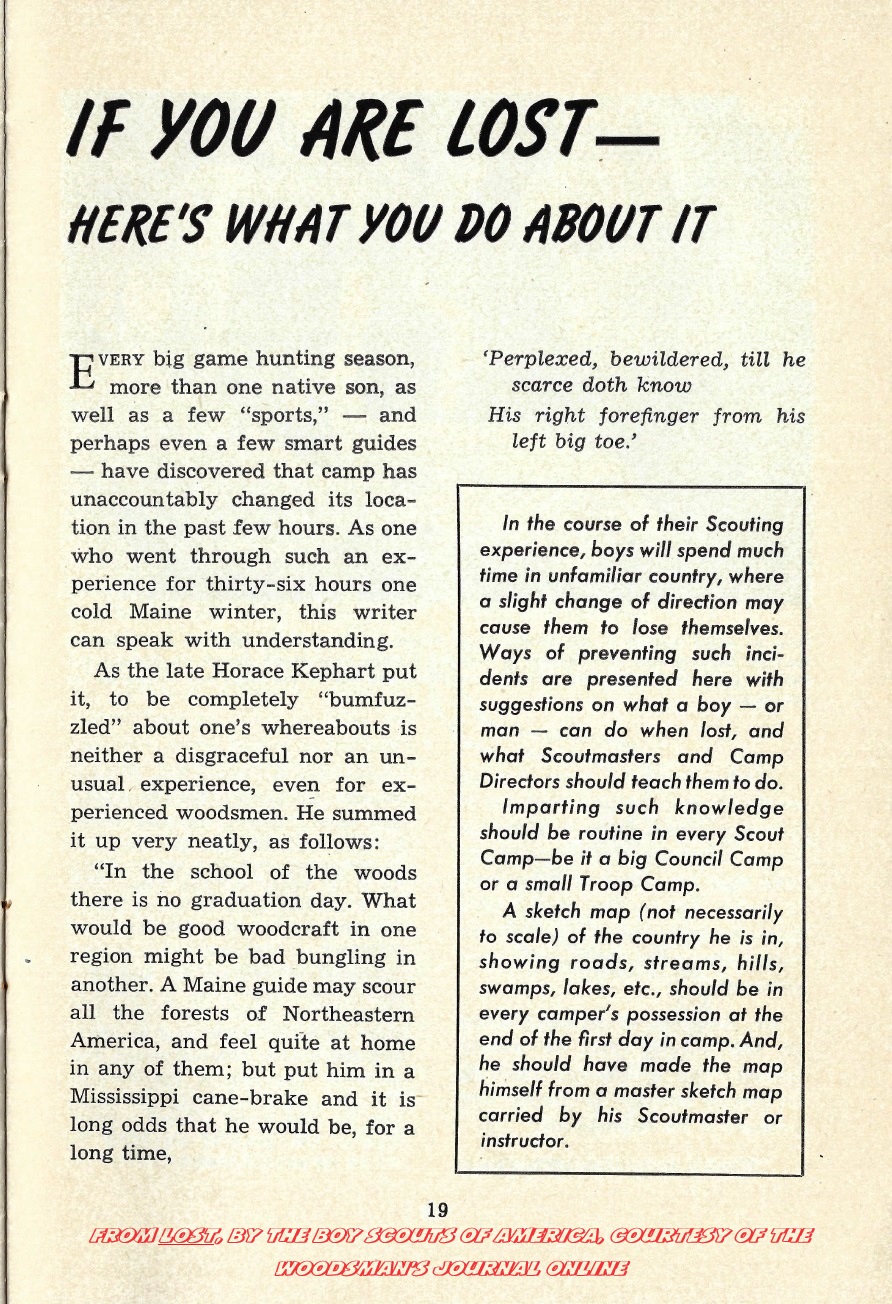
Lost©


Personally, I try not to use the word “lost”1, it is freighted with negative emotions, however that is the title of the Boy Scouts of America booklet that I found.  Since it is a hard to find pamphlet, and close to 75 years old, I uploaded it to Archive.org, HERE.  However, I thought that you would like a sneak preview of the survival information from the leaflet, along with some discussion.  So here it is.


Horace Kephart was quoted as saying, “In the school of the woods, there is no graduation day”, and he continued that the woodcraft tricks that you know don’t always transfer from one wilderness area to another, i.e. arctic spruce forest to tropical jungle, but the basics like not panicking, being coolheaded and being observant do.


Survival fundamentals rules are timeless and if you follow them, you can turn an emergency from a tragedy to simply an unfortunatesituation.


Remember, as the Arctic explorer Vihjalmur Stefansson said, if you can sleep, go ahead.  It is a myth that you will fall asleep and not awake because of the cold UNLESS you are so fatigued from lack of sleep, that you pass out.  So, rest whenever possible and conserve your energy...you will need it later!


And as Winston Churchill said, at Harrow, on October 29th, 1941, “Never give in...never, never, never, never, in nothing great or small, large or petty, never give in.”.


I hope that you are never in a wilderness emergency, but if you are, I hope you use the information from this pamphlet to turn an emergency into a simply unfortunate misplaced situation, instead of letting it spiral out of control into a lost tragedy.


I hope that you continue to enjoy The Woodsman’s Journal Online and look for me on YouTube at BandanaMan Productions for other related videos, HERE.  Don’t forget to follow me on both The Woodsman’s Journal Online, HERE, and subscribe to BandanaMan Productions on YouTube.  If you have questions, as always, feel free to leave a comment on either site.  I announce new articles on Facebook at Eric Reynolds, on Instagram at bandanamanaproductions, and on VK at Eric Reynolds, so watch for me.


That is all for now, and as always, until next time, Happy Trails!


Notes


1 I prefer using the term “misplaced”, instead of “lost” because misplaced things are ultimately found, but lost things never are.


Sources


Boy Scouts of America; Lost, [Boy Scouts of America, New York City, NY, 1950]


Sunday, April 14, 2024

When the crow caws three times©


Click HERE for what does the crow say


Conventional folklore has it that when a crow looks at you and caws three times, that someone close to you has died and that the crow has come to tell you the bad news.  There is a nesting pair of crows near my house, and if that was true, then I wouldn’t have any family left!  So, what does it mean when a crow caws three times?


Caw...Caw...Caw...


American crows, Corvus brachyrhynchos, are very smart, are occasional tool users1, and have a complex social structure, with research showing that they use analogical reasoning and can recognize faces of individual humans.


So, do crows’ caws mean anything?  The short answer is yes, according to Douglas Wacker, a researcher at the University of Washington at Bothell, who noted that crows “wouldn’t take the time or spend the energy to make all of these vocalizations unless they serve some purpose”.2  Crows make caws, rattles, croaks, clicks, honks, coos, and other sounds, the thing is that crows vocal ranges and repertoire of calls are so complex, that no one knows really knows what they are saying.  While crows’ calls are subtle and varied, there are two main types of calls, contextual calls with the crow responding to something in its environment, and non-contextual, with calls that don’t seem to be triggered by an event happening in the crows’ environment.


In fact, according to Kevin McGowan, a Crow researcher of the Cornell Laboratory of Ornithology, “Crows may be more complex communicators than other birds”.  In fact, according to McGowan, crow is more like Mandarin or Vietnamese, which are very complex tonal languages, where the same “word” can be used to mean different things, depending on the tone and how it’s used.3  So, a crow can use “caw” to mean different things, depending on the volume, the tone, and the number and the speed of the “caws”.


But what does it mean?


According to McGowan, “There’s a call they give that says, ‘heads up everybody, there’s a hawk’.  But they can also indicate ‘it’s getting closer, now we better hide’.   It’s the same word, but they speed up, ‘cawcawcaw’.  Finally, they change into a very different vocalization, which means ‘hide’.  He added, “There’s a lot in crow-speak that has to do with the timing of the notes, the space between them, and how quickly they are uttered”.  It would be like human-created music as language, where someone playing the same notes on a piano very softly (pianissimo), has a different meaning than someone playing the same the notes on the same piano very forcefully (fortissimo), the notes are the same, but the delivery and message are quite different.4


The most common crow calls are non-contextual companion or contact calls.  A companion call is an unhurried and relaxed series of one to ten “caws”, followed by a silence during which the crow is listening for a response.  This is followed by another burst of “caws” and more silence.  These calls don’t seem to be triggered by anything specific in the crows’ world.  It is just the crow’s way of saying “I am here, this is my territory, this pot is taken, the coast is clear, nothing exciting happening here, everything is fine here”!5 


So, a “caw...caw...caw...” is just the crow’s way of saying hello.


I hope that you continue to enjoy The Woodsman’s Journal Online and look for me on YouTube at BandanaMan Productions for other related videos, HERE.  Don’t forget to follow me on both The Woodsman’s Journal Online, HERE, and subscribe to BandanaMan Productions on YouTube.  If you have questions, as always, feel free to leave a comment on either site.  I announce new articles on Facebook at Eric Reynolds, on Instagram at bandanamanaproductions, and on VK at Eric Reynolds, so watch for me.


That is all for now, and as always, until next time, Happy Trails!


Notes


1 “American crows that excel at tool use activate neural circuits distinct from less talented individuals”, by Pendergraft et. al.


2 “Can Crows Talk? And If So, What Are They Saying?”, by A. Fonté,


3 “Crow communication is complicated”, by Joe Rankin,


4 Ibid.


5 “Can Crows Talk? And If So, What Are They Saying?”, by A. Fonté,


Sources


Fonté, A.; “Can Crows Talk? And If So, What Are They Saying?”, May 5, 2023, [© 2024 THE ARENA MEDIA BRANDS, LLC], https://pethelpful.com/birds/Can-Crows-Talk-And-If-So-What-Are-They-Saying#:~:text=The%20best%20explanation%20is%20that,four%20caws%2C%20repeated%20over%20time, accessed April 13, 2024


Pendergraft, LomaJohn T., Marzluff, John M., Shimizu, Toru, and Templeton, Christopher N.; “American crows that excel at tool use activate neural circuits distinct from less talented individuals”, October 3, 2023, [Nature Communications, (2023) 14:6539], https://www.ncbi.nlm.nih.gov/pmc/articles/PMC10589215/#:~:text=Individual%20variation%20in%20the%20ability,that%20favor%20adopting%20tool%20use, accessed April 13, 2024


Rankin, Joe; “Crow communication is complicated”, [©2024 www.burlingtonfreepress.com], https://www.burlingtonfreepress.com/news/, accessed April 13, 2024


Wikimedia, “American crow, City Park, New Orleans, Louisiana”, April 11, 2018, Melissa McMasters, https://commons.wikimedia.org/wiki/File:American_crow_(40896666114).jpg, accessed April 13, 2024


Wikimedia, “American Crow (Corvus brachyrhynchos) in Kitchener, Ontario, Canada”, July 28, 2019, Ryan Hodnett, https://commons.wikimedia.org/wiki/File:American_Crow_(Corvus_brachyrhynchos)_-_Kitchener,_Ontario_2019-07-28.jpg, accessed April 13, 2024


Wikimedia, “FIELD MARKS-black,iridescent plumage overall long,heavy,black bill brown eyes black legs and feet”, May 3, 2012, cuatrok77, https://commons.wikimedia.org/wiki/File:AMERICAN_CROW_(6997589886).jpg, accessed April 13, 2024