Sunday, July 10, 2022

Could You Survive? There is 30 Minutes of Daylight Remaining ©


So, you have wandered off the trail, while looking at wildflowers, and you have just realized that you have only 30 minutes, before the Sun goes down behind the mountains.  You don’t know where the path back is.  You are carrying a backpack with matches, a light jacket, a first aid kit, a snack, and a canteen.  So now what do you do?!


When Does the Sun Go Down?


Estimating the time till local sunset, graphic by the Author. 


Do you know how to tell how much daylight there is left before the Sun drops down behind the trees and mountains?  It is important to be able to estimate how many minutes of daylight are remaining, before the Sun goes down behind the local or apparent horizon, because the amount of remaining daylight you have depends on the terrain that you are in, wooded, hilly or flat and the time of year, as the time of sunset varies throughout the year. 


To calculate the amount of daylight remaining until sunset, hold your hands at arm’s length away from your body, and count how many fingers fit between the bottom of the Sun and the edge of the local horizon, be it a hill, ridge, or the top edge of a forest1.  Most survival experts calculate approximately 15 minutes per finger. 


This is a well-known hack and is a must know for anyone who spends any time in the woods, and I have used it often over the years. 
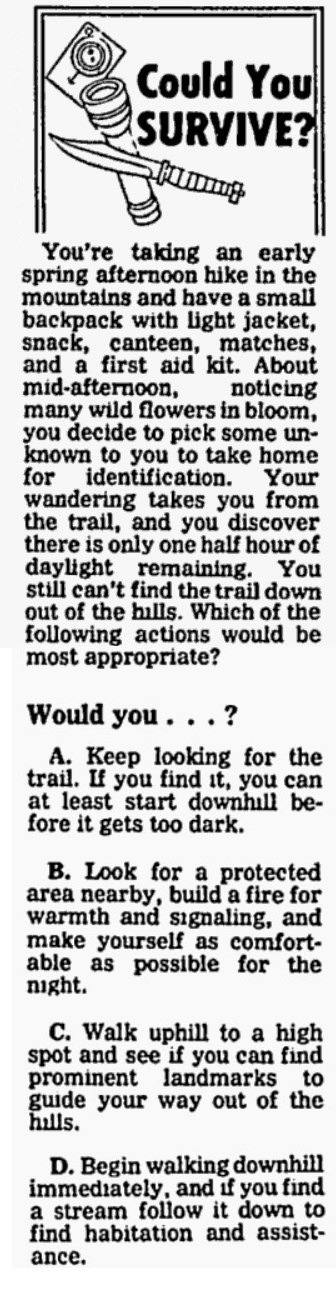
 

An Excerpt from Spokane Daily Chronicle, May 2, 1978, “Could You Survive”


So, you have only about two fingers, or 30 minutes of daylight left, that isn’t much time!  So, what would you do?  Would you choose A, B, C or D?  And which one is the correct answer? 


When caught in the woods by sundown, S.T.O.P.!  Photograph by the Author.


Master Sergeant John Dzedzy, a United States Air Force survival expert, and the author of this “Could You Survive” article, chose B, build a camp and a fire, and get comfortable for the night. 


Don’t travel after dark and find yourself in a Dead End!  Photograph by the Author.

Thirty minutes, or about two fingers of daylight, isn’t much time and as Master Sergeant Dzedzy explained, choice A, keep looking for the trail, choice C, walk uphill to try to find landmarks, or choice D, walk downhill to find a stream and follow it to civilization, all imply nighttime travel, which is inherently dangerous. 


It is very easy to trip in the dark and twist your ankle, poke yourself in the eye with an unseen branch, get more hopelessly lost, blunder into a swamp getting wet and chilling yourself, or even falling down a cliff or steep hillside, injuring or possibly, even killing yourself.  Also, as things go from bad to worse, you run the risk of panicking, and then you are truly lost!  If you insist on traveling after dark, through an area that you are unfamiliar with, you just might find yourself in a dead end!


So, instead of keeping moving and trying to walk out, spend the remaining 30 minutes of daylight, finding or building a windbreak and gathering plenty of firewood.  Ideally, and here is a pro-tip, you should always try to setup camp when there are still at least two hours, or eight fingers of daylight, remaining in the day.2  So, with only 30 minutes of daylight remaining you are going to have to work fast!


An excerpt from Handbook For Boys, by the Boy Scouts of America, June 1953, page 157.


You lose body heat to the wind, so always try to find a windbreak, and get out of the wind.  This will reduce the effects of wind chill and at the same time protects you from any wind-blown rain, sleet, and snow.  The lee side of the windbreak, the side downwind, or behind the windbreak, will offer you protection from the wind.  Oh, and remember you must sit between the fire and the windbreak3. 


An excerpt and illustrations from “But If You Do Get Lost”, Outdoors USA: 1967, by Kenneth M. Cole, page 90 to 91.


You can either find windbreaks, like large rocks, fallen trees, or thickets and groves of trees, or you can build them yourself from the materials at hand in the wilderness.  There are two types of windbreaks, solid ones like rocks, walls and logs, and permeable ones like groves of trees and thickets, which are also called shelterbelts.


The biggest difference between tinder, kindling and fuel wood is size and how much you need.  An excerpt of “How To Build A Campfire”, from Scoutmastercg.com, HERE.


Remember wood always burns faster than you think it will, so to keep your fire going all through the night and into the morning, you are going to need a lot!  Craig White, a Canadian survival expert, teaches that you will burn through a generous armload of wrist sized sticks each hour.  And the colder it is out, the more you will need to burn to stay warm.


An Excerpt from Spokane Daily Chronicle, May 2, 1978, “Could You Survive”


Hopefully, Master Sergeant Dzedzy’s advice will help you if you ever find yourself caught out in the woods by nightfall.  Remember to S.T.O.P and don’t panic!


S.T.O.P., photograph by the Author.


Don’t forget to come back next week and read “The Navigator’s Triangle ©”, where we will talk about another way to use the stars to find your directions in the wilderness.


I hope that you continue to enjoy The Woodsman’s Journal Online and look for me on YouTube at BandanaMan Productions for other related videos, HERE.  Don’t forget to follow me on both The Woodsman’s Journal Online, HERE, and subscribe to BandanaMan Productions on YouTube.  If you have questions, as always, feel free to leave a comment on either site.  I announce new articles on Facebook at Eric Reynolds, on Instagram at bandanamanaproductions, and on VK at Eric Reynolds, so watch for me.


That is all for now, and as always, until next time, Happy Trails!


Notes


1 For more information on the science behind this read “Estimating The Time Till Sunset©”, HERE, or become a Patreon sponsor and read “Could You Survive?  There is 30 Minutes of Daylight Remaining – Out Take©


2 You should always set up or start back to camp, or if you are misplaced, start building a shelter and a fire, before what woodsmen call the “big dark”, when there are eight fingers, or about two hours, of daylight remaining.  This is like Emerson Hough’s First Strict Camp Rule for hunters (from Out Of Doors, 1915) who were out hunting during the late fall or winter, which states, “…start home at half past two or three in the afternoon”, which is a couple of hours before the Sun goes down in the late fall and winter.  By returning to, or building you camp, while you still have two hours of daylight remaining, you will reduce your chance of having an accidental overnight adventure or injuring yourself as you make an overnight trek through the wilderness.


3 For more information on windbreaks read “...Seeking Shelter Against the Wind©” HERE and “But If You Do Get Lost”, Outdoors USA: 1967©”, HERE.


Sources


Boy Scouts of America, Handbook For Boys, [Boy Scouts of America, New York, New York, June 1953], page 157


“Calculating Sunset Time With Your Fingers”, http://awesci.com/calculating-sunset-time-with-your-fingers/, (accessed 11/27/18)


Green, Clarke; “How to Build a Campfire”, November 7, 2012, [Dynamik-Gen, 2019] https://scoutmastercg.com/how-to-build-a-campfire/


Hough, Emerson; Out Of Doors, (D. Appleton and Company, New York, New York [1915]) p. 269 - 282, reprinted in https://books.googleusercontent.com/books/content?req=AKW5QadnZNQ1xrsbkS3T4VJlC_uZQ8t4yj2UNH5POGbNio-1SDyFM8TAqUfl7ciDY5CuNZxvnnE0Pcxf1j6Thu_zOs5kz8rgR9MOtsbTxVgRVa3bwaKo0-D5YX2T4JaBO_z6G8vgwFNgLiJ9XCfBVnn9K4qR7ZFa0faNe3zmvfWDfmEo049sqXQlw697XIHDWNblRJj9niiabZoBB7aQHl82tf4y03cpU2hMdLVADF-7P2pvJKsZbLDnJN8ncLZ9IftMudapmn8E, (accessed 11/8/18)


Newquist, Susan; “Let Your Fingers Tell Time”, July 31, 2000, https://www.backpacker.com/skills/let-your-fingers-tell-time, (accessed 11/27/18)


Oelslager, Dr. Robert W.; Bushcraft, Scouting & Woodlore: Notes, Vol. I, [Privately Published]


Spokane Daily Chronicle, May 2, 1978, “Could You Survive”, Master Sergeant John Dzedzy, page 19, https://books.google.com/books?id=KPtLAAAAIBAJ&pg=PA10&dq=%22spokane+daily+chronicle%22+%22could+you+survive%22&article_id=6794,367919&hl=en&sa=X&ved=2ahUKEwioruKYj9v4AhVhD1kFHUluDXMQ6AF6BAgKEAI#v=onepage&q=%22spokane%20daily%20chronicle%22%20%22could%20you%20survive%22&f=false, accessed July 2, 2022


United States Department of Agriculture, Outdoors USA: 1967 Yearbook of Agriculture, [United States Government Printing Office, Washington, DC, 1967], p 87-89, https://archive.org/details/yoa1967/page/n3, accessed November 2, 2019


Sunday, July 3, 2022

Dry Gripes, Lead Poisoning and Mayapples©


“The Dry Gripes or the Comforts of a Hot Summer”, by The Trustees of the British Museum, HERE.


Dry Gripes, the Cholica Pictonum, or the Caribee Colick...


An excerpt from An Essay on the West-India Dry-Gripes, etc., by Thomas Cadwalader, page 1.


The “dry gripes” was a notorious malady which was epidemic during the 18th and early 19th centuries, in both England and in North America.  The primary symptoms of the “dry gripes” were severe abdominal cramps or colic, without any associated dysentery, and extreme fatigue and apathy, sometimes with a weakness of the hands and feet.  Benjamin Franklin, in a letter to Benjamin Vaughan, written on July 31, 1786, wrote of it and called it a “Dry-Belly ache1.  These symptoms of severe and griping abdominal pain have been written about since the times of the Greeks and the Romans, when they were called “Saturnism”, and depending upon the time and where they occurred, were known by different names, such as “Colica Pictonum” (Colic of Poitou), “Caribee Colick”, “Devonshire Colic”, or the “London gout”, to list a few.2  The one thing that all of them have in common, is that the severe abdominal pains that they are describing are symptoms of lead poisoning, and these symptoms were generally followed by even more severe symptoms of lead poisoning.


Lead poisoning...


An excerpt from An Essay on the West-India Dry-Gripes, etc., by Thomas Cadwalader, page 28.


Today lead poisoning is known as “plumbism”, and unfortunately, lead poisoning and its effects have been with humankind for millennia, as lead was one of the first metals to be refined and used by early societies.  Lead has been used since ancient times for plumbing, for lining storage containers, for glazing pots and making paints, for making pewter dishes and utensils, for making distilling equipment and even for sweetening3 or “fortifying” wine!  Lead can enter the body in the foods you eat or drink, dissolved in water, milk, wine, vinegar, cider, alcohol, or acid foods that have been stored in leaden containing vessels.  It can also be absorbed through the skin or breathed in as dust.


Today, modern Americans, usually have less than 20 ppm of lead in their bones, which is an indication of lifetime exposure, and levels below 50 ppm do not cause symptoms of lead poisoning.  The wealthy during the 18th and early 19th century usually had the highest exposure to lead, since they were the only ones who could afford to buy expensive wines and to eat and drink from pewter dishes, pewter being an alloy made by mixing lead and tin.  This is evidenced by Colonel Joseph Bridger, who died in 1686 and who, while he was alive, was one of the ten wealthiest of Virginia colonists, he had a bone lead level of 149 ppm, when his remains were tested in 2007!4


But everyone had some exposure to lead during the 18th and early 19th centuries, since all but the very poorest of people, who ate out of wooden bowls, ate and drank from lead-glazed pottery. 


Lead poisoning was also a disease of the workplace effecting miners as “miner’s colic”, painters as “painter’s pallor”, and potters as “potter’s disease”, and with the beginnings of industrialization more people were afflicted.  Even Benjamin Franklin experienced symptoms of lead poisoning, when in 1724, he worked in London as a compositor at the printing house of a Mr. Palmer.  He noted that at that time he experienced the “Dangles”, which is a palsy or weakness of the wrists or ankles, and which causes the hands and feet to drop and dangle.  This was frequently an additional symptom of the “dry gripes”, which was experienced on top of the belly pain: in Benjamin Franklin’s particular case it appears that it was caused by his handling of lead type.


“Symptoms of lead poisoning”, by Mikael Häggström, from Wikimedia, HERE.


So, if everyone was exposed to some lead during the 18th and early 19th centuries, just what caused the epidemic of “Dry-Belly aches” in the Americas and Great Britain during this time?  In a word, alcohol, and the brewing and distilling process by which it was made. 


“...against New England Rum, that it poison’d their People giving them the Dry-Belly ach, with a Loss of the Use of their Limbs. The Distilleries being examin’d on the Occasion, it was found that several of them used leaden Still-heads and Worms, and the Physicians were of Opinion that the Mischief was occasiond by that Use of Lead”, Benjamin Franklin in a letter to Benjamin Vaughan, July 31, 1786.


On September 3, 1723, the Massachusetts Colony passed “An Act for Preventing abuses in Distilling of Rum and Other Strong Liquors with Leaden heads or Pipes”, in response to the epidemic of “dry gripes”.  Apparently, the Massachusetts rum distillers prior to this act, used pewter or lead heads as covers and pewter or lead worms or pipes, to produce rum from molasses and the lead from the distilling equipment ended up in the rum.  Maybe this explains why it was known as “kill-devil” rum in England at this time!5.


“Moonshine still recently confiscated by the Internal Revenue Bureau photographed at the Treasury Department”, 1921, annotated by the Author, from Wikimedia, HERE.


Additionally, England signed the Treaty of Methuen in 1703 which allowed for the importation and sale of “fortified” wines, from Portugal, Spain, the Canary, and the Madeira Islands.   Fortified wines, such as port or sherry, were often made with a brandy that was distilled using pewter or lead containing equipment, and it might have been stored and shipped in

wooden barrels with lead-lined lids or lead fastenings6.  In fact, Milton Lessler reported that English port bottled between 1770 and 1830 contained up to 1900 mg of lead per liter.


Hard cider was also a dangerous drink, as the apples were squeezed with lead pounds and presses and then the cider was left to ferment and harden in lead-glazed earthenware pots, from which it rapidly became infused with lead.  This was a particular problem in Devonshire during the harvest, where the cause of the “Devonshire Colic” was discovered in 1767 by physician Sir George Baker, to be lead in the cider.


All three of these alcoholic drinks with the beginning of industrialization and mass production became cheaper and more easily available during the 18th and early 18th centuries, and all would have contained enough lead to a cause of belly ache, the “dry gripes” and lead poisoning.


Using a poisonous plant to cure a poisoning...


A painting by Charles Frederick Millspaugh, 1887, in American Medicinal Plants, from Wikimedia, HERE.


Medical science being what it was, in the 18th and early 19th centuries, people resorted to some rather extreme measures to relieve the pains in their bellies caused by the “dry gripes”. 


An excerpt from Medicine in Virginia in the eighteenth century, by Wyndham B. Blanton, M.D., page 216.


One remedy was made from mayapples, podophyllum peltatum, is a plant that is almost entirely toxic, all parts of the plant, except the ripened berry contain podophyllotoxin, an alkaloid, which is highly poisonous!  For more on Mayapples read “Mayapples...They Aren’t Really Apples ©”, HERE.  During the 18th and early 19th century, in North America, the roots of this plant were used to make a cathartic medical tonic to purge a patient and relieve constipation and to induce vomiting.


An excerpt from The Family Nurse, by Lydia Child, page 105


So next time you enjoy an alcoholic drink, be glad that there is no lead in it and that you don’t get to enjoy a mayapple purgative as a chaser.


Don’t forget to come back next week and read “Could You Survive: There is 30 Minutes of Daylight Remaining ©”, where we will talk about what the survival experts recommend that you do when you realize you are “misplaced” and there is only thirty minutes of daylight remaining.


I hope that you continue to enjoy The Woodsman’s Journal Online and look for me on YouTube at BandanaMan Productions for other related videos, HERE.  Don’t forget to follow me on both The Woodsman’s Journal Online, HERE, and subscribe to BandanaMan Productions on YouTube.  If you have questions, as always, feel free to leave a comment on either site.  I announce new articles on Facebook at Eric Reynolds, on Instagram at bandanamanaproductions, and on VK at Eric Reynolds, so watch for me.


That is all for now, and as always, until next time, Happy Trails!


Notes


1 From “Benjamin Franklin Experienced Symptoms of Lead Poisoning from Typesetting During his Apprenticeship”, by Jeremy M. Norman.


2 From “Lead and Lead Poisoning from Antiquity to Modern Times”, by Milton A. Lessler, table 3, page 80


3 In Roman and Greek times , wine was sweetened or fortified by adding “sapa”, an artificial sweetener, which is a syrup that is prepared from freshly pressed grape juice, or “must”, (from the Latin phrase “vinum mustum”, meaning ‘young wine’), that has been boiled and concentrated in a lead container.  Wine that had “sapa” added to it resisted spoiling and tasted sweeter due to the lead acetate (Pb(CH3COO)2), also known as “sugar of lead”, a salt that strangely enough has a sweet flavor.


4 Skeletal lead content reflects lifetime exposure.  Lead levels in bone are expressed as parts per million (ppm) -- micrograms of lead per gram of bone ash, and a very high lead content in 17th, 18th or early19th -century bone indicates a person of means.


From “Pottery, Pewter and Poison”, National Museum of Natural History, Smithsonian Institution.


5 From “Lead and Lead Poisoning from Antiquity to Modern Times”, by Milton A. Lessler, table 3, page 80


6 From “Sack and sugar, and the aetiology of gout in England between 1650 and 1900”, by Christopher Rivard, et al.


Sources


Blanton, Wyndham B., M.D.; Medicine in Virginia in the eighteenth century, [Richmond, Garrett & Massie, Inc., 1931], page 216, https://catalog.hathitrust.org/Record/001557339, accessed June 21, 2022


Cadwalader, Thomas; An Essay on the West-India Dry-Gripes, etc., [B. Franklin, Philadelphia 1745], https://books.google.com/books?id=i2FpAAAAcAAJ&pg=PA28&lpg=PA28&dq=%22dry+gripes%22+definition&source=bl&ots=3xrBvb5tly&sig=ACfU3U3uc8jYTHig2n7mpz4uIFqc8bKvXA&hl=en&sa=X&ved=2ahUKEwj-86Hm-b_4AhUmMlkFHRnQA0oQ6AF6BAg1EAM#v=onepage&q=%22dry%20gripes%22%20definition&f=false, accessed June 25, 2022


Corn, Jacqueline K.; “Historical Perspective to a Current Controversy on the Clinical Spectrum of Plumbism”, Milbank Mem Fund Q Health Soc., Winter 1975; 53 (1), pages 93 to 114, https://www.milbank.org/wp-content/uploads/mq/volume-53/issue-01/53-1-Historical-Perspective-to-a-Current-Controversy-on-the-Clinical-Spectrum-of-Plumbism.pdf, accessed June 25, 2022


Child, Lydia; The Family Nurse [Richard Bentley, London, 1837], page 105, https://books.google.com/books?id=EAplAAAAcAAJ&printsec=frontcover&dq=Childs,+Lydia.+The+Family+Nurse&hl=en&newbks=1&newbks_redir=0&sa=X&ved=2ahUKEwjPx5T7_NP4AhUZFVkFHUQdBlwQ6AF6BAgKEAI#v=onepage&q=Childs%2C%20Lydia.%20The%20Family%20Nurse&f=false, accessed June 29, 2022


Lessler, Milton A.; “Lead and Lead Poisoning from Antiquity to Modern Times”, [Ohio Journal of Science, Volume 88, Number 3, 1988], pages 78 to 84, https://www.biologicaldiversity.org/campaigns/get_the_lead_out/pdfs/health/Lessler_1988.pdf, accessed June 25, 2022


National Museum of Natural History, Smithsonian Institution,  “Pottery, Pewter and Poison”, https://naturalhistory.si.edu/education/teaching-resources/written-bone/unearthing-chesapeake/pottery-pewter-and-poison, accessed June 25, 2022


Norman, Jeremy M.; “Benjamin Franklin Experienced Symptoms of Lead Poisoning from Typesetting During his Apprenticeship”, [© 2004–2022 Jeremy M. Norman, HistoryofInformation.com], https://www.historyofinformation.com/detail.php?id=4759, accessed June 25, 2022


Rivard, Christopher; Thomas, Jeffrey; Lanaspa, Miguel A.; Johnson, Richard J.; “Sack and sugar, and the aetiology of gout in England between 1650 and 1900”, Rheumatology, Volume 52, Issue 3, March 2013, Pages 421–426, https://doi.org/10.1093/rheumatology/kes297, accessed July 2, 2022


The Trustees of the British Museum, “The Dry Gripes or the Comforts of a Hot Summer”, [© The Trustees of the British Museum], https://www.britishmuseum.org/collection/image/1014583001, accessed June 25, 2022


Varney, Tamara L.; Swanston, Treena; Coulthard, Ian; Cooper, David M. L.; George, Graham N.; Pickering, Ingrid J.; and Murphy, A. Reginald; “A Preliminary Investigation of Lead Poisoning in a Napoleonic Era Naval Cemetery in Antigua, W.I”, Caribbean Connections: A Publication of the Filed Research Centre 2 (1): Special Issue focusing in the Bioarchaeology of the Caribbean, 2012, https://www.royalnavycemeteryantiguaproject.com/uploads/8/6/7/9/86790892/varney_et_al_caribbean_connections_2012.pdf, accessed June 25, 2022


Wikimedia, “American_medicinal_plants;_an_illustrated_and_descriptive_guide_to_the_American_plants_used_as_homopathic_remedies-_their_history,_preparation,_chemist”, by Charles Frederick Millspaugh, 1887, https://commons.wikimedia.org/wiki/File:American_medicinal_plants;_an_illustrated_and_descriptive_guide_to_the_American_plants_used_as_homopathic_remedies-_their_history,_preparation,_chemistry_and_physiological_effects_(1887)_(17534042604).jpg, accessed June 21, 2022


Wikimedia, “Moonshine still recently confiscated by the Internal Revenue Bureau photographed at the Treasury Department”, 1921, https://commons.wikimedia.org/wiki/File:Moonshine_still_recently_confiscated_by_the_Internal_Revenue_Bureau_photographed_at_the_Treasury_Department_LCCN89706121.tif, accessed June 27, 2022


Wikimedia, “Symptoms of lead poisoning”, by Mikael Häggström, June 7, 2015, https://commons.wikimedia.org/wiki/File:Symptoms_of_lead_poisoning_(vector).svg, accessed June 27, 2022