Sunday, September 12, 2021

Should I Stay, or Should I Go, and the 72-Hour Rule©


The title of a 1982 song by the Clash and a great survival question, graphic by the Author.


At some point, if you wander in the wilderness long enough, you are going to find yourself “misplaced”!  Just remember that being misplaced isn’t the same as being “lost”, because even Daniel Boone was “bewildered” once for three days (for more on this read “Being Bewildered and Bending the Map©”, HERE).  Most times, you will reorient yourself and proceed on your way in just a short time.  Sometimes you aren’t that lucky, and you end up having an unexpected overnight adventure.  Most times when you are “misplaced” searchers will find you within the next 72 hours.  In fact, Devon O’Neill writing in Outside, quoted Paul Anderson, who is a 42-year veteran of the National Park Service, and who spent 11 years as superintendent of Denali National Park, as saying that “Our stats show 85 percent of all lost people are found within the first 12 hours, and 97 percent are found within the first 24 hours”. 


Should I Stay, or Should I Go?


However, what happens if you fall into the unlucky 3% who aren’t found within the first 72 hours1?  When the rescuers stop looking for you, you will go from being “misplaced” to being “lost” that’s what!  When this happens, you will have to answer the question, “Should I stay, or should I go?”.


A case in point is Geraldine Largay, who on July 21, 2013, stepped off the Appalachian Trail, near Redington Township, Maine, and became lost.  She realized that she did not know where she was or how to return to the trail, so she set up her tent, tried to call for help with her cell phone and waited for the rescuers to find her.  Her husband reported her missing on July 24 and a massive search began and even though the search remained open for two years, she was never found.  Geraldine survived for at least 26 days, before dying of starvation and exposure.  She wasn’t found until October 2015, when her remains, including her cell phone and journal, were found inside her collapsed tent. 


She did everything that experts said to do, she stopped, built a camp, called for help, and waited for the rescuers to find her, but they never did and eventually the rescuers stopped searching for her. 


The question “Should I stay, or should I go?” is a tough question to answer.  No matter what, you don’t want to try to walk out too soon, because if you move you are simply making it harder for the searchers to catch up with you, if they are still looking, that is.  However, if they have stopped looking, then you are on your own and will have to self-rescue.  But there a couple of things to think about before you bug out


The updated “Survival Drill”, can help you decide whether you should stay, or you should go.  Graphic by the Author, for more read, “Survival Drill”, Updated and Explained ©”, HERE.


Are you injured?  Are you able to walk out?


Are you injured”?  If the answer to this question is “yes”, then ask yourself, “are you able to walk out”?  If the answer to the second question is “no”, then you should stay put.  There might be situations where your injuries are so severe that you wouldn’t survive walking out, or perhaps your injuries affect your mobility, and you aren’t able to walk out. 


Are your signals working?


In the first “Golden Hour2 after your wilderness emergency you followed the “Rule of Threes”, you took care of any injuries, found shelter from the wind and weather, and called and signaled for help, but it has been more than 72 hours and the rescuers still haven’t found you, so now what?


Well, perhaps, your calls and signals for help haven’t been seen or heard, so ask yourself, “are your signals working, can they be seen from the air”?  Maybe the spot where you have set up your campsite is difficult to see from the air, or maybe your signals are hard to see.  Before you decide to bug-out, you should try to use some more active signals, like flashing a signal mirror or even, possibly, lighting a “tree torch”.


An excerpt from FM 3-05.70, page 315.  Just be careful, you don’t want to create a forest fire, especially since you could get burnt alive by it!


The most effective visual signal is the signal mirror, or heliograph, and according to The Survival Book3 it “is second only to the radio as a rescue device”.  Sweep the horizon with your signal mirror at regular and frequent intervals, the flash can be seen by rescuers even if you, yourself, can’t see or hear them. 


Build signal fires and shadow or contrast signals in open areas, close to your shelter, if possible.  The survival manual Down but not Out, states that three fires, 100 feet (30 m) apart and arranged in a triangle or in a row are an international signal for help.  Remember bright flames at night and during the day, black smoke against a light background or white smoke against a dark background, will attract attention.  The U.S. Coast Guard recommends that each letter of a shadow or contrast signal be 18 feet tall by 3 feet wide (5.5 m by 1 m).


Pages from “Survival Hints for the Sportsman, 1959©”, HERE.


Can I orient myself?


Before you attempt to walk-out and self-rescue yourself, you first must answer the question “can I orient myself”?  Wandering off aimlessly will only make things worse, and if you can’t figure out where you are first, you will not be able to create a plan to get where you want to go.  If you have a compass and a map, by orienting the map to north, and studying the terrain features around you, you should be able to find out where you are on the map.  If you don’t have a compass and a map, you can study the movement of the Sun and use the “Shadow-tip Method” to determine the cardinal directions (for more on this read “How To Find Your Way Without A Compass, Part Three, The Shadow-tip Method©”, HERE).  At the very least, you must find the cardinal directions and a visible terrain feature along your proposed route of travel to help guide you during your travel before you bug out.


Excerpts from Better Ways Of Pathfinding, on position finding and land navigation, by Robert S. Owendoff, pages 28 to 31


No matter what, if you plan on walking out and self-rescuing, leave a message at your old campsite detailing your plans and the date and time that you left, and leave an arrow made of branches or stones on the ground, pointing in your direction of travel.


The arrow points the way, photograph by the Author.


Don’t forget to come back next week and read “There and Back Again...Finding Your Way©”, where we will talk about finding your way in the woods.


An excerpt from The Book Of Woodcraft, by Ernest Thompson Seton, page 162-163.


I hope that you continue to enjoy The Woodsman’s Journal Online and look for me on YouTube at Bandanaman Productions for other related videos, HERE.  Don’t forget to follow me on both The Woodsman’s Journal Online, HERE, and subscribe to BandanaMan Productions on YouTube.  If you have questions, as always, feel free to leave a comment on either site.  I announce new articles on Facebook at Eric Reynolds, on Instagram at bandanamanaproductions, and on VK at Eric Reynolds, so watch for me.


That is all for now, and as always, until next time, Happy Trails!


Notes


1 Remember, sometimes it takes a while before anyone realizes you are missing, and some police departments have a policy of waiting an additional 24 to 72 hours before they begin to look for a missing person.  So, keep this in mind before you bug out.


2 The first hour after any wilderness emergency is critical, and what you do or don’t do can determine your survival and for that reason it is often called the “Golden Hour”.  The first hour is also the most stressful, you will be disoriented and scared, and these feelings will only be made worse if you are injured and in pain.  Use the “Rule of Threes” to help guide you.  First, take care of any injuries, this is crucial, particularly in the case of severe injuries which can lead to shock.  Second, find or build a shelter from the wind and weather and start a fire.  This is particularly important if you or someone else is injured or the weather is cold, wet, or windy.  And third, call or signal for help.  The first hour after a wilderness emergency is also the golden hour for alerting rescuers and improving your chances of eventual rescue.  If you are uninjured and the weather is mild, you could move this task up to become your second priority. 
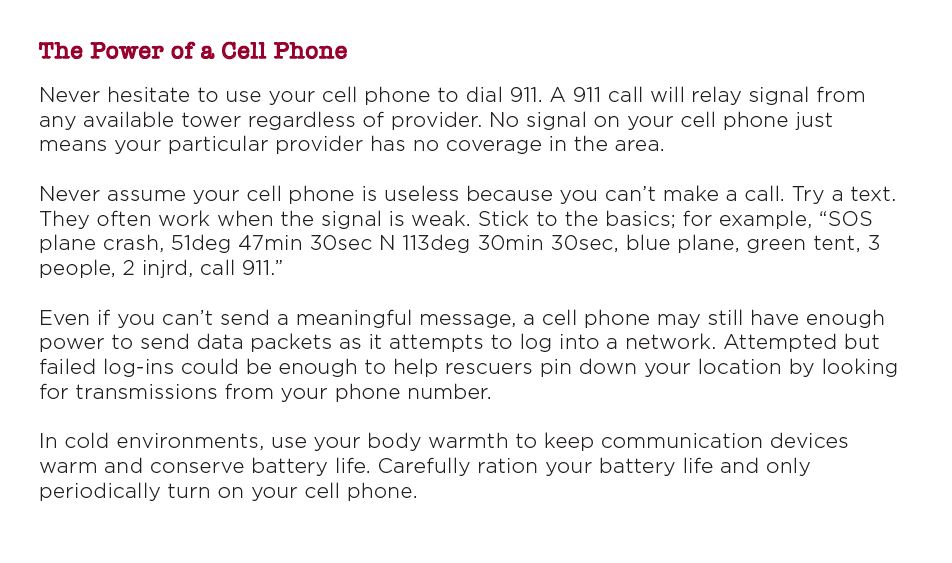
 

An excerpt from “Survive: Beyond the Forced Landing”, by the Air Safety Institute, AOPA, HERE.


3 The Survival Book, 1959, by Paul H Nesbitt, Alonzo W. Pond and William H Allen, page 27.


4 Outdoor Survival Training for Alaska’s Youth, by Dolly Garza, page 30


Sources


Adams, Char; “Hiker Who Died After Getting Lost on Appalachian Trail Left Journal for Loved Ones: 'When You Find My Body, Please Call My Husband”, updated May 26, 2016, [© 2021 Meredith Corporation], https://people.com/celebrity/hiker-who-died-on-appalachian-trail-kept-journal-of-the-ordeal/, accessed September 2, 2021


Air Safety Institute, AOPA; “Survive: Beyond the Forced Landing”, [Frederick, Maryland], http://www.google.com/url?sa=t&rct=j&q=&esrc=s&source=web&cd=57&ved=0ahUKEwjjpoab-eTYAhWMp5QKHYYIA0o4MhAWCEswBg&url=http%3A%2F%2Fwww.aopa.org%2F-%2Fmedia%2Ffiles%2Faopa%2Fhome%2Fpilot%2520resources%2Fasi%2Fsafety%2520advisors%2Fsa31.pdf&usg=AOvVaw0MXBFxEgfsS5ow6y80vbbv, accessed September 1, 2021


Garza, Dolly; Outdoor Survival Training for Alaska’s Youth, [University of Alaska Fairbanks, 2005], page 30


Headquarters, Department of the Army; FM 3-05.70, [Washington DC, May 17, 2002], page 315, https://irp.fas.org/doddir/army/fm3-05-70.pdf, accessed September 10, 2021


Information Canada; Down but not Out, [Maracle Press, Ltd, Ottawa, Canada, 1975], page 81 to 88


National Council, Boy Scouts of America, Scouting, Volume 8, Issue 10, [Boy Scouts of America, May 6, 1920],


Nesbitt, Paul H.; Pond, Alonzo W. and Allen, William H.; The Survival Book, [D. Van Nostrand Company, Inc., Princeton, New Jersey, 1959], page 27 to 29


O’Neill, Devon “How Backcountry Search and Rescue Works”, Outside, March 4, 2016, [© 2021 Outside Interactive, Inc.], https://www.outsideonline.com/2059616/how-backcountry-search-and-rescue-works, accessed 10/09/2018


Owendoff, Robert S.; Better Ways Of Pathfinding, [The Stackpole Company, Harrisburg, Pennsylvania, 1964].  Page 28-31

Thompson Seton, Ernest; The Book Of Woodcraft [Garden City Publishing Co., Inc., Garden City, NY; 1921], page 162-163


Waite, Sara; “Merino man publishes survival guide”, updated May 8, 2019, [©2021 MediaNews Group, Inc.], https://www.journal-advocate.com/2013/07/26/merino-man-publishes-survival-guide/, accessed September 9, 2021


Sunday, September 5, 2021

A Survival Kit, Your Ace in the Hole ©


The ace of spades, an ace in the hole, just like a survival kit, photograph by the Author.


In the August 1972 edition of Flying Machine, Richard C. Young III wrote an article titled “Ace in the Hole”, where he talked about survival kits and what you should do as a pilot if you crash in the wilderness.  Now, I know that more people wander through the wilderness than fly over it and getting lost in the woods is not quite the same as crashing a plane in the woods, but it can be close.  For example, you could be walking along a ravine and stumble and fall down the slope into the valley below, you are hurt and cannot get out, now you must survive!


“Ace in the Hole” is a good article and in it Mr. Young points out the importance of having a survival kit, suggests items to be included in your survival kit, and recommends where to keep your survival kit.


So, let’s talk about the importance having an ace in the hole.


A Survival Kit, Your Ace in the Hole


The Author’s survival kit, picture by the Author.


An ace in the hole, originally meant an ace that had been dealt and was held face down, it has come to mean an advantage or resource that is kept in reserve until needed. 


You should always, always, ALWAYS, bring a survival kit with you, because you never know when an emergency will happen.


What’s in your survival kit...?


Okay”, you say, “but, what should I have in my survival kit?


In “Ace in the Hole”, the author recommended bringing 30-40 waterproofed, wax-dipped matches in a plastic medicine bottle, with a piece of emery cloth glued to the inside of the lid; some homemade bottle-cap candles or tea-candles; a signal mirror; a compass; a roll of 40-pound monofilament fishing line for fishing, snaring, repair, etc.; an assortment of size 1, 5 and 8 fishing hooks, iodine for water purification; salt tablets2; non-lubricated condoms; insect repellent; multivitamins; a sheath knife with a sharpening stone; and two to three dry-cleaner shrouds (plastic bags).


The Rule of Threes, graphic by the Author.


Most survival experts today recommend following the “Rule of Threes” when building your survival kit, so that your survival kit solves your most immediate survival needs of shelter and fire first, followed by water and lastly by food. 


This is what I carry.


Shelter supplies, 1) paracord, 18 feet (5.5 meters); 2) a knit hat, clothes are portable shelter; 3) two heavy duty contractor grade trash bags, all of which weigh 12 ounces (340 grams).  Photograph by the Author.


The Author’s survival kit, which is kept in an aluminum soap dish, held closed with two heavy duty rubber bands, and kept in two plastic Ziploc® quart freezer bags, inside a cloth ditty bag.  Also pictured is my spare utility knife and spare compass, all of which weigh 8 ounces (227 grams).  Photograph by the Author.


The contents of the Author’s survival kit, 1) Fire starting supplies, (from bottom left to right), a mini plastic Ziploc® bag containing two CakeMate Relight trick birthday candles and four UCO Stormproof matches and a striker; a metal match; a BIC Mini lighter, one packet of Landsmann Fire Starter; one piece of a Coghlan's Waterproof Fire Stick; and some cotton.  2) Multiple use aluminum foil, two, 1 foot (30 cm) square pieces.  3) First aid, one antibiotic ointment packet and three Band-Aid Butterfly Closures.  4) Water storage and Disinfection, one Reynolds® Slow Cooker Liner, 13 x 21 inches (330 mm x 533 mm), holding up to 6.5 quarts (6 liters).  5) Food gathering and repair, one mini fishing kit, which contains 5 hooks and 5 split shot sinkers, two large safety pins, a needle and two feet (60 cm) of thread, and that has just over 26 feet (8 meters) of monofilament fishing line wound around the outside of it.  6) Signaling and direction-finding, (from bottom left to right), a Fresnel lens, a compass, a signal mirror, and a signal card.  7) Food gathering and repair, 17 feet (5 meters) of 12-pound test fishing line.  8) Signaling, one Maglite Solitaire LED Flashlight.  Photograph by the Author.

The Author’s comfort supplies, clockwise from the top, a micro first aid kit, two spare Ziploc® quart bags, a pump spray bottle of insect repellant, a headlamp, a small roll of toilet paper, a BIC lighter with three feet (1 meter) of duct tape wrapped around it, and a 50 SPF broad spectrum sunscreen stick, all kept in two plastic Ziploc® quart freezer bags, all of which weigh 8 ounces (227 grams).  Photograph by the Author.


Many of the items in my survival and comfort kit have multiple uses, such as the antibiotic ointment, the sunscreen stick, the toilet paper, and the duct tape, all of which can be used to help me to get my fire started if necessary.


My survival and comfort supplies were all selected to help me first take care of any injuries and then to get a shelter built and a fire made.  After that comes building signals, finding a source of water, disinfecting it and then last of all, finding food.  The reason for this is the “72-hour rule”.  Most “misplaced” people, in the United States, are found within 72 hours of being reported missing.  In fact, experts note that 85% of “misplaced” persons are found alive within 12 hours and 97% are found alive within the first 24 hours of being reported missing.  The key statement is “of being reported missing”; that is why it is so very important to have a trip plan and to always tell someone, a responsible someone at your home base, when you are leaving, the route you are taking, where you are going and when you will be back.  And never, never, never, ever change your plans without telling this someone.  This is just like pilots who plan their route and file a flight plan, which includes the place of departure and the time leaving, the route to be followed, the destination and the arrival time, and the number of people on their flight.  The more that others know about your planned path and your departure and arrival times, the less time that you will spend waiting for rescue in the case of an emergency. 


In your pack, or in your pocket...


Mr. Young’s recommendation to keep your survival kit in the map compartment of the plane, is like keeping your survival kit in your backpack or the trunk or glove compartment of your car.  The Fourth Edition of the Alaska Air Medical Escort Training Manual recommends, that you carry a personal survival kit that fits in your pockets, because people usually find themselves in survival situations with only what is in their pockets1.  If your survival supplies are not in your pockets, it is possible that you won’t be able to reach them in the case of a wilderness emergency.


The Author’s survival PFD, with an orange Peak 1 fanny pack attached to the back, and survival vest, photograph by the Author.


Personally, I keep my survival and comfort supplies in the pockets of my either my survival vest or my survival PFD, depending on whether I am on the water, paddling and portaging, or hiking along a trail.  You can easily get separated from your pack, or the gear in your canoe; but you aren’t likely to get separated from your clothes!


Where I put the gear I carry in my survival vest or survival PFD: 1) Shelter supplies, in the back pocket; 2) my compass and pea-less plastic whistle, both of which weigh 2 ounces (57 grams), in the front upper pocket; 3) my survival kit and spare knife and compass, in the lower left front pocket; 4) my comfort supplies, in the lower right front pocket; 5) a BanadanaMan Emergency Bracelet, that contains 174 inches (442 cm) of string, which I wear on my wrist; and 6) my neck knife, which weighs 4 ounces (113 grams) and, obviously, goes around my neck.  Photograph by the Author.


My survival vest is just a fishing vest that I found at Sears, and my survival PFD is a fishing model with a Peak 1 fanny pack attached to the back.  Both can be comfortably worn beneath a pack, whether I am portaging or hiking.


For more on survival vests, survival kits and surviving plane crashes in the wilderness, check out these great sites.


“The Survival Vest”, The Backcountry Pilot, HERE


“EssentialsTM Aviator Survival Vest TM, HERE


“Adventure® Medical Kits, Pocket Survival PakTM & Pocket Survival PakTM Plus, HERE


Could You Survive – First-Aid Supplies for a Survival Kit©, HERE


Individual Aid and Survival Kit, Circa 1963, Part One ©, HERE


Individual Aid and Survival Kit, Circa 1963, Part Two ©, HERE


“Survive: Beyond the Forced Landing”, HERE


For your convenience the article “Ace in the Hole”, by Richard C. Young III has been included below, it can also be found HERE, in the August 1972 edition of Flying Machine.


Don’t forget to come back next week and read “Should I Stay, or Should I Go, and the 72-Hour Rule©”, where we will talk about the 72-hour rule and when you should stop waiting for rescue.


I hope that you continue to enjoy The Woodsman’s Journal Online and look for me on YouTube at Bandanaman Productions for other related videos, HERE.  Don’t forget to follow me on both The Woodsman’s Journal Online, HERE, and subscribe to BandanaMan Productions on YouTube.  If you have questions, as always, feel free to leave a comment on either site.  I announce new articles on Facebook at Eric Reynolds, on Instagram at bandanamanaproductions, and on VK at Eric Reynolds, so watch for me.


That is all for now, and as always, until next time, Happy Trails!


Notes


1 Alaska Air Medical Escort Training Manual, Fourth Edition, page 225


2 According to FM 21-18, Foot Marches, June 1990, page 2-5, “...salt in food compensates for the daily salt requirements.  Additional intake of salt should be under the direction and supervision of a physician or physician’s assistant.


Sources


Air Safety Institute, AOPA; “Survive: Beyond the Forced Landing”, [Frederick, Maryland], http://www.google.com/url?sa=t&rct=j&q=&esrc=s&source=web&cd=57&ved=0ahUKEwjjpoab-eTYAhWMp5QKHYYIA0o4MhAWCEswBg&url=http%3A%2F%2Fwww.aopa.org%2F-%2Fmedia%2Ffiles%2Faopa%2Fhome%2Fpilot%2520resources%2Fasi%2Fsafety%2520advisors%2Fsa31.pdf&usg=AOvVaw0MXBFxEgfsS5ow6y80vbbv, accessed September 1, 2021


Carrier, Brian; Alaska Air Medical Escort Training Manual, Fourth Edition, Revised, [Dept. of Health and Social Services, Division of Public Health, Section of Injury Prevention and EMS, Juneau, Alaska, 2006], page 225,


Ritter, Doug; “EssentialsTM Aviator Survival Vest TM, [© 2008-2012 Douglas S. Ritter], http://www.dougritter.com/dr_essentials_vest.htm, accessed February 2, 2018


Ritter, Doug; “Adventure® Medical Kits, Pocket Survival PakTM & Pocket Survival PakTM Plus, [© 2008-2012 Douglas S. Ritter], http://www.dougritter.com/psp_index.htm, accessed February 2, 2018


Vandene, John; “The Survival Vest”, The Backcountry Pilot, [© 2021 Backcountry Pilot.], https://backcountrypilot.org/knowledge-base/safety-and-survival/161-the-survival-vest#article, accessed February 2, 2018


Young, Richard C. III; “Ace in the Hole”, Flying Magazine, August 1972, Volume 91, Number 2, [Ziff-Davis Publishing Company, New York, New York], page 54-55, https://books.google.com/books?id=tPhKvA9sdHYC&pg=PA53&dq=%22as+any+e6b+owner+can+tell+you%22&hl=en&sa=X&ved=2ahUKEwiY4cuk7OrnAhVPVK0KHeE1CEYQ6AEwAHoECAAQAg#v=onepage&q=%22as%20any%20e6b%20owner%20can%20tell%20you%22&f=false, accessed May 5, 2020