Sunday, March 1, 2020

“What to leave in, What to leave out”...Preventing Load-Creep ©


An excerpt from The Book of Camping and Woodcraft, by Horace Kephart, page 111.
  
When packing for a wilderness adventure, the trick is to take just what you need and no more.  But, “...striking a happy medium between too much luggage and too little1, can be easier said than done.

What do you need?  What don’t you need?  What is important to you?  What can you live without?  What are you willing to carry?  What to leave in, what to leave out2?  These are important questions that you need to answer every time you pack to go on a trek in the wilderness.  Another important question is how much can you carry?  For more on how much you can carry, read “How Heavy is Too Heavy?”, HERE. 

What to leave in, what to leave out...

 
Excerpts from The Book of Camping and Woodcraft, by Horace Kephart, page 112.

Everyone has different things that are important to them, and different things that they can live without.  Myself personally, I always carry a light-weight hand axe and a homemade travel board game, with me on my adventures3. 


The author’s light-weight hand axe and a homemade travel board game, photos by the author.

Horace Kephart, who wrote the classic, The Book of Camping and Woodcraft, in 1906, very famously always carried a handless china mug with him on his wilderness treks.


My modern stainless-steel cup and a handless china mug, like Horace Kephart’s, photos by the author.

Other people that I have known have carried a hard-bound edition of Harry Potter’s adventures on their adventure, each to their own, I guess.  If you can carry it and you don’t have to sacrifice important and necessary items, go ahead and bring your favorite knickknack: it’s your back after all.

Things That Can Lead to Load-Creep

Sometimes it is hard to reduce the weight of your pack because of uncertainty and the desire to “be prepared”.

Uncertainty can lead to load-creep when you are uncertain of the weather, the terrain, the insects, the conditions you will experience, your ability and the abilities of others in your group, and a thousand other worries.  Uncertainty is a fear which can cause you to over pack and carry too much.  Uncertainty is increased when you have insufficient knowledge of what to expect.  You can reduce your uncertainty by talking to experienced, qualified people who have been where you are going and who have done what you want to do: ask them about the terrain, the conditions, if the bugs are bad, what special situations they encountered, or whatever it is that is worrying you.  Another way of reducing your uncertainty is to study maps and satellite photos.  Satellite photos used to be only for large corporations and governments that could buy satellite time, but now, thanks to Google Maps, they are available to everyone.
 
An excerpt from The Book of Camping and Woodcraft, by Horace Kephart, page 110.
  
The desire to “be prepared” can lead to over-packing.  I am a big proponent of being prepared, I lecture on being prepared, I pride myself on always being prepared for most situations, but it is possible to be over prepared.  You can’t be prepared for everything and if you carried everything that you thought you might need you wouldn’t be able to move!  You will probably never have the emergencies that you worry about and plan for, which is why I agree with Richard C. Young III, who quoted Aristotle when he wrote, “A likely impossibility is always preferable to an unlikely possibility4.  So, to keep from being over prepared, prioritize the top 70% to 80% of the most likely situations that you might encounter, determine which emergency items that they share and bring just those items.  Since, you can’t be prepared for every event, sometimes you will just have to wing it!  This is where experience, both your own and that of others, and advanced training comes in handy: don’t forget, experience and knowledge weigh nothing!

Load-creep, It Will Happen to You...

Load-creep happens to everyone, newbies, experienced guides, everyone in between and it will happen to you, too!  So, what can you do to keep load-creep to a minimum, the next time you go out into the woods?  Start out by making a list of everything that you are taking with you before you head out into the wilderness.  While you are out on your adventure, make a list of the things that you would have liked to have had that you left behind, and what you would have used them for.  When you get back, on your list of everything that you took with you, check mark the items that you used and write down what you used them for.  Keep these lists!  After you have been out in the wilderness three to five times, if there is an item on your list of things that you are taking with you that you haven’t used, consider leaving it at home!

While this is a good system it isn’t fool proof.  Prior to the summer of 2017, I hadn’t needed a bug-net in my previous five trips through Algonquin Provincial Park, so I left it at home.  It had been a wet spring, with a lot of rain, on top of a winter with a lot of snow and the rivers, lakes and ponds were all full, of water and mosquitos!  That year I was canoeing up the Nipissing River, and I really would have liked to have had that bug-net so that I didn’t have to eat, breathe and blink mosquitos.

So, try for that “happy medium5, but don’t beat yourself up if load-creep happens.  Just do better next time!

I hope that you continue to enjoy The Woodsman’s Journal Online and look for me on YouTube at Bandanaman Productions for other related videos, HERE.  Don’t forget to follow me on both The Woodsman’s Journal Online, HERE, and subscribe to BandanaMan Productions on YouTube.  If you have questions, as always, feel free to leave a comment on either site.  I announce new articles on Facebook at Eric Reynolds, on Instagram at bandanamanaproductions, and on VK at Eric Reynolds, so watch for me.

That is all for now, and as always, until next time, Happy Trails!


Notes


1 Horace Kephart, The Book of Camping and Woodcraft, page 111

2 My apologies to Bob Seger, who is one of favorite music artists, this line from “Against The Wind” just fit perfectly with the subject of this article.

3 Here are some other things that I never leave home without, two large contractor grade trash bags (in case I need instant shelter), a knit hat and a sweater (I carry these spring, summer, fall and winter), a Bic® Lighter, tinder and a fire-starting kit (which includes tea candles and a second, spare lighter), a pocket knife and my survival kit, a spoon and my metal canteen with its nesting metal cup.

4 Richard C. Young III, “Ace in the Hole”, Flying, August 1972, p. 55

5 Horace Kephart, The Book of Camping and Woodcraft, page 111


Sources


Young III, Richard C., “Ace in the Hole”, Flying, August 1972, Volume 91, Number 2, [Ziff-Davis Publishing Co., New York, NY], p. 54-55, https://books.google.com/books?id=tPhKvA9sdHYC&pg=PA39&dq=Flying+Magazine+Aug+1972&hl=en&sa=X&ved=2ahUKEwiSs-TG3eznAhXDmXIEHd5XAf44MhDoATAGegQIBxAC#v=onepage&q=Flying%20Magazine%20Aug%201972&f=false, accessed 2/25/2020


Sunday, February 23, 2020

Coffee, Tea or … Chocolate? Part Five: Tasseography or What’s at the Bottom of Your Cup! ©

Photo by the Author.
   
Oh no!  Here you are, drinking a nice cup of late 18th and early 19th style tea, coffee or hot drinking chocolate and there are dregs in the bottom of your cup.  What do you do!  What do YOU do!  Well, you could rinse those dregs away, or just like some people did during the late 1700's and early 1800's, you could use those spent tea leaves or coffee grounds and tasseography to divine the future.
  
Today, at least in the U.S., in this modern age of coffee filters and tea bags; it would embarrass your host or hostess if you found spent tea dregs or coffee grounds at the bottom of your cup.  But historically this wasn’t always the case, in the late 18th and early 19th centuries, there were no filters and coffee and tea was simply dumped into the pot to brew.  And so, coffee and tea drinkers recognized that slops happened, and they even invented a fortune-telling “science”, called “tasseography”, to have fun with the inevitability of spent grounds and leaves at the bottom of their cup.


“Telling Fortune in Coffee Grounds”, by Isaac Cruikshank, 1790, Courtesy of The Lewis Walpole Library, Yale University.

So, what is at the bottom of your cup and what does the science of tasseography say about your future!?

Louisa Lawford, who wrote The Fortune-Teller; or Peeps in Futurity, in 1861, explained tasseography as straight lines are good, wavy lines are bad and circles mean you should expect to receive money.  In addition, she explained further that dogs and human figures are lucky, while other four-footed animal figures are not and speaking of bad luck, it was considered to be bad luck to read the grounds or dregs in your own cup.  To try this fun tea-party game at home, brew yourself, and a couple of others, a nice strong cup of tea or coffee, or even of drinking chocolate and then consult Ms. Lawford’s tasseography instructions below.  And for more information on how to brew that perfect cup of late 18th and early 19th century drinking chocolate, tea or coffee follow the links, drinking chocolate, HERE, tea, HERE, and coffee, HERE.


Excerpts from Louisa Lawford’s The Fortune-Teller; or, Peeps into futurity, the cover and pages 109 to 111


I hope that you have enjoyed this article as much as I did.  And next time you are drinking a cup of late 18th and early 19th century style coffee, tea or even drinking chocolate, from your modern day mug, and you find dregs at the bottom, don’t despair, just hand it to the person next to you and ask them to tell you what shapes they see!

 
Dregs in the bottom of a cup of hot drinking chocolate, I wonder what it means?  Photo by the author.

I hope that you continue to enjoy The Woodsman’s Journal Online and look for me on YouTube at Bandanaman Productions for other related videos, HERE.  Don’t forget to follow me on both The Woodsman’s Journal Online and subscribe to BandanaMan Productions on YouTube, and if you have questions, as always, feel free to leave a comment on either site.  I announce new articles on Facebook at Eric Reynolds, on Instagram at bandanamanaproductions, and on VK at Eric Reynolds, so watch for me.

That is all for now, and as always until next time, Happy Trails!


Sources


Cruikshank, Isaac, “Telling Fortune in Coffee Grounds”, [R. Sayer, Fleet Street, London, April 10, 1790], Courtesy of The Lewis Walpole Library, Yale University, http://findit.library.yale.edu/catalog/digcoll:550651, accessed 2/19/20

Lawford, Louisa; The Fortune-Teller; or, Peeps into futurity, [Routledge, Warne, and Routledge, London, 1861], https://ia802205.us.archive.org/7/items/fortunetelleror00lawfgoog/fortunetelleror00lawfgoog.pdf, accessed 1/15/20


Sunday, February 16, 2020

Drinking Black Tea to Stay Hydrated...Say What?! ©


Photo by the author.

I am sitting here drinking a large mug of good, strong black tea and naturally my thoughts turned to field disinfection of water and how to avoid dehydration in the wilderness.  Isn’t that what everyone thinks as they enjoy a cup of tea on a cold February morning?  I know, I know, weird, right?

Everyone knows that hydration and fluid balance are important, not just for modern-day adventurers, but for everyone.  The reason why hydration is so important is, because, if you get sufficiently dehydrated you will DIE!  And that, is all together a bad thing.  For more information on the dangers of dehydration read “What is Dehydration and How Do You Avoid It? ©”, HERE.

And we all know, or we should all know, that the best way to disinfect water to drink is by boiling it.  For more on boiling water to disinfect it, read “Water Disinfection: When is boiled, boiled enough…?”, HERE.

 
Boiling water to disinfect it, picture by the author.

The biggest complaint about this method of water disinfection, is what do you do when you are thirsty and want a drink now!  Just what are you going to do with all that hot boiled water?

Why put a tea bag in it and drink it down of course!

 
A cup of tea, photo by the author.

Now wait a moment,” you say, “Ok hydration is important, and boiling is a great way of disinfecting water, I get that.  But aren’t tea and other caffeinated drinks a diuretic?  Don’t they make you pee out more water than you drink down?  No, not according the latest research, so read on and “ruminate whilst I illuminate...1.

It is a common misconception that if you drink caffeinated drinks like tea, you will lose more water than you drink, and you will dehydrate.  Another misconception is that you have to drink water with your coffee or tea to keep from dehydrating.  According to Dr. Carrie Ruxton and Valerie Hart, who wrote “Black tea is not significantly different from water in the maintenance of normal hydration”, these misconceptions are not true. 

There are studies that show a modest diuretic effect occurs when people consume caffeine pills, with a dosage of between 370 to 612 mg per day for an average sized adult weighing 154 pounds (70 kg).  However, caffeine pills are not mugs of tea and these studies can’t be directly compared, because the average cup of tea only contains between 42 and 50 mg of caffeine2 and this caffeine is consumed with seven to eight ounces of liquid (200 to 250 ml).  In Dr. Ruxton and Ms. Hart’s study, test subject drank either four mugs of tea (an average daily caffeine intake of 168 mg) or six mugs of tea (a dose of 252 mg of caffeine) over twelve hours3.  Over the course of the study, it was found that consuming either four or six mugs of tea a day had no adverse effect on hydration and that water and tea have the same ability to hydrate your body.

But Bandanaman,” you say, “I drink coffee not tea, can I drink coffee with out becoming dehydrated?

Yes, yes you can.  However, remember that coffee contains about three times as much caffeine as tea, and as the Tea Advisory Panel’s E-Bulletin suggests, as long as you don’t drink more than 300 mg of caffeine, which is equal to six to seven cups of tea or up to two cups of coffee, in one sitting, you are okay.

I hope that you continue to enjoy The Woodsman’s Journal Online and look for me on YouTube at Bandanaman Productions for other related videos, HERE.  Don’t forget to follow me on both The Woodsman’s Journal Online and subscribe to BandanaMan Productions on YouTube, and if you have questions, as always, feel free to leave a comment on either site.  I announce new articles on Facebook at Eric Reynolds, on Instagram at bandanamanaproductions, and on VK at Eric Reynolds, so watch for me.

That is all for now, and as always, until next time, Happy Trails!


Notes


1 My apologies to Robin Williams and Genie, but I love the 1992 Disney film Aladdin.

2 42 mg of caffeine is the estimated dosage, for tea prepared by a standardized method, as calculated by Dr. Ruxton and Ms. Hart for their study and 50 mg is the dosage of caffeine per cup as calculated by the British Food Standard Agency
Ruxton, Carrie H. and Hart, Valerie A., “Black tea is not significantly different from water in the maintenance of normal hydration”, p 1 & 3

3 The mugs of tea in this study were made by the researchers in a standardized manner; by adding a tea bag and 7.8 ounces (230 ml) of freshly boiled water to a mug, stirring the tea bag in the mug three times clockwise before letting it brew for 40 seconds.  After 40 seconds, the tea was stirred three more times, before the bag was squeezed against the side of the mug and removed.  Just under an ounce of milk (.7 of an ounce or 20 ml to be exact) was added to the tea, resulting in a cup of tea that was just over 8 ounces (240 ml).  So, four mugs of tea in a day equal just over 32 ounces (960 ml) and six mugs in a day equal just over 48 ounces (1,440 ml) of liquid.


Sources


Ruxton, Carrie H. and Hart, Valerie A., “Black tea is not significantly different from water in the maintenance of normal hydration”, [British Journal of Nutrition, January 19, 2011], p. 1-8


Sunday, February 9, 2020

How Heavy is Too Heavy? ©

 
A picture of the author in 1981, in Algonquin Provincial Park, when I weighed a little under 100 pounds (45.5 kgs).  I was carrying a pack that tipped the scale at about 70 pounds (32 kgs), which was about 70% of my body weight.  From the Gerry L. Reynolds Collection, used with permission.


How heavy will the packs be?  How heavy should they be?  How heavy are the canoes?  How heavy is too heavy?  These were the questions that several members of Boy Scout Troop 285 asked me.  They are planning an expedition to Algonquin Provincial Park and were concerned with how heavy the packs and canoes would be and how heavy was too heavy.  I gave them the quick and simple answer that you can carry about 30% of your body weight, without becoming overly fatigued, and that if you carry more than 50% of your body weight, you would become fatigued and you would have a higher risk of injury.

After I got home, though, I got to thinking; maybe there is more to this question than I answered.  So, I did some research and here is what I found out.
 
A picture of the author in 1981, in Algonquin Provincial Park, carrying a 17-foot Coleman Ramflex canoe, which weighed 85 lbs. (approximately 39 kgs), this canoe was over 80% of my body weight.  From the Gerry L. Reynolds Collection, used with permission.
 What Determines How Much You Can Carry?


There are two key factors which determine how much you can carry, your body weight and your level of physical conditioning.  There is a direct relationship between body weight and someone’s load carrying ability: the larger the person, the greater their fit-body weight, the more they can carry.  Also, in general, the better shape you are in, the more you can carry.


How Much Can You Carry?


According to Major Townsend’s thesis, The Factor Of Soldier’s Load, you can carry up to 30% of your body weight, or for an average American male1, about 48 to 52 pounds (22 to 24 kgs) without becoming fatigued.  For every additional 10 pounds (4.5 kgs) that you carry, above 30% of your body weight, you will become increasingly fatigued and experience, approximately, a 15% decrease in your agility, strength, speed, reaction time and endurance2.  Fatigue is the result of exercise or exertion and to recover from fatigue you will need to rest.  The greater the exertion, the greater your level of fatigue and the more rest you will require.

If the load that you are carrying is greater than 45% of your body weight, which for the average American male is a weight of between 72 to 78 pounds (33 to 35 kgs), then you will become fatigued.  Additionally, you will lose more than 35% of your agility, strength, speed, reaction time and endurance and you will be a greater risk of injuring yourself when carrying these loads3.

You can carry loads of up to 59% to 94% of your body weight, which for the average American male is between 100 to 150 pounds (45.5 to 68 kgs), for short distances of 12-1/2 miles (20 kilometers) a day for several days. However, you will be significantly fatigued, and you will lose between 75% to 100% of your agility, strength, speed, reaction time and endurance.  In addition, you will be at a significantly greater risk of being injured while carrying loads of this weight4.
 
A picture of the author in July 17, 2017, on the Kioshkowi Lake to Little Mink Lake portage, carrying canoe, which weighed 72 lbs. (approximately 33 kgs), this is about 40% of my body weight, used with permission.

Things to Keep in Mind...


First. when the researchers talk about body weight, they mean “fit-body weight”.  If you are carrying a few too many pounds, these pounds will count against the total weight, that you can carry on your back. 

Second, this information was created from data gathered by researchers from route marches, marches that lasted from several hours to a day in length and covered up to 12-1/2 miles (20 kilometers) per march.  This is an important thing for people to keep in mind, there is a difference between portaging between lakes and hiking all day long: “long-carries” versus “short-carries”.  From personal experience, carries of less than an hour, are quickly recovered from, even if you are carrying above 30% of your body weight.  However, having said that, multiple small-carries, i.e. portages, have a cumulative effect over the course of a day and will cause you to become increasing fatigued.


Excerpts from Foot Marches, FM 21-18, p. 5-5

Third, “load training” can only increase a person’s ability to carry weight by 10% to 20% over the maximum that they could carry before the training began.  In other words, you can learn to carry, based on the weight of the average American male, an additional 16 to 34 pounds (7 to 15 kgs) without becoming fatigued.  Beyond this point, the researchers state, no other increases in load carrying without increasing fatigue are possible.  Additionally, the American military historian and researcher, S. L. A. Marshall advocated “load training” only up to 30% of your body weight or slightly higher.  Other researchers have found that aerobic activity, such as running, calisthenics and weight-lifting exercises are not good training for “load carrying”5.  Instead, it was found that the best way to train to carry weight on your back, was walking while carrying weight on your back.
 
A picture of the author in July 17, 2017, on the Kioshkowi Lake to Little Mink Lake portage, used with permission.

For more information about how to carry loads over a portage see “Algonquin Portaging 101 ©”, found HERE.


I hope that you continue to enjoy The Woodsman’s Journal Online and look for me on YouTube at Bandanaman Productions for other related videos, HERE.  Don’t forget to follow me on both The Woodsman’s Journal Online and subscribe to BandanaMan Productions on YouTube, and if you have questions, as always, feel free to leave a comment on either site.  I announce new articles on Facebook at Eric Reynolds, on Instagram at bandanamanaproductions, and on VK at Eric Reynolds, so watch for me.


That is all for now, and as always, until next time, Happy Trails!


Notes


1 Townsend, Stephen J., Major; The Factors Of Soldier's Load, p. 15
Major Townsend wrote an excellent thesis, which I highly recommend reading: it is a summary of several military field manuals and research reports.  According to Major Townsend, average American males weigh between 160 to 171 pounds or 73 to 78 kgs.


2 Ibid, p. 15


3 Ibid, p. 16


4 Ibid, p. 16


5 Ibid, p. 81-82


Sources


Townsend, Stephen J., Major; The Factors Of Soldier's Load, [Fort Leavenworth, Kansas, 1994], p. 15-16, http://www.themilsimperspective.com/wp-content/uploads/2018/10/a284389-THE-FACTORS-OF-SOLDIERS-LOAD.pdf, accessed 02/02/2020


Foot Marches, FM 21-18 [Headquarters, Department of the Army, Washington, DC, June 1990], p. 2-7


The Infantry Rifle Company, FM 3-21.10 (FM 7-10) [Headquarters, Department of the Army, Washington, DC, July 2006], p. 11-4, https://www.bits.de/NRANEU/others/amd-us-archive/FM3-21-10%2806%29.PDF, accessed 2/3/2020


Sunday, February 2, 2020

Have You Read the Polar Manual? ©


The cover of the Polar Manual, 4th edition, 1965


How many of you like to adventure in the winter wilderness?  How many of you have ever read the Polar Manual, Fourth Edition, 1965, by Captain Earland E. Hedblom, MS, USN?  Come on, be honest now, raise your hands?

If the answer is a “yes” followed by a “no”, then you are in luck because I am going to talk about a book that you have to read!  In fact, you should take notes: I know that I did.

This book should have been titled, the Polar Manual, How to Survive and Have Fun When It’s Cold!  Most modern adventurers probably haven’t read this book, which is a shame because it is an excellent book, full of timeless and interesting tidbits, tips and “do’s and don’t’s” on winter, Arctic and Antarctic camping.  Now the reason most people haven’t read this is because the 4th Edition of the Polar Manual, 1965, is a hard book to find.  I know, because I looked and only found one copy for sale, world-wide, and I bought it!  But don’t despair, there is an excellent PDF, provided by www.archive.org, found HERE.  This is a great PDF, I downloaded and printed it, studied, wrote notes and generally enjoyed it; long before I found a copy for my library.

Recently, I started to re-read the 4th edition of the Polar Manual and I thought I would bring it to your attention.  Now, notice that I specified 4th edition, because there is a big difference between editions.  I have a copy of the 1960, 2nd edition and it only has 124 pages, while the 1965, 4th edition has 163 pages, that is 25% more! 


Where is the Arctic and sub-arctic, an excerpt from the Polar Manual, 4th edition, 1965

The Polar Manual covers Arctic and Antarctic geography, physiology, hygiene, heat conservation, clothing, nutrition, sanitation, cold injuries, survival and many other topics.  But you don’t have to be in the Antarctic or Arctic areas to use this valuable information, you can be anywhere, wherever it is cold in the winter, like the northern temperate zone and most of Europe, the United States and United Kingdom!

In future posts, I will write in more detail about the information that is found in the Polar Manual, but to whet your appetite, I hope that you enjoy the excerpts below.
 
From page 6 of the 4th edition of the Polar Manual.


Winter hygiene “do’s and don’t’s” from pages 22 and 23 of the 4th edition of the Polar Manual.
 
Clothing, insulation and layering from page 31 of the 4th edition of the Polar Manual.


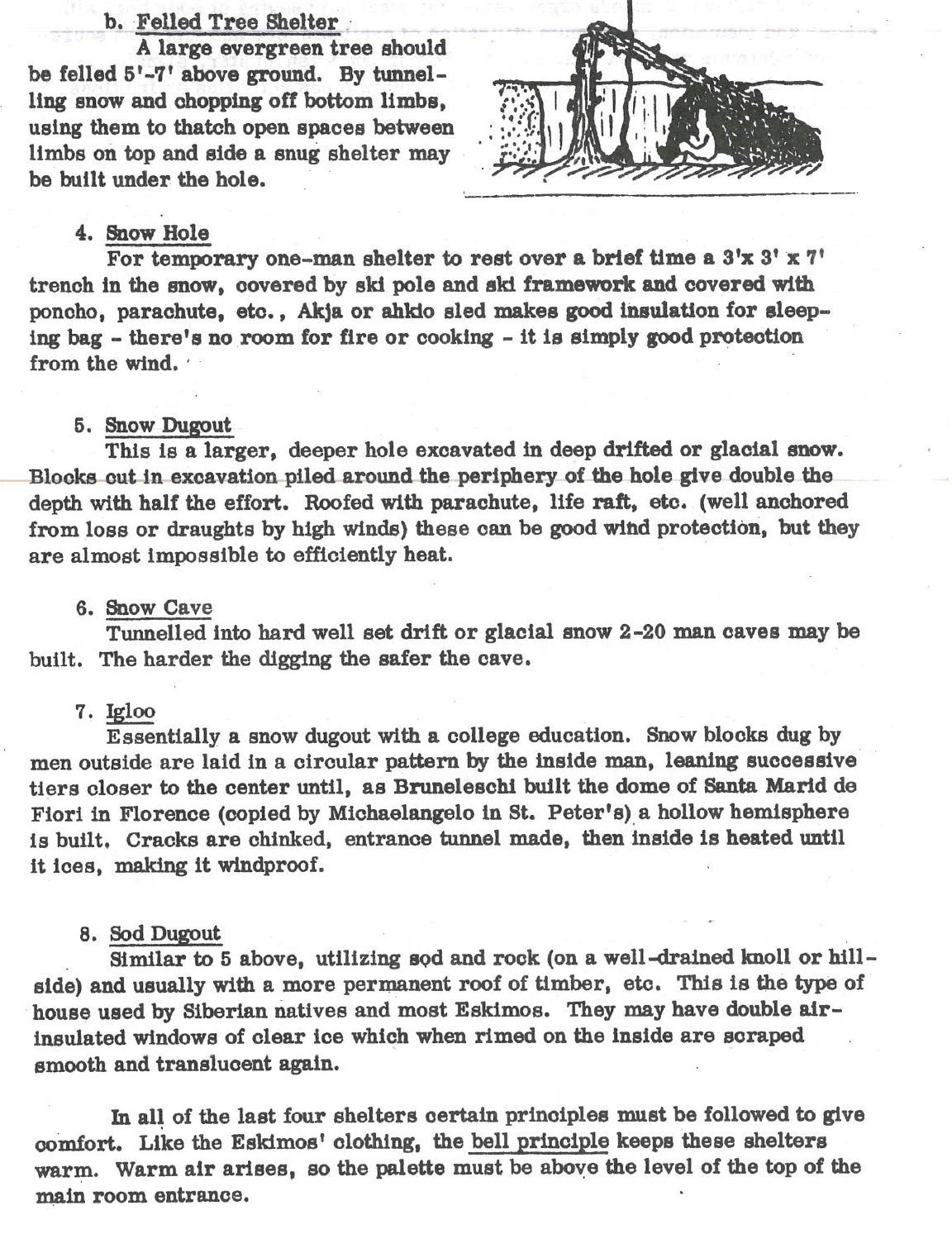
Survival tips from pages 116 to 119 and pages 129 to 130 of the 4th edition of the Polar Manual.

  
I hope that you continue to enjoy The Woodsman’s Journal Online and look for me on YouTube at Bandanaman Productions for other related videos, HERE.  Don’t forget to follow me on both The Woodsman’s Journal Online and subscribe to BandanaMan Productions on YouTube, and if you have questions, as always, feel free to leave a comment on either site.  I announce new articles on Facebook at Eric Reynolds, on Instagram at bandanamanaproductions, and on VK at Eric Reynolds, so watch for me.

That is all for now, and as always, until next time, Happy Trails!

Sources

Hedblom, Captain Earland E. MC, USN; Polar Manual, Fourth Edition, [National Naval Medical Center, Bethesda, MA, 1965], p. 37, https://ia800305.us.archive.org/33/items/PolarManual4thEd1965/Polar%20Manual%204th%20ed%20%281965%29.pdf, accessed 12/07/2019