Sunday, April 13, 2025

The Practical Swordsman’s Pocket Compendium, An Introduction, Part Two©


Author’s note -- I hope that you enjoy learning from this resource!  To help me to continue to provide valuable free content, please consider showing your appreciation by leaving a donation HERE.  Thank you and Happy Trails!


The roots of the Anglo-American military style of fencing grew out of two separate traditions: the broadsword traditions of the Scottish Highlands and the English style of post renaissance fencing.


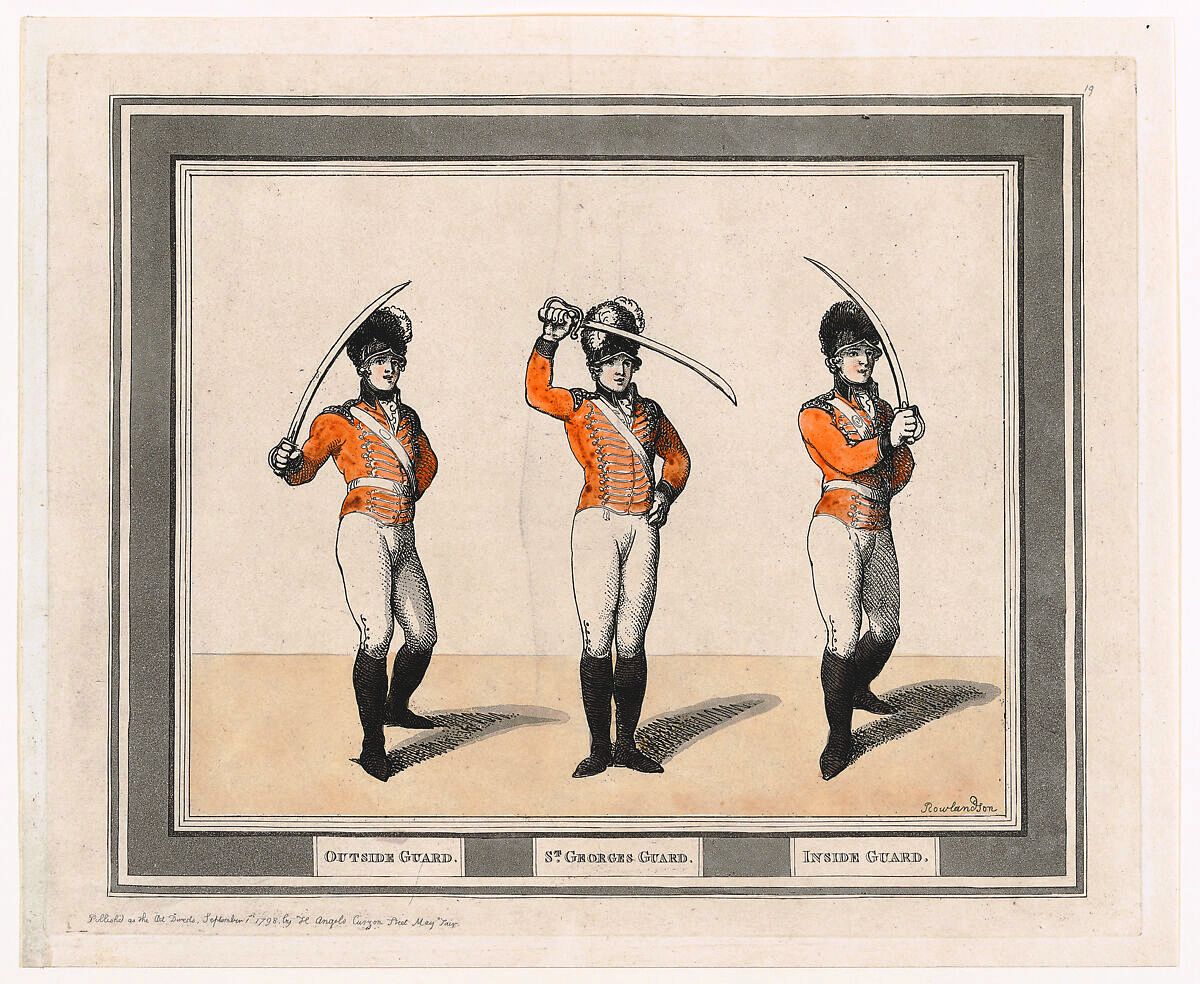
The English backsword method was built around the Medium, Inside, Outside, St. George’s and Hanging guards, as set out in English civilian manuals.


The Scottish traditions of sword-play, which were influential in the development of all later Anglo-American sword-play styles, were brought to the literary world with the publication of Anti-Pugilism or the science of defence exemplified in short and easy lessons for the practice of the Broadsword and Single Stick, (1790) by a ‘Highland Officer’, who has been identified as Captain G. Sinclair of the 42nd Blackwatch.


The Scottish broadsword systems departed from the English backsword method in three areas.  The three areas thought to be part of the Scottish Highlander’s broadsword tradition, are as follows:


The way in which the Medium guard is held.  Captain Sinclair taught that the Medium guard is to be held with the elbow bent and the point directed upwards at approximately a 45 degree angle.  When held in this fashion, the Medium guard is limited in its ability to defend and has little offensive capacity, it is simply “between the inside and the outside”.


This is contrasted with the way the earlier English sword masters had taught the Medium guard, or as they called it the ‘Unicorne guard’.  They taught that the Medium guard was to be held with the arm fully extended and with the point threatening your opponent.  In this manner the guard was used to keep your opponent at bay.


The second difference is the in the way that the Hanging Guard is held.  Captain Sinclair taught that the Hanging Guard is to be held on the Inside line, guarding the swordsman’s left side.  This manner of holding the Hanging Guard is similar to how George Silver taught that the ‘True Guardant’ was to be held.


English sword masters taught that the Hanging Guard should be held in an extended fashion, on the Outside line (the right side of a right handed fencer).  This manner of holding the Hanging Guard was later described as a ‘hanging guard in seconde’.  This was the guard that George Silver describes as the ‘Imperfect Guardant’.


The third difference is in the use of the Spadroon Guard, a guard that was designed to protect against a low cut or thrust, towards your left or inside, or the inside of your wrist.  This guard is similar to the later Half Circle Guard, it differs only in that the Spadroon Guard is held lower, with the blade held more horizontally.  This guard, makes use of the basket hilt, a hilt that is considered to have been developed in the Scottish Highlands, to make a single-time, thrust-with opposition attack.


If you enjoyed this introduction to sword fighting, look for the next chapter of The Practical Swordsman’s Pocket Compendium coming soon.


I hope that you enjoy learning from this resource!  To help me to continue to provide valuable free content, please consider showing your appreciation by leaving a donation HERE.  Thank you and Happy Trails!


I hope that you continue to enjoy The Woodsman’s Journal Online and look for me on YouTube at BandanaMan Productions for other related videos, HERE.  Don’t forget to follow me on both The Woodsman’s Journal Online, HERE, and subscribe to BandanaMan Productions on YouTube.  If you have questions, as always, feel free to leave a comment on either site.  I announce new articles on Facebook at Eric Reynolds, on Instagram at bandanamanaproductions, and on VK at Eric Reynolds, so watch for me.


That is all for now, and as always, until next time, Happy Trails!


Sources


Amberger, J. Christoph; Officers and Gentlemen: On the history of fencing at the U.S. Naval Academy, http://www.swordhistory.com/excerpts/corbesier.html, accessed March 7, 2005


Bertrand, J. Mark; Teach Yourself Swordsmanship (In a Lifetime of Easy Steps), Sword Forum, http://SwordForum.com, accessed March 7, 2005


Hagist, Don N.; “Donald McCraw of the 42nd Regiment Wields his Broadsword”, March 4, 2019, [Journal of the American Revolution © 2025], https://allthingsliberty.com/2019/03/donald-mccraw-of-the-42nd-regiment-wields-his-broadsword/, accessed April 12, 2025


Gross, Noah; The Walking Stick in Mandatory Palestine and Israel, by http//www.savateaustralia.com, accessed March 7, 2005


Mitchell, Russell; Reconstructing the Use of Medieval and Renaissance Hungarian Sabres, [SPADA, Vol 1, 2003]


O’Rourke, Matthew J.; A New System of Sword Exercise, with a Manual of the Sword for Officers, Mounted and Dismounted, [New York, George R. Lockwood, 1873]


Page, Thomas; The Use of the Broad Sword, [M. Chase, Norwich, 1746], https://archive.org/details/page-broad-sword, accessed April 12, 2025


Rowlandson, Thomas; “Outside Guard, St. Georges Guard, Inside Guard”, [Henry Angelo, Publisher, September 1, 1798], The Metropolitan Museum, https://www.metmuseum.org/art/collection/search/739542, accessed April 12, 2025


Rowlandson, Thomas; “Half Circle Guard, Medium Guard”, [Henry Angelo, Publisher, September 1, 1798], The Metropolitan Museum, https://www.metmuseum.org/art/collection/search/739522, accessed April 12, 2025


Rowlandson, Thomas; “The Guards of the Highland Broadsword as taught at Mr. H. Angelo's academy”, [Henry Angelo, Publisher, January 20, 1799], https://www.britishmuseum.org/collection/object/P_1856-0913-240, accessed April 12, 2025


Wagner, Paul and Rector, Mark, Highland Broadsword: Five manuals of Scottish Regimental Swordsmanship, [Chivalry Bookshelf, 2004], p 50


Wroughton, Captain Frederick; The Broad Swordsman's Pocket Companion, Volume 1, [Chigrey, London, 1830], https://books.google.com/books?id=YbFn6-NJV7IC&printsec=frontcover&source=gbs_ge_summary_r&cad=0#v=onepage&q&f=false, accessed April 12, 2025


Sunday, April 6, 2025

The Practical Swordsman’s Pocket Compendium, An Introduction, Part One©


Author’s note -- I hope that you enjoy learning from this resource!  To help me to continue to provide valuable free content, please consider showing your appreciation by leaving a donation HERE.  Thank you and Happy Trails!


The Art of Fencing, in a military sense, is undoubtedly of immense value; but I can further, with safety, say that it is also part of a good education.


Theory of Fencing, with the small sword exercise, by Antoine J. Corbesier, Washington D.D., Government Printing Office, 1873, preface


Obviously, the age of the sword as a serious military weapon, ended well before the First World War, so why would someone today, at the beginning of the 21st century, want to learn to use a sword in a historically accurate way?


  •        Perhaps you are a military re-enactor.
  •        Perhaps you want to learn a martial art that originated in your own culture.
  •       Perhaps because you realize the limitations of modern sport fencing.
  •        Perhaps you are interested in learning a practical method of self –defense.
  •        Perhaps you are looking for a good form of exercise and a little bit of fun.


“It’s a mystery why anyone would want to learn to use a sword properly.  After all, you will never fight a duel.  You will never be attacked in earnest by a skilled swordsman.”


Teach Yourself Swordsmanship (In a Lifetime of Easy Steps), by J. Mark Bertrand


This article is the first in a compilation of the teachings of the masters of the late 18th to early 20th centuries and is the introduction to The Practical Swordsman’s Compendium (yet unpublished).  This book is designed as a study guide for those interested in learning ‘historical swordsmanship’, specifically the system of fencing developed and taught from the late 18th century to the early part of the 20th century, by the Anglo-American military, for use with the broadsword and by extension, the saber, cut-and-thrust sword and cudgel or stick.


It is hoped that by combining the 162 years of teachings of various sword masters, from the 18th, 19th and 20th centuries, that The Practical Swordsman’s Compendium will be more complete, since during that time the system of swordplay evolved due to:


  •        Influences from the continental school of the ‘Art of Defense’,
  •        Broadswords, sabers, and cut-and-thrust swords becoming progressively lighter over time.


However, having said this, the core teachings of the Anglo-American military swordplay, stayed remarkably consistent throughout the 18th, 19th and 20th centuries.


“…systems have a history, a tradition, something scientific…”

The Walking Stick in Mandatory Palestine and Israel, by Noah Gross


The history of the Anglo-American military broadsword system is in many ways, the history of the Angelo School of Fencing.  Domenico Malevolto Angiolo Tremamando, who was more widely known as Domenico Angelo, the anglicized form of his name, was born in 1716, in Leghorn, Italy; and died, in 1802, at the age of 86 in England.  He was by avocation, primarily, a riding instructor.  However, he studied the small sword in Paris under Master Teillagory, from whom he learned the principles of the French School of the ‘Art of Defence’.


In 1755, he came to London and opened Angelo’s salle d’armes.  A key to his success was his ability to attract powerful and influential patrons at the English Court.   His patrons included the Earl of Pembroke and the Duke of Devonshire.  And in 1758, he was appointed by Agusta of Saxe-Gotha-Altenberg, the Dowager Princess of Wales, widow of Frederick Lewis, Prince of Wales, to be the fencing and riding master to her sons, George, Prince of Wales (who later in 1760, became King George III) and Edward, Duke of York.


Henry Angelo, Domenico’s son, who was better known as ‘Harry’, was born in 1756, and took over the school in 1780.  He was the fencing tutor for King Georges III’s sons, George, who was later King George IV, and Frederick, Prince Bishop of Osnabrück, who was later the Duke of York and Albany and Commander in Chief. 


In 1794 Harry Angelo took his second son, Henry, as a partner, Henry jr. was only fourteen years old at the time, having been born in 1780.


Harry Angelo and his son Henry developed their method of broadsword use during the years of the Napoleonic conflict.  While the Angelo’s were obviously influenced by John Gaspard Le Marchant’s, Rules and Regulations for the Sword Exercise of the Cavalry, 1796, it appears that the greatest influences on their method of broadsword use was the English style of backsword play and the Scottish Highland tradition of broadsword use.


Don’t forget to come back next week for the rest of “The Practical Swordsman’s Compendium, An Introduction, Part Two©”, where we will talk more about English style of backsword play and the Scottish Highland tradition of broadsword use.


I hope that you enjoy learning from this resource!  To help me to continue to provide valuable free content, please consider showing your appreciation by leaving a donation HERE.  Thank you and Happy Trails!


I hope that you continue to enjoy The Woodsman’s Journal Online and look for me on YouTube at BandanaMan Productions for other related videos, HERE.  Don’t forget to follow me on both The Woodsman’s Journal Online, HERE, and subscribe to BandanaMan Productions on YouTube.  If you have questions, as always, feel free to leave a comment on either site.  I announce new articles on Facebook at Eric Reynolds, on Instagram at bandanamanaproductions, and on VK at Eric Reynolds, so watch for me.


That is all for now, and as always, until next time, Happy Trails!


Sources


Amberger, J. Christoph; Officers and Gentlemen: On the history of fencing at the U.S. Naval Academy, http://www.swordhistory.com/excerpts/corbesier.html, accessed March 7, 2005


Bertrand, J. Mark; Teach Yourself Swordsmanship (In a Lifetime of Easy Steps), Sword Forum, http://SwordForum.com, accessed March 7, 2005


Gross, Noah; The Walking Stick in Mandatory Palestine and Israel, by http//www.savateaustralia.com, accessed March 7, 2005


Mitchell, Russell; Reconstructing the Use of Medieval and Renaissance Hungarian Sabres, [SPADA, Vol 1, 2003]


O’Rourke, Matthew J.; A New System of Sword Exercise, with a Manual of the Sword for Officers, Mounted and Dismounted, [New York, George R. Lockwood, 1873]


Wagner, Paul and Rector, Mark, Highland Broadsword: Five manuals of Scottish Regimental Swordsmanship, [Chivalry Bookshelf, 2004], p 50


Sunday, March 30, 2025

How to Choose a Campsite, Part Two©


Author’s note -- I hope that you enjoy learning from this resource!  To help me to continue to provide valuable free content, please consider showing your appreciation by leaving a donation HERE.  Thank you and Happy Trails!


I ran out of space (and time) to complete last weeks article, so here is the rest, and remember there is no such thing as a “perfect” campsite, but knowing the Five S’s will help you find a “good” campsite.  The next most important things to consider after safety and shelter are supply, space and slope.


Supply

You need a good supply of both water and wood, unless you are planning to use camp stoves, in which case you can skip the wood. 


The U.S. National Academies of Sciences, Engineering, and Medicine recommends a daily fluid intake of about 15.5 cups (3.7 liters or one gallon) of fluids per day for men, and about 11.5 cups (2.7 liters or ¾ of a gallon) of fluids a day for women.  This is just water for drinking, for cooking and washing you will need at least one gallon each.


Your campsite should always be located near a water source.  always collect your drinking and cooking water upstream” from your campsite.  Be careful where you collect water, remember to search upstream for at least 75 steps, 200 feet or 60 meters, above where you intend to collect water to make sure there is no garbage, dead animals, or anything else polluting the water.


Bear in mind the place for washing clothes and other water-related activities, such as watering animals, is always downstream of where your drinking water is gathered.


The average campfire burns approximately one cubic foot of wrist thick hardwood an hour, the same amount of soft wood, pine or fir, will burn twice as fast1.  This is a stack about half as high as your knee, since the average adult knee is about 20 inches, 51 cm, high, this is a pile 10 inches high, 16 inches long, and 10 inches wide  To keep a large crackling fire burning from evening to morning takes between ten and twenty cubic feet of wood, although a small campfire can be kept burning with just five to eight cubic feet of wood.  To maintain a single campfire for several hours or two shorter fires, you will need between four to five cubic feet of wood per day, and usually you will need one to two cubic feet of wood to cook a meal.


Space

 Remember, you just need to find a flat space large enough to hold your sleeping pad, or two, or four pads if you’re camping with a partner or partners.  If there enough level space for every tent or shelter, then it is a “good” campsite.


Slope


The ground where you decide to camp should be “level”, with a very gentle or gentle slope, otherwise you will be sliding downhill all night long in your sleep. 


To find out if the ground is mostly level, you can eye-ball it or, as Philip Werner from SectionHiker suggests HERE, you can use “The Bottle Level Method”.  Place a clear plastic water bottle, tipped on its side, on the ground you want to measure; the water bubble will tell you whether the surface is level or not. 


Flat ground can be tough to find, so if there is a slope, you can pitch or build your shelter either parallel with the slope or perpendicular to the slope, and which you choose may come down to a combination of personal preference, the steepness of the slope and what gear you have available.


The most common recommendation is to pitch your tent parallel to the slope, with your head and the entrance uphill.  This way:


·       You won’t wake up in the middle of the night with a headache.

·       Your entrance to the tent isn’t downhill so you and your gear won’t shoot out in the morning when you open the door.


Pitching your tent parallel to the slope is fine when it’s a gentle slope, however on steeper slopes, place your backpack and clothes under their feet down at the bottom of the tent to keep from sliding.  


The other option is to set up your tent so that the opening of the tent is perpendicular to the slope, and your head and feet are level, with one side lower than the other when you’re sleeping.  Unless it is only a gentle slope, you’ll need to pad the downhill side of your sleeping pad or camp mattress with your backpack or clothing to create a level surface. This way:


·       You won’t keep rolling onto your downhill side.


Now you know the Five S’s, it’s time to find a “good” campsite.


POP QUIZ!


So let’s put it all together...POP QUIZ TIME!


So what is the answer, A, B, C, or D, or some combination of them?


Did you get the correct answer?  I hope so.


Author’s note -- I hope that you enjoy learning from this resource!  To help me to continue to provide valuable free content, please consider showing your appreciation by leaving a donation HERE.  Thank you and Happy Trails!


Don’t forget to come back next week and read “Ten Essentials of Winter Camping ©”, where we will talk about how to camp in the winter wilderness and stay warm and safe.


I hope that you enjoy learning from this resource!  To help me to continue to provide valuable free content, please consider showing your appreciation by leaving a donation HERE.  Thank you and Happy Trails!


I hope that you continue to enjoy The Woodsman’s Journal Online and look for me on YouTube at BandanaMan Productions for other related videos, HERE.  Don’t forget to follow me on both The Woodsman’s Journal Online, HERE, and subscribe to BandanaMan Productions on YouTube.  If you have questions, as always, feel free to leave a comment on either site.  I announce new articles on Facebook at Eric Reynolds, on Instagram at bandanamanaproductions, and on VK at Eric Reynolds, so watch for me.


That is all for now, and as always, until next time, Happy Trails!


Sources


Anders, Mark; “12 Tips to Help You Sleep Well on the Trail”, ScoutLife, [© 2025, Boy Scouts of America], https://scoutlife.org/outdoors/outdoorarticles/12741/how-to-sleep-well-on-the-trail/, accessed March 29, 2025


Buck, Jordan; “How Much Firewood to Bring for Camping (With a cheat sheet!)”, [© 2025 Backfire LLC], https://backfire.tv/how-much-firewood-for-camping/#:~:text=The%20average%20campfire%20burns%20approximately,5%2D8%20bundles%20per%20day, accessed March 29, 2025


Clarke, Julia; “Stop the slide: 8 tips for camping on a slope”, Advnture, June 27, 2022, https://www.advnture.com/features/camping-slope, accessed March 29, 2025


Department of the Air Force; Air Force AFM 64-3 Survival Training Edition, pages 3-6 to 3-8, https://books.google.com/books?id=Ywad0WT1rO4C&pg=SA3-PA6&dq=picking+choosing+shelter+camp&hl=en&newbks=1&newbks_redir=0&sa=X&ved=2ahUKEwiF0byKjJSMAxULFlkFHSjvGCYQ6AF6BAgNEAM#v=onepage&q&f=false, accessed March 22, 2025


Green Bar Bill; Boys’ Life, November 1948, [The Boy Scouts Of America, New York, NY, 1948], page 18, https://books.google.com/books?id=np-xlH1i_zcC&pg=PA18&dq=The+old+formula+for+a+good+camp&hl=en&sa=X&ved=2ahUKEwi2k7CAv5yMAxXdD1kFHW2OBfQQ6AF6BAgEEAM#v=onepage&q=The%20old%20formula%20for%20a%20good%20camp&f=false, accessed March 21, 2025


National Avalanche Center; “Temperature Inversion”, [© 2017 – 2025 Avalanche.org], https://avalanche.org/avalanche-encyclopedia/weather/temperature-inversion/, accessed March 22, 2025


Seaton, Scott; “From Our Duffel Bag”, Boys’ Life, March 1952, page 42, https://books.google.com/books?id=STKNgoQa1hgC&pg=PA42&dq=%22four+s%27s+of+camp%22&hl=en&sa=X&ved=2ahUKEwj76OD01JyMAxVnFVkFHY4lFG0Q6AF6BAgGEAM#v=onepage&q=%22four%20s's%20of%20camp%22&f=false, accessed March 21, 2025

Shane, Herbert E.; “Beds and Bedding”, Hunter-Trader-Trapper, Vol. XLIX, No. 1, April 1923, page 72, https://books.google.com/books?id=vQ_OAAAAMAAJ&pg=PA72&dq=Tarp+as+a+shelter&hl=en&newbks=1&newbks_redir=0&sa=X&ved=2ahUKEwi-rb2CvZyMAxVSFmIAHbHBJw04ChDoAXoECAYQAw#v=onepage&q=Tarp%20as%20a%20shelter&f=false, accessed March 21, 2025


Unknown Author; “Housing in extreme survival conditions”, https://pochta-polevaya.ru/blogs/1288/312235.html, accessed March 22, 2025


Werner, Philip; “How to Find a Level Campsite: A Neat Little Trick”, May 9, 2023, SectionHiker, https://sectionhiker.com/how-to-find-a-level-campsite-a-neat-little-trick/, accessed March 29, 2025


World Health Organization; “Technical Notes on Drinking-Water, Sanitation and Hygiene in Emergencies”, https://cdn.who.int/media/docs/default-source/wash-documents/who-tn-09-how-much-water-is-needed.pdf, accessed March 29, 2025