This is the seventh in a series of eleven articles on
the top ten wilderness survival skills, things you should know before you go
into the wilderness. To read the
previous article go HERE
– Author’s Note
The Number
Seven, Top Ten Wilderness Survival Skill: Water

knowing how to find and disinfect water and much you need to keep from becoming dehydrated.
Remember,
in a wilderness survival situation, where to find water is a large topic and it
depends largely on whether you are in the forest, at the seashore, or on the
ocean. Before you enter the wilderness,
you should always make sure that you know how and where to find water in the
area that you are going to be in.
 |
The “Rule of Threes”, graphic by the Author.
After
a wilderness emergency, you can only survive for about three days without water,
so after caring for any injuries, finding shelter, and building a fire; your next
priority is to find and disinfect some water!
How much
water do I need?
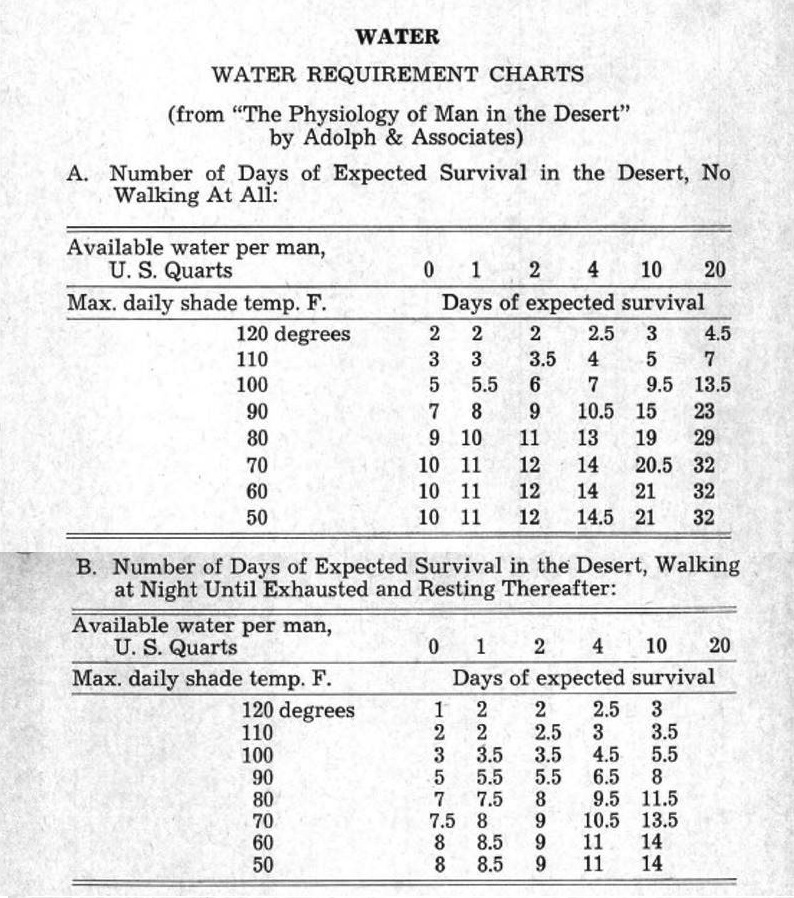 |
An excerpt from Desert Survival: Information For Anyone Traveling In The Desert Southwest, 1962, by Civil Defense Joint Council, pages 10 and 11.
A person’s daily water requirements depend on
the environment and whether it is hot, cold, temperate, humid, or dry. It also depends on their level and duration of
physical activity and exercise, their body size and gender, and whether they
are eating food.
Dehydration
 |
The Dehydration Clock, with the percentage of body weight loss and symptoms. Graphic by the Author.
Dehydration occurs when
your body loses more water from perspiration, respiration, and digestion than
it takes in1. All the
chemical activities in your body take place in a water solution and water plays
a vital role in maintaining your body’s temperature. To lose heat and to stay below the upper
threshold of human tolerance, you must sweat and when you sweat, you lose
water, and if you don’t replace this lost water, you will become
dehydrated.
Humans are mostly water,
about 60%, and since every drop in your body is needed, losses must be made up
by drinking fluids. If your water loss
is not made up, you will become dehydrated.
Interestingly, you don’t even begin to feel thirsty until you are more
1% dehydrated, which means that you have already lost about ¾ of a quart of
water! The good news is that dehydration
of less than 2% of your body weight, does you no harm and many people are
regularly this dehydrated. In fact, you
might be dehydrated right now, while you read this article, and not even know
it!
Many people regularly lose between 2% to 5% of their body weight
without any long-term effect, because they don’t drink any water between meals,
and only drink fluids when they eat. At
a loss 2.5% of body weight, which is almost 2
quarts or about 2 liters of body fluid, your work efficiency will decrease by
25%. When this happens, you
will only be able to walk ¾ as far and as fast, work only ¾ as hard and lift
just ¾ as much as you could if fully hydrated.
When you lose 10% of your body weight in water,
your ability to regulate your body temperature decreases by 30% to 40%. A loss of fluid equal to 15% of your body
weight is, unfortunately, usually fatal.
Most people think dehydration
only happens in hot areas, however it is just as easy to become dehydrated in
temperate, cold or high altitude regions.
Cold environments are less dehydrating than hot environments, since
75% of your body’s excess heat can be dissipated into the environment without
sweating. The average person in a cold
environment requires from two to six quarts or liters of
water daily, depending on their exercise level.
In temperate climates, depending on the season, you can release about
50% of your excess body heat into the environment without sweating. On average, in temperate zones, you will
require from two to five quarts or liters of water daily. In high altitude environments, because every
activity takes more energy due to the altitude and the bulky clothing you must
wear, and because the air is drier, you will need between four and five quarts or
liters of water each day. Hot and dry,
or hot and humid regions are the most dehydrating of all environments, as you
are unable to dissipate excess body heat into the environment without sweating. In these areas, you will need an average of three
to ten quarts or liters of water each day, and the harder or longer you work,
the more water you will need.
For
more about hydration and the wilderness, read “What is Dehydration and How Do
You Avoid It? ©”, HERE,
and “Desert Survival: Information For Anyone Traveling In
The Desert Southwest, 1962 ©”, HERE.
Disinfecting
water?
Before
you drink that first big gulp of life-giving water, you should disinfect it
first, whenever possible2. Many
times, modern people, living in developed countries, take pure, disinfected
water for granted. But once you venture
away from modern municipal water supplies, or if there is a disaster and these modern
systems are offline, you will have to find pure water or disinfect the water
yourself to kill all the dangerous bacteria, viruses, protozoa, and parasites
living in it, before you can drink it or cook with it.
 |
An excerpt from the Field Artillery Manual, 1928, page XXX, 6-7
Today,
boiling is still considered the most effective means of disinfecting
your drinking water, provided you have the means and the fuel to build a
fire. The Field Artillery Manual,
1928, suggested that you boil your water for five minutes to ensure that your
water is disinfected. However, today the
United States CDC recommends heating water to a rolling boil for one minute,
and for an additional three minutes at elevations above 2,000 meters (6,562
feet), to ensure that the water has remained hot enough, for long enough, to
destroy any dangerous pathogens.
Similarly, the National Wilderness Conference advocates bringing water
to a rolling boil for one minute at sea level and boiling it for an additional
one minute for every 1,000 feet (305 meters) above sea level, to ensure that
dangerous pathogens are destroyed.
For
more information read “Water Disinfection: When is
boiled, boiled enough…? ©”, HERE.
Now,
the biggest complaint about boiling as a method of water disinfection is, what
are you going to do with all that hot boiled water? You are thirsty and
want a drink now, so what should you do?
Why,
put a tea bag in it and drink it down of course!
 |
A cup of tea, photo by the author.
Did
you know that you can stay hydrated by drinking tea, and to a lesser extent
coffee? Well, according to the latest
studies you can!
For
more information on this read, “Drinking Black Tea to Stay Hydrated...Say
What?! ©”, HERE.
And don’t
forget to sleep!
 |
Make sure you get some rest, photograph by the Author.
Just
as, on average, you can’t live longer than three days without water, you can’t
live more than three days without sleep.
According
to current studies, going without sleep affects your body in the same way as
drinking alcohol does. Even moderate
sleep deprivation impairs your alertness, your memory, and your motor
performance and precision. In fact,
after only 17 to 19 hours without sleep, you will perform as if your blood
alcohol concentration (BAC) is 0.08%, which is considered impaired by US
law. As a comparison, for the average
sized American woman, this would mean drinking three standard drinks in an
hour, and for the average sized American man, it would take drinking four
standard drinks in an hour, to reach a BAC of 0.08%3.
Now,
many people go without sleeping for 24 hours, it isn’t that uncommon. However, not sleeping for more than 24 hours
will affect you in the same way as if your blood alcohol concentration was at
0.10%, this is the equivalent of four or five standard alcoholic drinks,
depending on your size and weight. And
the effects of not sleeping get progressively worse after 24 hours. In fact, the effects of going without sleep
for more than 24 hours include, drowsiness, irritability, impaired
decision-making and judgement, impaired hearing, and vision, decreased hand-eye
coordination, increased muscle tension and tremors. In addition, you might begin to experience
altered perceptions or hallucinations and memory deficits.
In
a wilderness survival situation, would you drink until you were drunk? No, of course not! But if you don’t sleep, that is exactly what
you are doing. And hallucinating and
seeing things that aren’t there can seriously impact your chances of surviving
a wilderness emergency, so work smarter not harder, and when you can rest,
REST! If all your immediate survival
needs are met, take a nap, sleep!
Sleeping will lower your metabolism, helping you to conserve vital and
scarce energy, it will decrease you level of fatigue, it will help you to think
more clearly and control fear, and it will increase your task efficiency when
you are performing critical survival chores.
For
more on sleeping and survival, read “When it Comes to Survival, Get Some Rest!
©”, HERE.
While we
are talking about water, let’s talk about food...
 |
For a great article about the effects of going for a week without food in the wilderness, read “Food not necessary for survival”, by Robert C. Gibson, HERE.
Digestion
requires water, so if your water is limited don’t eat, because digesting food
or alcohol requires water and if you don’t have water to drink, it will only
make you more dehydrated.
So,
if you are short on water, don’t eat!
Remember, you can live for about three weeks without eating, and
statistically speaking, most times when you are “misplaced”, searchers
will find you within 72 hours.
For
more on the 72-Hour Rule, read “Should I Stay, or Should I Go, and the 72-Hour
Rule©”, HERE.
Don’t forget to come back next week and read “Posting
a Christmas Letter Like Old Ebenezer Scrooge ©”, where we will talk about posting
letters in the later 18th and early 19th centuries and
how to fold them to make an envelope.

I
hope that you continue to enjoy The Woodsman’s Journal Online and look for me
on YouTube at Bandanaman Productions for other related videos, HERE. Don’t forget to follow me on both The
Woodsman’s Journal Online, HERE,
and subscribe to BandanaMan Productions on YouTube. If you have questions, as always, feel free
to leave a comment on either site. I
announce new articles on Facebook at Eric Reynolds, on Instagram at
bandanamanaproductions, and on VK at Eric Reynolds, so watch for me.
That
is all for now, and as always, until next time, Happy Trails!
Notes
1 Your
body constantly loses water through body processes that remove toxic body
wastes, processes such as breathing, urinating, and defecating. Other factors, such as heat or cold exposure,
exercise, high altitude activity, burns, or illness, all can cause your body to
lose water. Additionally, your body
requires water to maintain the normal human body temperature of 98.6o F
or 37oC and staying at this temperature is critical. Exceeding either the upper or the lower
limits of human temperature tolerance by just a few degrees reduces your
efficiency and puts you in danger of starting done a slippery, and often fatal slope. The body temperature of an otherwise healthy
person can be raised by absorbing too much heat from the air, if the air is
above 92oF or 33oC, from direct sunlight, from radiant
heat from the ground, from a sun-warmed object or a fire, or by generating body
heat from exercise.
2
“A doctor can fix giardia, but he can’t fix dead”, or “doctors can
cure a lot of things, but they can’t cure dead” is a survival refrain that
Peter Kummerfeldt teaches, and I have echoed since I first heard it in
2005. When worst comes to worst, and you
are facing dehydration, drinking actually or potentially infected water is
better than not drinking any water at all.
This
might seem like common sense, however as my daughter says, “what is common
sense to one person, isn’t common sense to another; common sense only exists in
the context of your environment”, she is so smart! As an example of this, in the 1990’s two
hikers in the Grand Canyon, ran out of water and didn’t want to refill their
water bottles at a late season creek-bed pothole, which was teeming with
tadpoles and other life: one of the hikers later died of dehydration and the
other barely survived.
Peter
Kummerfeldt is a 71-year-old survival expert who graduated from the Air Force
Survival Instructor Training School and later was an instructor at the Basic
Survival School, in Spokane, Washington, in the Arctic Survival School,
in Fairbanks, Alaska, and the Jungle Survival School, in the Republic of
the Philippines. Also, Peter was the Survival
Training Director for the United States Air Force Academy, Colorado Springs,
for twelve years (from Peter Kummerfeldt’s biography at “OutdoorSafe with Peter
Kummerfeldt”, found HERE)
“Canyon Missteps,
Lesson: Respect For Danger” Popular Mechanics, Volume 182, Number 8, August
2005, page 67,
3
In the United States, the term “standard drink” refers to a drink which
contains enough alcohol to raise an average person’s Blood Alcohol
Concentration (BAC) by between 0.02% and 0.025%. One standard drink is considered to be one 12
fluid ounce (355 ml) of 5% alcohol by volume (ABV) beer, or one 5 fluid ounce
(148 ml) of 12% ABV wine, or one 1.5 fluid ounce (44 ml) of 40% ABV (80 proof)
shot of hard liquor. So, two standard
drinks will raise your blood alcohol concentration to about 0.05%, three
standard drinks will raise your BAC to about 0.08%, and four standard drinks
will equal 0.10% BAC, without taking size differences into consideration. The general rule of thumb is, for an average
sized American woman it will take drinking three standard drinks per hour, and for
an average sized American man, four standard drinks per hour, to reach a BAC of
0.08%.
Editorial Staff, “How Many Drinks Does it Take
to Reach a .08 BAC?”
Patrick T. Barone, “How Many Drinks Does it
Take to Get to a .05 Legal Limit?”,
Sources
Barone, Patrick T.; “How Many Drinks Does it
Take to Get to a .05 Legal Limit?”, May 8, 2018 [BaroneDefenseFirm.com, 2020], https://baronedefensefirm.com/blog/how-many-drinks-does-it-take-to-get-to-a-05-legal-limit/, accessed February 29, 2020
Civil
Defense Joint Council, Desert Survival: Information For Anyone Traveling In
The Desert Southwest, 1962 (Maricopa
County; Phoenix, Arizona [1962]) reprinted in http://docs.azgs.az.gov/SpecColl/1988-01/1988-01-0026.pdf, p. 5-20
Editorial Staff, “How
Many Drinks Does it Take to Reach a .08 BAC?”, June 13, 2014, [Ignition Interlock Help, 2018] https://www.ignitioninterlockhelp.com/blog/many-drinks-take-reach-08-bac/, February 29, 2020
Gibson, Robert C.; “Food not necessary for survival”,
Lewiston Morning Tribune, Jul 12, 1977, [Lewiston, Idaho – Clarkston,
Washington], page 4-B
https://books.google.com/books?id=nJxfAAAAIBAJ&pg=PA16&dq=wilderness+survival&article_id=5524,3212411&hl=en&sa=X&ved=2ahUKEwje4Nz45c_0AhWZkokEHQohBgk4RhDoAXoECAgQAg#v=onepage&q=wilderness%20survival&f=false, accessed December 7, 2021
Scott
J. Montain, PhD, and Matthew Ely, MS Water Requirements and Soldier Hydration,
(Borden Institute, Walter Reed Army Medical Center, Washington, DC) http://www.usariem.army.mil/assets/docs/publications/articles/2010/HydrationPDF.pdf,
accessed March 26, 2018
Carrie
H. Ruxton and Valerie A. Hart, “Black Tea is not significantly different from
water in the maintenance of normal hydration in human subjects”, [British
Journal of Nutrition, 2011], page 1 to 8, https://www.teaadvisorypanel.com/assets/uploads/files/news/a9faf-bjn-tea-hydration.pdf,
accessed October19, 2018
Katherine
Zeratsky, R.D., L.D., “I've been seeing ads that say caffeinated drinks hydrate
you as well as water does. Is this true?”, from https://www.mayoclinic.org/healthy-lifestyle/nutrition-and-healthy-eating/expert-answers/caffeinated-drinks/faq-20057965,
accessed October19, 2018


