Sunday, March 23, 2025

How to Choose a Campsite, Part One©


Author’s note -- I hope that you enjoy learning from this resource!  To help me to continue to provide valuable free content, please consider showing your appreciation by leaving a donation HERE.  Thank you and Happy Trails!


There is no such thing as a “perfect” campsite, but all “good” onea will share few simple qualities.  You can call it the “Shelter-Water-Wood Formula” or the “Five W’s”, but I prefer the “Five S’s”.


But First...


Setting up a camp, whether it is pitching a tent or building a survival shelter takes time; start at least two hours before dark, eight fingers, since daylight will help you look for the “Five S’s”.


Five S’s


Before you decide on a campsite, think about the things that make a campsite a “good” campsite: Safety, being the most important, followed by Shelter, Supply, Space, and Slope, in that order.


Safety


First and foremost a camp site must be safe!  That means there are no “widow makers”, leaning trees, dead standing trees or live trees with dead limbs, just waiting to fall on your camping spot.  In mountain country, stay away from avalanche zones, either of snow or stone.  And don’t pick a spot by that babbling brook or sweetly flowing river, because if rains upstream, it will flood downstream, and your campsite and you might get washed away!  If you do camp near a brook, camp on the outside bend where the bank is higher, rather than on the inside bend where the bank is low.  Also, check to make sure that your campsite isn’t already occupied by ants, bees, stinging insects, snakes, etc.  Don’t camp on trails, whether game trails or people trails, it is no fun to have bears, moose, or people traipsing through your camp at night.  Pick a spot where you can safety hang a bear bag in a tree at least 10 feet, 3 meters, high and 3 feet or 1 meter away from the trunk – NEVER keep any “smellables” or food in your shelter at night.


·       Camp about 75 steps, 200 feet or 60 meters, away from the water’s edge

·       Camp about 75 steps, 200 feet or 60 meters, from trails

·       Hang your bear bag about 75 steps, 200 feet or 60 meters, away from your camp site – DOWNWIND from your camp site.


Shelter

The winds you must worry about are the prevailing winds, and mountain and valley breezes.


Prevailing winds which in the mid-latitudes, between 35° and 65°, blow from the southwest to the northeast in the Northern Hemisphere and from the northwest to the southeast in the Southern Hemisphere.  In the north tropics (north of the equator) the winds blow northeast to southwest and in the southern tropics (south of the equator) they blow southeast to northwest. 


Mountain and valley breezes are winds caused by the daily heating and cooling of the ground.  At night, the higher elevations cool first and the colder dense air flows downhill and downstream into valleys and collects there, filling the valley bottom with cold air.  This is known as “cold air drainage” or “temperature inversions” and can create a fog.  Fog such as this is most commonly seen in the autumn and spring months and is thickest around sunrise when surface temperatures are at their lowest.  Where temperature inversions occur most often, you will find cold-adapted species like spruce (Picea spp.) and balsam fir (Abies balsamea) at lower elevations, and warm-adapted broadleaf species, such as sugar maple (Acer saccharum), red maple (Acer rubrum), and American beech (Fagus grandifolia) at the higher elevations.


If you can, pitch your tent with the rear or if the wind is strong one of the rear corners perpendicular to the wind.  This means the door of the tent will be in leeward (downwind).
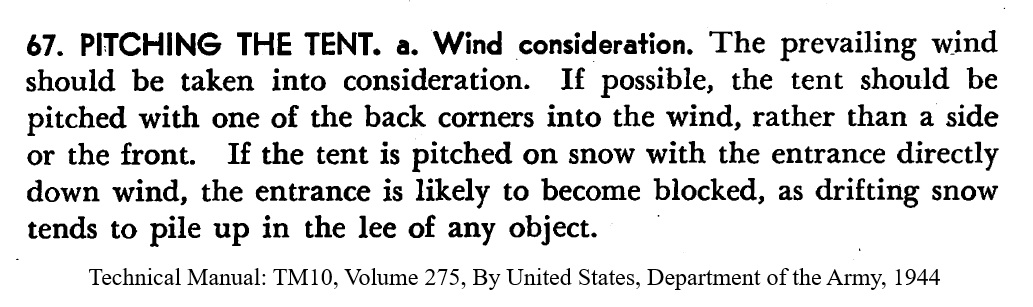


·       Don’t camp in a valley bottom, because cold night air settles there, or on a hilltop because of storms, lightning and wind, but on a flat bench halfway up the valley wall.

·       Do set the front of your shelter to the lee (downwind) of the prevailing or nighttime winds.  This prevents mosquitoes from being blown into your shelter.


Don’t forget to come back next week and read “How to Choose a Campsite, Part Two©”, where we will talk about the last three S’s -- Space, Supply, and Slope.


I hope that you enjoy learning from this resource!  To help me to continue to provide valuable free content, please consider showing your appreciation by leaving a donation HERE.  Thank you and Happy Trails!


I hope that you continue to enjoy The Woodsman’s Journal Online and look for me on YouTube at BandanaMan Productions for other related videos, HERE.  Don’t forget to follow me on both The Woodsman’s Journal Online, HERE, and subscribe to BandanaMan Productions on YouTube.  If you have questions, as always, feel free to leave a comment on either site.  I announce new articles on Facebook at Eric Reynolds, on Instagram at bandanamanaproductions, and on VK at Eric Reynolds, so watch for me.


That is all for now, and as always, until next time, Happy Trails!


Sources


Department of the Air Force; Air Force AFM 64-3 Survival Training Edition, pages 3-6 to 3-8, https://books.google.com/books?id=Ywad0WT1rO4C&pg=SA3-PA6&dq=picking+choosing+shelter+camp&hl=en&newbks=1&newbks_redir=0&sa=X&ved=2ahUKEwiF0byKjJSMAxULFlkFHSjvGCYQ6AF6BAgNEAM#v=onepage&q&f=false, accessed March 22, 2025


Green Bar Bill; Boys’ Life, November 1948, [The Boy Scouts Of America, New York, NY, 1948], page 18, https://books.google.com/books?id=np-xlH1i_zcC&pg=PA18&dq=The+old+formula+for+a+good+camp&hl=en&sa=X&ved=2ahUKEwi2k7CAv5yMAxXdD1kFHW2OBfQQ6AF6BAgEEAM#v=onepage&q=The%20old%20formula%20for%20a%20good%20camp&f=false, accessed March 21, 2025


National Avalanche Center; “Temperature Inversion”, [© 2017 – 2025 Avalanche.org], https://avalanche.org/avalanche-encyclopedia/weather/temperature-inversion/, accessed March 22, 2025


Seaton, Scott; “From Our Duffel Bag”, Boys’ Life, March 1952, page 42, https://books.google.com/books?id=STKNgoQa1hgC&pg=PA42&dq=%22four+s%27s+of+camp%22&hl=en&sa=X&ved=2ahUKEwj76OD01JyMAxVnFVkFHY4lFG0Q6AF6BAgGEAM#v=onepage&q=%22four%20s's%20of%20camp%22&f=false, accessed March 21, 2025


Shane, Herbert E.; “Beds and Bedding”, Hunter-Trader-Trapper, Vol. XLIX, No. 1, April 1923, page 72, https://books.google.com/books?id=vQ_OAAAAMAAJ&pg=PA72&dq=Tarp+as+a+shelter&hl=en&newbks=1&newbks_redir=0&sa=X&ved=2ahUKEwi-rb2CvZyMAxVSFmIAHbHBJw04ChDoAXoECAYQAw#v=onepage&q=Tarp%20as%20a%20shelter&f=false, accessed March 21, 2025


Author Unknown; “Housing in extreme survival conditions”, https://pochta-polevaya.ru/blogs/1288/312235.html, accessed March 22, 2025

Sunday, March 16, 2025

May the Sun Shine Warm on Your Face©


Author’s note -- I hope that you enjoy learning from this resource!  To help me to continue to provide valuable free content, please consider showing your appreciation by leaving a donation HERE.  Thank you and Happy Trails!


It’s almost St. Patrick’s Day and may the Sun shine warm upon your face … so that you know what direction you’re facing!


Directions from the Sun


Everywhere in the world the Sun rises in the east and in the evening, it sets in the west.  On the winter solstice (December 21st), it rises at 23° 27′ south of east and on the summer solstice it rises at 23° 27′ north of east (June 21st); only rising due east and setting due west on the spring (March 21st) and autumn equinoxes (September 23rd). 


You can find your direction from the Sun’s position at any time of the day, besides just in the early morning and early evening.


The position of the Sun in the sky can be used for orientation if you know the general time of day.  In the morning, the Sun rises roughly in the east (due east only on the equinoxes) and tracks southward in the northern hemisphere, or northward in the southern hemisphere, before setting in the west (again due west only on the equinoxes).  At noon, when you face the Sun, you are looking either south or north depending on whether you are above or below the Equator. 


When the Sun has reached its highest point in the sky,  at solar noon, and it is directly overhead, it is at its zenith.  In the North Temperate Zones, anywhere between the Arctic Circle at 66° 33′ N and the Tropic of Cancer at 23° 27′ N, the path of the Sun is south of the zenith in the winter and almost overhead during the summer.  At solar noon, during the winter if you face the Sun, you face south.


In the South Temperate Zone, between the Tropic of Capricorn at 23° 27′ S and the Antarctic Circle at 66° 33′ S, the situation is reversed, with the path of the Sun is north of the zenith in the winter and almost overhead during the summer.  At solar noon, during the winter if you are facing the Sun, you are facing north.


And in the tropics, the Torrid Zone, the noon Sun will either east or west of you, or directly overhead, depending on the season and the date.


And now for the rest of the prayer.


Happy St. Patrick’s Day!


Don’t forget to come back next week and read “Ten Essentials of Winter Camping ©”, where we will talk about how to camp in the winter wilderness and stay warm and safe.


I hope that you enjoy learning from this resource!  To help me to continue to provide valuable free content, please consider showing your appreciation by leaving a donation HERE.  Thank you and Happy Trails!


I hope that you continue to enjoy The Woodsman’s Journal Online and look for me on YouTube at BandanaMan Productions for other related videos, HERE.  Don’t forget to follow me on both The Woodsman’s Journal Online, HERE, and subscribe to BandanaMan Productions on YouTube.  If you have questions, as always, feel free to leave a comment on either site.  I announce new articles on Facebook at Eric Reynolds, on Instagram at bandanamanaproductions, and on VK at Eric Reynolds, so watch for me.


That is all for now, and as always, until next time, Happy Trails!


Sources


Buzzacott, Francis Henry; The Complete American and Canadian Sportsman's Encyclopedia of Valuable Instruction, [The American and Canadian Sportsman’s Assn., Chicago IL, 1905], https://books.google.com/books?id=mFcCAAAAYAAJ&printsec=frontcover&dq=The+Complete+American+and+Canadian&hl=en&newbks=1&newbks_redir=0&sa=X&ved=2ahUKEwjEp-_Vt4OMAxX6MlkFHdGlDswQ6AF6BAgJEAM#v=onepage&q=The%20Complete%20American%20and%20Canadian&f=false, accessed March 11, 2025


Gibson, J.; Soldiers’ Own Note Book and Diary For 1918, [Charles Letts & Co., London, 1918], page 30, http://heritage.christchurchcitylibraries.com/Archives/OSullivan/Clutterbuck/Diary/PDF/0050.pdf, accessed March 13, 2025


Oelslager, Dr. R. W., Bushcraft, Scoutcraft & Woodlore, Vol. II, Figure 186, [privately published] page 210 to 211, this volume can be found HERE.


Tarr, Ralph Stockman; New Geographies: First book, Book 1, Part 2, [The Macmillan Company, New York 1913], page 91 to 92, https://books.google.com/books?id=5VMAAAAAYAAJ&pg=PA92&dq=winter,+the+sun+will+be+south+of+you&hl=en&newbks=1&newbks_redir=0&sa=X&ved=2ahUKEwi7vPqxoYyMAxWgrokEHfbgN0IQ6AF6BAgIEAM#v=onepage&q=winter%2C%20the%20sun%20will%20be%20south%20of%20you&f=false, accessed March 15, 2025


United States, Department of the Air Force; Survival AFM 64-65, August 15, 1969, [U.S. Government Printing Office, Washington DC], page 2-87, https://books.google.com/books?id=RX24AAAAIAAJ&pg=SA2-PA87&dq=%22Figure+2-56%22+equinoxes&hl=en&newbks=1&newbks_redir=0&sa=X&ved=2ahUKEwjC08jb0ImMAxXypokEHauYKp4Q6AF6BAgFEAM#v=onepage&q=%22Figure%202-56%22%20equinoxes&f=false, accessed March 14, 2025

Sunday, March 9, 2025

Hershey’s Tropical Chocolate Bar, Part Trois Chocolat, The Monster Lives!©


For More on Tropical Chocolate Bars click HERE for “Hershey’s Tropical Chocolate Bar, Part Deux, It’s Alive, Bwahahaa!©” and HERE for “Hershey’s Tropical Chocolate Bar, Part Deux, The Taste Test!©”


Author’s note -- I hope that you enjoy learning from this resource!  To help me to continue to provide valuable free content, please consider showing your appreciation by leaving a donation HERE.  Thank you and Happy Trails!


The cocoa butter finally came in, so I tried to mix the ever elusive Tropical Chocolate Bar.  It wasn’t a total failure, but it certainly wasn’t the success I hoped for.  


But I believe I know where I went wrong.  It wasn’t as dry as my first attempt, it could be molded, but it still wasn’t the wonderful chocolate bar I remembered from the 1970’s.  It did make a great cake of ready to drink hot chocolate, just add water, though.  It had a café mocha flavor and was quite good.


Oh well, I believe that where I went wrong was in the conversion of parts to grams to teaspoons (tsp), I screwed up the math, so back to the drawing board. 


Now, it is time for the final mixing and then the torture test...I mean the temperature test...bwahaha!


The laboratory is now set up, so let’s make a Tropical Chocolate Bar, bwahahaha!


·       8 squares (60 grams) of Bakers Unsweetened Baking Chocolate

·       6 tablespoons (46 grams) of powdered sugar

·       1 tablespoon (18 grams) of nonfat dry milk powder

·       1 teaspoon (8 grams) of cocoa butter (8 grams)

·       a smidgen, no more than 1/32 teaspoon (less than ½ gram) of ethyl vanilla


To melt the Bakers Unsweetened Baking Chocolate, use either a microwave or a double-boiler on a stove.

Microwave the chocolate in 30-second intervals, stirring between each, until the chocolate is mostly melted and only a few tiny pieces remain, about 1 1/2 minutes in total.


I used a double boiler for this test and found that it allowed me to keep the chocolate warm long enough to mix the dry ingredients thoroughly.


Mix in the remaining ingredients until it is a fudge like consistency and comes cleanly off the bottom of the pan and then press the chocolate into a mold with a rubber spatula or an icing spatula .  If the mix appears to be too liquid, add another ½ teaspoon of nonfat dry milk powder.


Let cool, remove from the mold and enjoy.  The mold I used made three bars, so each bar weighs 1.3 ounces (38 grams).


Now, to find out if the chocolate bar will survive an hour at 120o F (49o C).  To do this I used an Elite Gourmet food dehydrator, and a candy thermometer.


After an hour at 120o F (49o C), the chocolate bar must survive a dent test with a dropped ball bearing, to be a true Tropical Chocolate Bar.  I dropped a one ounce (28 gram) ball bearing from 4 inches (10 cm) and the chocolate bar barely dented, although it was sticky and soft.


I had two chocolate lovers try it and they both asked for more, enjoying both the taste and the mouth feel.  So, it’s alive!  Bwahaha!


I originally scanted the ingredients by rounding down the number of teaspoons of powdered sugar and nonfat dry milk powder, so the next time I make this recipe, I plan on adding ¾ of teaspoon (4 grams) more of nonfat dry milk powder to see if it withstands the temperature test even better than this batch, since there is some room to spare in the recipe1.  Good luck and I hope you enjoy the chocolate!


I hope that you enjoy learning from this resource!  To help me to continue to provide valuable free content, please consider showing your appreciation by leaving a donation HERE.  Thank you and Happy Trails!


I hope that you continue to enjoy The Woodsman’s Journal Online and look for me on YouTube at BandanaMan Productions for other related videos, HERE.  Don’t forget to follow me on both The Woodsman’s Journal Online, HERE, and subscribe to BandanaMan Productions on YouTube.  If you have questions, as always, feel free to leave a comment on either site.  I announce new articles on Facebook at Eric Reynolds, on Instagram at bandanamanaproductions, and on VK at Eric Reynolds, so watch for me.


That is all for now, and as always, until next time, Happy Trails!


Sunday, March 2, 2025

Behind The Eight Ball©


Author’s note -- I hope that you enjoy learning from this resource!  To help me to continue to provide valuable free content, please consider showing your appreciation by leaving a donation HERE.  Thank you and Happy Trails!


So, over the last eight days I’ve worked over 75 hours, this deadline (see last week’s note) is kicking my ass!  I just didn’t have the time to write anything worth sharing with you this week, so I thought I would list my Top 8 Articles of All Time, in case you have missed any of them.


HERE

HERE

HERE

HERE

HERE

HERE

HERE

HERE


Hopefully, I will be back to you next week with a new article and until then I hope that you enjoy learning from this resource!  To help me to continue to provide valuable free content, please consider showing your appreciation by leaving a donation HERE.  Thank you and Happy Trails!


I hope that you continue to enjoy The Woodsman’s Journal Online and look for me on YouTube at BandanaMan Productions for other related videos, HERE.  Don’t forget to follow me on both The Woodsman’s Journal Online, HERE, and subscribe to BandanaMan Productions on YouTube.  If you have questions, as always, feel free to leave a comment on either site.  I announce new articles on Facebook at Eric Reynolds, on Instagram at bandanamanaproductions, and on VK at Eric Reynolds, so watch for me.


That is all for now, and as always, until next time, Happy Trails!


Sources


Wikimedia; “A little fun on a Friday night”, by Will Folsom, October 29, 2010, https://commons.wikimedia.org/wiki/File:The_Elusive_Eight_(5127727938).jpg, accessed February 28, 2025