Sunday, September 10, 2023

“OK I'm lost, and I'm having an Unexpected Overnighter©”


For more on this adventure look for the future videos on my YouTube Channel, at BandanaMan Productions, HERE -- Author’s Note


So last weekend I got lost, I prefer the word “misplaced”, personally ... and I did it on purpose!  I had an on-purpose, unexpected overnighter, unplanned adventure, and spent the night alone in the middle of the Allegheny National Forest.  This way, I could create some videos to demonstrate what you should and shouldn’t do. 


The “Leave a trip plan with a responsible person and a note in your car at the trail head”, and “always have a buddy” rules are all part of the “it CAN’T happen to ME” rule.  They are good rules to always follow, however unfortunately, they are often forgotten or ignored by hunters and hikers, and all too often this leads to tragedies.  The unexpected CAN happen to YOU, so be prepared, leave a note, and take a buddy with you, because Mother Nature dislikes the unprepared and her reminders to follow the rules are often killers! 


To get lost on purpose, I had to bend the “it CAN’T happen to ME” and the “Leave a trip plan with a responsible person and a note in your car at the trail head” rules, and I completely broke the always have a buddy rule!


I couldn’t really break the “it CAN’T happen to ME” rule, because obviously, I was planning on having it happen to me!  However, even with all my experience and training, I must admit that I was a little nervous, because anything completely unexpected, like a fall, a medical emergency, sudden bad weather, COULD happen.  I figured a little nervousness was a good thing, because it would keep me on my toes. 


I only bent the “Leave a trip plan with a responsible person and leave a note in your car at the trail head” a little, since even though I didn’t leave a note in my car, I did tell my basecamp crew roughly where I was going and when I would be back.  However, other than that I was on my own as I walked off into the wilderness without a buddy. 


I was lucky because I picked a good weather weekend to get “misplaced” on, it was warm, almost hot during the day, but because the sky was clear it got cold at night.  The temperature in the valley bottom when I left was below 50o F (10o C), so I wore a fleece jacket as I walked out of camp, carrying my camera gear and my “Oh, Shit Kit!”1 in a pack, and a ferrocerium striker, a pocketknife, a quart bottle of water, and my “minimum item survival kit”2 in my vest. 


I waited till it was about was about two hours from local sunset (the time when the sun sets behind the local trees and hills) and then pretended to myself that I didn’t know my way back to camp (I did) and that there wasn’t time to get back before dark (there wasn’t).  I was on the summit of the 1,700 foot (518 meter) high ridge overlooking two valleys, and I decided that because of the lack of available firewood, water, and shelter, I needed to find a better spot to spend the night.


I left some signals pointing in the direction I was headed in and started downhill looking for some shelter from the nighttime winds and weather. 


I need to find some place that satisfied the majority of the 5 W’s, which are protection from the wind, a lack of widow-makers andwildlife, and plenty of wood and water.


Since, one of the first rules of survival is “Do Not Waste Precious Energy”, I hoped to find rock shelter, a type of half cave, (for more read “Rock Shelters or Half-Caves, That Home Away From Home, Part One ©, HERE, Part Two ©, HERE, and “Remember This If You Want to be Warm ©”, HERE)  but I was willing to settle for an uprooted tree or big rock (for more read, “Fallen Trees, an Emergency Shelter ©”, HERE)


I was lucky and I was able to find a rock shelter facing east and downhill, which was within about 100 feet (approximately 30 meters) of where I was when I decided I was “misplaced”. 


There was plenty of dead wood on the ground nearby and the rock shelter gave good protection from the night-time winds, which generally flow downhill and down-valley.  Also, because it was between the ridge top and the valley floor, it would be warmer than either, due to the thermal belt. 


There weren’t any widow-makers in the surrounding trees and no wildlife in the rock shelter, both of which I was glad for.  The only thing that this shelter lacked was easy access to water, it was a dry camp.


After checking to make sure the rock ceiling was safe, I gathered more firewood than I thought I would need (which means I would burn through most of it by morning).  Then, I built a reflector/fire ring from stones about three feet (one meter) long and about 12 inches (30 cm) wide. 


By building the fire just past the “dripline” of the half-cave, I minimized the chances of thermally shocking the roof of the shelter and causing it to collapse down on me.  The heat radiated into the rock shelter, and the outside of the rock face acted as a chimney to draft the smoke up and away.


Whenever you are sleeping rough, remember that to sleep warm you need a reflector, a fire and a backwall, and you sleep between the fireand the backwall.


Also, I gathered all the windblown leaves that I could find under the roof of the shelter, heaped them up into a pile, and covered themwith my trash bags, to insulate me from the cold ground.  By then it was beginning to get dark and anticipating that I would probably wake every hour or so from the cold, to rebuild or add wood to the fire, I laid down to get some rest.  The “long fire” fire lay that I had built, helped to keep my whole body warm, and since I was practicing the “Do Not Waste Precious Energy” rule, it allowed me to burn long, thick pieces of wood that I wouldn’t have been able to break otherwise.  As the middle of the logs slowly burned away, I simply pushed the ends further into the fire.


It wasn’t a great night’s sleep, the temperature dropped below 60o F (15o C), and it got a little chilly, but I made it through the night and walked out to the roadhead in time to meet my basecamp crew.


Don’t forget to come back next week and read “The Science Behind Signal Mirrors ©”, where we will talk about how to mirrors and other improvised reflecting devices to attract attention.


I hope that you continue to enjoy The Woodsman’s Journal Online and look for me on YouTube at BandanaMan Productions for other related videos, HERE.  Don’t forget to follow me on both The Woodsman’s Journal Online, HERE, and subscribe to BandanaMan Productions on YouTube.  If you have questions, as always, feel free to leave a comment on either site.  I announce new articles on Facebook at Eric Reynolds, on Instagram at bandanamanaproductions, and on VK at Eric Reynolds, so watch for me.


That is all for now, and as always, until next time, Happy Trails!


Notes


1 My “Oh, Shit Kit!”, was only to be opened in emergencies, and contained a first aid kit, a       Spot satellite GPS messenger, a light sleeping bag, a 1 liter Nalgene bottle of water, a lighter, some toilet paper as tinder, and axe and a sheath knife.


2 My “minimum item survival kit” included, two 42-gallon, 3.0 mil contractor bags, a one quart-sized Ziploc® style freezer bag, a meal replacement bar, a pea-less whistle, a brightly colored, yellow bandana, a mirror, a piece of 12 by 18 inch (30 by 46 cm) heavy duty aluminum foil, and a knit cap.


Sources


Burns, Allen Joseph; “Prehistoric Rockshelters Of Pennsylvania: Revitalizing Behavioral Interpretation From Archaeological Spatial Data”, August, 2009, https://www.google.com/search?rlz=1C1OKWM_enUS921US921&ei=da6FX5vbD72JytMP0JCMkAM&q=rock+shelter+drip+line+hearth&oq=rock+shelter+drip+line+hearth&gs_lcp=CgZwc3ktYWIQAzIFCCEQoAE6BAgAEEc6BQghEKsCOggIIRAWEB0QHjoHCCEQChCgAVC9R1ipU2DiWGgAcAJ4AIABVogBxgOSAQE3mAEAoAEBqgEHZ3dzLXdpesgBBcABAQ&sclient=psy-ab&ved=0ahUKEwjb6ZKK2bHsAhW9hHIEHVAIAzIQ4dUDCA0&uact=5, page 72, accessed October 13, 2020


Sunday, August 27, 2023

100 MPH Tape©


100MPH tape, duct tape, duck tape, it doesn’t matter what you call it, it is an awesome product with literally thousands of uses.  But who invented this life and time saving tape, and what is its history?


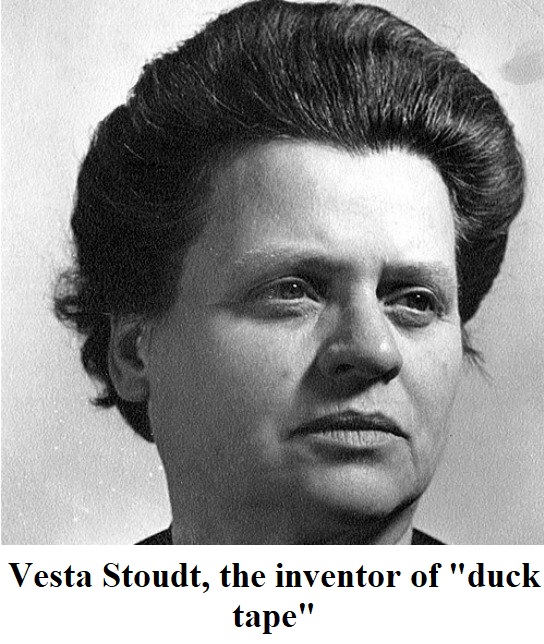
During World War II, Vesta Stoudt, a mother of eight, who had two sons in the armed forces, went to work in Illinois’s Green River Ordnance Plant, inspecting and packing the cartridges that were used to launch rifle grenades by the Army and Navy.  These cartridges were packed eleven to a box, and like many of the boxes designed to carry military supplies, they were taped shut with thin paper tape and waxed to make them gas, water, and damp-proof.  A tab of tape was left loose, so that it could be pulled, to easily break the waterproof wax coating and open the box.  The thing was that the thin paper tape wasn’t very strong, and the tape-tabs often tore off, as soldiers tried to open the ammo boxes, leaving them desperately scrambling to tear open the boxes under enemy fire.  Vesta thought of a solution to this difficulty, why not use a stronger, cloth-based waterproof tape, instead of the weak paper tape?  She brought her suggestion to her supervisors at Green River Ordnance Plant, but they ignored it.


However, Vesta wasn’t the type of person to accept defeat so easily, especially with the lives of soldiers and sailors at stake, so she decided to take her idea to the top, ALL the way to the top – and on February 10, 1943, she wrote a letter to President Franklin D. Roosevelt, explaining both the problem and her solution:

“I suggested we use a strong cloth tape to close seams, and make tab of same.  It worked fine, I showed it to different governmentinspectors they said it was all right, but I could never get them to change tape.  Now your son, my son and our neighbor’s son must pull this tape off some way, perhaps with his teeth or his knife if he is lucky enough to have one, nine chance out of ten he hasn’t any”. 1


Roosevelt was so impressed with Vesta’s idea that he forwarded it onto the War Production Board in Washington, D.C., and on March 26, 1943, the War Production Board formerly accepted her idea and asked Johnson & Johnson to begin production.


Vesta Stoudt, for her invention, received an official thank you letter from the War Production Board and the Chicago Tribune gave her the War Workers Award, on October 25th, 1943.


According to author Margaret Gurowitz, Johnson & Johnson called the new tape, “Duck Tape”, because it was waterproof like a duck and because it was made with cotton-duck fabric.  After World War II, it became known as “Duct Tape”, because it could be used to tape metal ducts together.


During the Vietnam War, the soldiers called duct tape, “100 Mile an Hour Tape”, because it could withstand winds up to 100 mph (160 kph) and could be used to reinforce or repair helicopter rotor blades!


So, what can you use duct tape for?


First, it is important to remember that original style duct tape doesn’t stick well to rough surfaces, like concrete, rock, stucco, and evensome cloth, because it has a thin adhesive layer and therefore can only stick to the high points of the surface.  Also, it doesn’t work on surfaces with high oil or plasticizer content, like EPDM rubber or PVC.  So, remember to use it on smooth, non-oily surfaces, where it will stick better and make a stronger bond!


Oh, and duct tape doesn’t work below freezing (32oF or 0oC), although it won’t be hurt by freezing and will work like normal when it returns to temperatures above freezing.  Duct tape works well at temperatures between 40° to 120°F (4oC to 49oC), depending on the brand, but it works best at room temperature.  Additionally, it will keep sticking up to 150°F (66 oC), above that it will begin to lose adhesion, before failing completely around 200° F (93oC).


Also, it is important to clean the surface and brush off any loose particles and dirt from the surface you are taping, before applying duct tape.  Apply the tape carefully, smoothing out any pockets or rolls, for the best results.


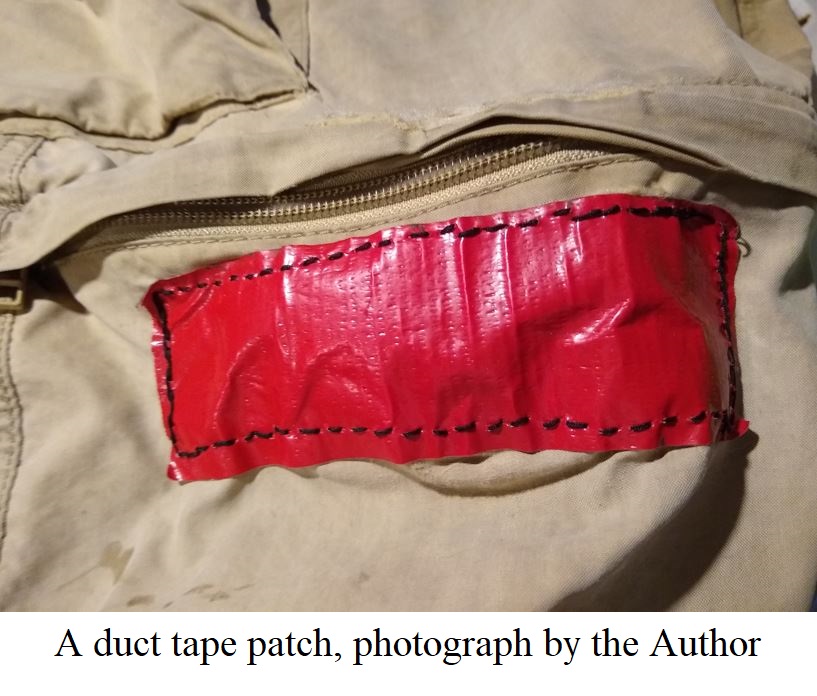
As for what you can use it for, let your imagination run wild!  I used to work in a steel mill, and it was common to see someone with duct tape wrapped around a finger, or an arm, because they had cut themselves and the closest item to cover and close the cut was duct tape.  Personally, I have used it on hiking or canoeing expeditions, to cover cuts, hot or raw spots on feet.  I have also used duct tape to make temporary repairs of tents, boots, and even pants!


But there are so many kinds, which is best?


Polyken 231 Military Grade, T-Rex® Brute Force™ Duct Tape, Gorilla Tape or Duck Brand Duct Tape, which is best?  The first three all claim that they are stronger, more durable than the original Duck Brand Duct Tape.  I have never used Polyken 231 or T-Rex® duct tape, but I have used both Gorilla Tape and the original Duck Brand Duct Tape.  Personally, I found that Gorilla Tape sticks better, is more water resistant, and is more durable, in more situations, than the original Duck Brand Duct Tape.  This agrees with Gorilla Tape’s claim that it is “Made with double-thick adhesive, strong reinforced backing, and a tough all-weather shell, this duct tape is great for projects and repairs both indoors and out.  Gorilla tape sticks to smooth, rough and uneven surfaces, including wood, stone, stucco, brick, metal and vinyl”.2


But in the end, any duct tape is better than no duct tape at all in an emergency.  So don’t leave home without it!


Next week I am going on an adventure, and your regularly scheduled article will be back the week after, so don’t forget to come back and read “OK I'm lost and I'm having an Unexpected Overnighter©” where I will tell you all about how I got lost and spent the night alone in the middle of the Allegheny National Forest.


I hope that you continue to enjoy The Woodsman’s Journal Online and look for me on YouTube at BandanaMan Productions for other related videos, HERE.  Don’t forget to follow me on both The Woodsman’s Journal Online, HERE, and subscribe to BandanaMan Productions on YouTube.  If you have questions, as always, feel free to leave a comment on either site.  I announce new articles on Facebook at Eric Reynolds, on Instagram at bandanamanaproductions, and on VK at Eric Reynolds, so watch for me.


That is all for now, and as always, until next time, Happy Trails!


Notes


1 “The Woman Who Invented Duct Tape”, by Margaret Gurowitz


2 From Gorillatough.com, https://www.gorillatough.com/product/black-gorilla-tape/


Sources


Armstrong, Mark; “Gorilla, Duct or Flex Tape – Which Is Best Underwater?”, KayakGuru, January 5, 2023, [© Copyright 2023 by Kayak Guru], https://kayakguru.com/gorilla-duct-flex-underwater/, accessed August 26, 2023


Dybedahl, Matt; “Quick Tip: 25 Survival Uses for Duct Tape”, October 27, 2015, [© 2023 The Sportsman’s Guide, Inc.] https://guide.sportsmansguide.com/duct-tape-survival/, accessed August 26, 2023


Gurowitz, Margaret; “The Woman Who Invented Duct Tape”, June 21, 2012, © Johnson & Johnson Services, Inc. 2011, https://www.kilmerhouse.com/2012/06/the-woman-who-invented-duct-tape, accessed August 26, 2023


Sunday, August 20, 2023

“1001 Survival Uses of Safety Pins©”


No one ever thinks about the lowly safety pin!  It’s a wonderful tool that is all too often taken for granted and, unfortunately, also often forgotten!  Safety pins have been around forever,1 but they were accidently reinvented in modern times by a U.S. inventor, named Walter Hunt, in 1849.  He was desperate to pay a debt and was nervously twisting a piece of wire when he looked down and saw the design for a safety pin.  He paid off his debt, by selling the rights to the safety pin for just $400.00!2 


“So, what does the safety pin have to do with survival”, you ask?  Well, let’s talk about it.


One of the best lists, that I have found for improvised wilderness uses of safety pins, was created by Dr. Eric A. Weiss, a wilderness medical expert and professor of Emergency Medicine at Stanford University, for the Second Congress on Wilderness Medicine.


Let’s talk about some of these and some others that didn’t make Dr. Weiss’s list.


Pinning the tongue out of the way...

First of all, ouch!  But safety pins can be very useful in emergency surgery and keeping the airway open is vitally important.


Holding gaping wounds together...

Years ago, when my youngest son was 13 and was going to Boy Scout Camp, I helped him to pack a survival kit so he could take the survival merit badge.  I packed three large safety pins into it and told him about all the different uses for them and how in an emergency you could use them to hold gaping wounds together.  The instructor was a product of nepotism, daddy was a big wig in the local council, and he roundly criticized my son saying that you couldn’t do that.  But you can and here is how you do it.


This was a common way of closing gaping wounds until quite recenttimes, and in fact the Masai, and other tribes, in East Africa, routinely used thorns, flame treated to harden and sterilize them, with string to close wounds, much the way we still close turkeys before roasting them.


Relieving a subungual hematoma...


Subungual hematomas result from injuries to the nail bed that cause bleeding under the finger or toenail.  The blood pools under the nail, and turns a reddish, brownish, blueish, or grey/blackish color.  The pooled blood puts pressure on the nailbed causing throbbing pain which often disappears when the pressure on the nail bed is relieved by drilling and draining.  Subungual hematomas can be treated within 48 hours of injury, by making a hole through the nail into the hematoma with a safety pin that has been sterilized in a flame.  This is a process called trephining and drains the blood and releases the pressure.


Fishhooks...


Safety pins can be used in a pinch as a fishhook.  Simply bend themuntil they are open and if possible, bend the tip back into a barb.


Fixing things...


The things that can be fixed with safety pins are limited only by your imagination!  You can fix fishing poles, glasses, broken sipper pulls, ski bindings, ripped buttonholes or clothes, or even unclogging camping stove jets.


Organizing and attaching things...


You can organize fishhooks, other safety pins, zip ties, and other things by hanging them from a safety pin.


Other uses are limited only by your imagination...


But where or wear should you keep them...


You should always have some with you, kept in your repair or “possible” kit (for more on “possible” kits read So, What’s in Your Possible Kit!? ©, HERE), pinned to the inside of a chest pocket flap, or pinned elsewhere on your shirt, and definitely in your survival kit.  


Don’t forget to come back next week and read “100-MPH Tape ©”, where we will talk about how to camp in the winter wilderness and stay warm and safe.


I hope that you continue to enjoy The Woodsman’s Journal Online and look for me on YouTube at BandanaMan Productions for other related videos, HERE.  Don’t forget to follow me on both The Woodsman’s Journal Online, HERE, and subscribe to BandanaMan Productions on YouTube.  If you have questions, as always, feel free to leave a comment on either site.  I announce new articles on Facebook at Eric Reynolds, on Instagram at bandanamanaproductions, and on VK at Eric Reynolds, so watch for me.


That is all for now, and as always, until next time, Happy Trails!


Notes


1 Ancient examples of safety pin, or fibula as they are called, from the 11th to 10th century BCE, have been found in Crete, per Oscar W. Muscarella, “Ancient Safety Pins”


2 “Medical Miracles”, by Richard Bauman, reported that the design was sold for $400.00, other sources state $300.00.


Sources


Bauman, Richard; “Medical Miracles”, The Rotarian, Jun 1989, page 16 to 19

https://books.google.com/books?id=ZzIEAAAAMBAJ&pg=PA18&dq=safety+pin&hl=en&sa=X&ved=2ahUKEwiB3cvxy-GAAxWFnokEHYBgDwQ4KBDoAXoECAcQAg#v=onepage&q=safety%20pin&f=false, accessed August 23, 2023


Erichsen, John Eric; The Science and Art of Surgery, Volume 2, Tenth Edition, [London, Longmans, Green & Co., 1895], page 665-666, https://books.google.com/books?id=HACCp4Q5z-AC&pg=PA666&dq=trussing+pins+suture&hl=en&newbks=1&newbks_redir=0&sa=X&ved=2ahUKEwj47cG4utqAAxVOGlkFHa6SDpsQ6AF6BAgFEAI#v=onepage&q=trussing%20pins%20suture&f=false, accessed August 13, 2023


Friedmann, Lawrence W.; “Amputations and Protheses in Primitive Cultures”, Bulletin of Prosthetics Research, Spring 1972, page 131, https://books.google.com/books?id=ArWmmxfpYB8C&pg=RA1-PA131&dq=thorn+sutures+africa&hl=en&newbks=1&newbks_redir=0&sa=X&ved=2ahUKEwjBt53-t9qAAxVZD1kFHWEdAxUQ6AF6BAgMEAI#v=onepage&q=thorn%20sutures%20africa&f=false, accessed August 13, 2023


Muscarella, Oscar W.; “Ancient Safety Pins”, Expedition Magazine 6, no. 2 (January, 1964), https://www.penn.museum/sites/expedition/ancient-safety-pins/, accessed August 18, 2023


Wikimedia, “Annual_report_of_the_Board_of_Regents_of_the_Smithsonian_Institution_(1929)_(14596908300)”, https://commons.wikimedia.org/wiki/File:Annual_report_of_the_Board_of_Regents_of_the_Smithsonian_Institution_(1929)_(14596908300).jpg, accessed August 18, 2023


Wikimedia, “Patent_6281.jpg”, by William L. Hunt, 1849, https://commons.wikimedia.org/wiki/File:Patent_6281.jpg, accessed August 18, 2023


Wikimedia; This is a subungual hematoma of the finger”, November 2, 2014, by Callaleo, https://commons.wikimedia.org/wiki/File:Subungal_hematoma_of_the_finger.jpg, access August 19, 2023